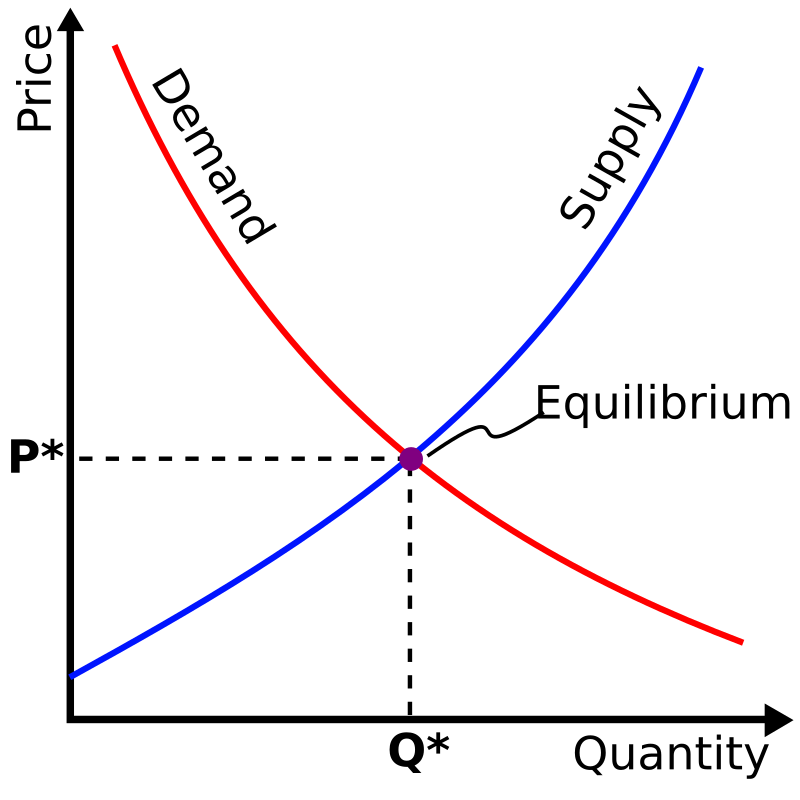
File:Supply-demand-equilibrium.svg · Wikimedia Commons · See Wikimedia Commons
econometrics
Sign in to saveEconometrics is an application of statistical methods to economic data in order to give empirical content to economic relationships. More precisely, it is "the quantitative analysis of actual economic phenomena based on the concurrent development of theory and observation, related by appropriate methods of inference." An introductory economics textbook describes econometrics as allowing economists "to sift through mountains of data to extract simple relationships." Jan Tinbergen is one of the two founding fathers of econometrics. The other, Ragnar Frisch, also coined the term in the sense in w
Econometrics applies statistical methods to economic data to test and quantify the relationships that economic theory describes, allowing economists to find meaningful patterns in large amounts of information. It matters because it bridges the gap between economic theory and real-world evidence, enabling researchers to understand how the economy actually works rather than just how it should work in theory.
AI-generated from the Wikipedia summary — may contain errors.
Wikidata facts
- Instance of
- academic major
Show 5 more facts
- Commons category
- Econometrics
- topic's main category
- Category:Econometrics
- Stack Exchange tag
- stats.stackexchange.com/tags/econometrics
- significant person
- Daniel McFadden
- on focus list of Wikimedia project
- Wikipedia:Vital articles/Level/4
Sources (10)
via Wikidata · CC0
~21 min read
Encyclopedic overview
15 sectionsContents
- History
- Basic models: linear regression
- Theory
- Methods
- Example
- Journals
- Limitations and criticisms
- Difficulties in model specification
- Macroeconomic critiques
- Lucas critique
- Austrian School critique
- See also
- References
- Further reading
- External links
Econometrics is an application of statistical methods to economic data in order to give empirical content to economic relationships. More precisely, it is "the quantitative analysis of actual economic phenomena based on the concurrent development of theory and observation, related by appropriate methods of inference." An introductory economics textbook describes econometrics as allowing economists "to sift through mountains of data to extract simple relationships." Jan Tinbergen is one of the two founding fathers of econometrics. The other, Ragnar Frisch, also coined the term in the sense in which it is used today.
A basic tool for econometrics is the multiple linear regression model. Econometric theory uses statistical theory and mathematical statistics to evaluate and develop econometric methods. Econometricians try to find estimators that have desirable statistical properties including unbiasedness, efficiency, and consistency. Applied econometrics uses theoretical econometrics and real-world data for assessing economic theories, developing econometric models, analysing economic history, and forecasting.
Excerpted from Wikipedia’s “econometrics” article, available under the CC BY-SA 4.0 licence.
Gallery (4)
Available in 72 languages
- Español
- Français
- Deutsch
- 中文
- 日本語
- Русский
- Português
- Italiano
- العربية
- हिन्दी
- Afrikaans
- Albanian
- Armenian
- Asturian
- Azerbaijani
- Bahasa Indonesia
- Bangla
- Basque
Show 53 more
- be_x_old
- Belarusian
- Bulgarian
- Catalan
- Corsican
- Czech
- Danish
- Esperanto
- Estonian
- Filipino
- Finnish
- Galician
- Georgian
- Gilaki
- Greek
- Hebrew
- Hungarian
- Irish
- Javanese
- Kannada
- Kazakh
- Lao
- Latvian
- Lingua Franca Nova
- Lithuanian
- Macedonian
- Malay
- Mongolian
- Nederlands
- Norwegian
- Norwegian Nynorsk
- Pashto
- Polski
- Punjabi
- Romanian
- Serbian
- Serbian (Latin)
- simple
- Slovak
- Slovenian
- Sundanese
- Svenska
- Tiếng Việt
- Türkçe
- Ukrainian
- Urdu
- Uzbek
- Waray
- Wu Chinese
- zh_yue
- فارسی
- ไทย
- 한국어
via Wikidata sitelinks · CC0