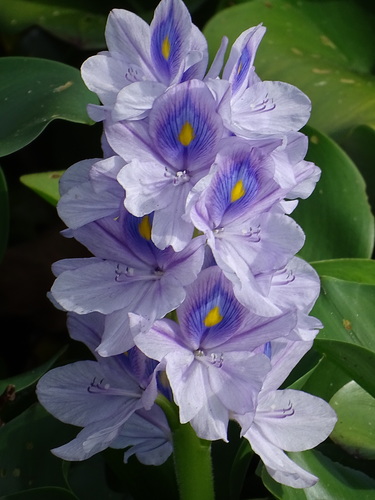
no rights reserved, uploaded by 葉子 · cc0
Eichhornia
Sign in to saveAlso known as water hyacinths
Eichhornia, commonly called water hyacinths, was a polyphyletic genus of the aquatic flowering plants family Pontederiaceae. Since it was consistently recovered in three independent lineages, it has been sunk into Pontederia, together with Monochoria. Each of the three lineages is currently recognized as subgenera in Pontederia: Pontederia subg. Cabanisia, which includes P. meyeri, P. paniculata (the Brazilian water hyacinth), and P. paradoxa Pontederia subg. Oshunae, which includes the common water hyacinth, P. crassipes Pontederia subg. Eichhornia, which includes P. azurea, P. diversifoli
In the Vinony graph
Vinony's link graph records 39 inbound references to Eichhornia, and connects out to Africa, South America and Madagascar.
Vinony files it under Commelinales genera, Commons link from Wikidata and Freshwater plants.
Vinony links it to 29 Wikipedia language editions.
Species
common water hyacinth
GENUS
- KingdomPlantae
- PhylumTracheophyta
- ClassLiliopsida
- OrderCommelinales
- FamilyPontederiaceae
凤眼蓝属(学名:Eichhornia)是雨久花科下的一个属,为浮水草本植物。该属共有6种,分布于南美。
via GBIF · Kew POWO
Museum specimens
- Specimen records
- 247
- With media
- 89
- Family
- Pontederiaceae
- Collections
- UFERSA, US, MO, NHMUK
- Recorded in
- Brasil, United States, Guyana, Chile, Venezuela, Bolivia, Peru, Paraguay
Research
1,088 papers- Eichhornia crassipes (Mart.) Solms: Uses, Challenges, Threats, and Prospects.TheScientificWorldJournal · 2020
- Unlocking the potential of Eichhornia crassipes for wastewater treatment: phytoremediation of aquatic pollutants, a strategy for advancing Sustainable Development Goal-06 clean water.Environmental science and pollution research international · 2024
- Potential of Eichhornia crassipes for biomass refining.Journal of industrial microbiology & biotechnology · 2008
- Global impact of water hyacinth (Eichhornia Crassipes) on rural communities and mitigation strategies: a systematic review.Environmental science and pollution research international · 2024
- Analysis of utilization technologies for Eichhornia crassipes biomass harvested after restoration of wastewater.Bioresource technology · 2017
via PubMed
Wikidata facts
- Instance of
- taxon
- Parent taxon
- Pontederiaceae
- Image
- Common Water hyacinth.jpg
Show 8 more facts
- taxon rank
- genus
- taxon name
- Eichhornia
- Commons category
- Eichhornia
- topic's main category
- Category:Eichhornia
- Commons gallery
- Eichhornia
- taxon common name
- 凤眼蓝属
- different from
- Pistia stratiotes
Sources (1)
via Wikidata · CC0
~1 min read
Encyclopedic overview
3 sectionsContents
- Description
- References
- External links
Eichhornia, commonly called water hyacinths, was a polyphyletic genus of the aquatic flowering plants family Pontederiaceae. Since it was consistently recovered in three independent lineages, it has been sunk into Pontederia, together with Monochoria. Each of the three lineages is currently recognized as subgenera in Pontederia: Pontederia subg. Cabanisia, which includes P. meyeri, P. paniculata (the Brazilian water hyacinth), and P. paradoxa Pontederia subg. Oshunae, which includes the common water hyacinth, P. crassipes Pontederia subg. Eichhornia, which includes P. azurea, P. diversifolia, P. heterosperma, and P. natans
Pontederia subg. Eichhornia is pantropical, centered in South America but with P. natans being endemic to continental Africa and Madagascar. The other three species are restricted to the Neotropics.
Excerpted from Wikipedia’s “Eichhornia” article, available under the CC BY-SA 4.0 licence.