Eidophusikon
Sign in to saveAlso known as eidophusokon
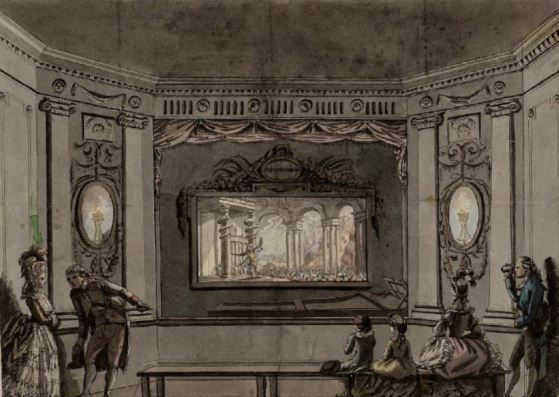
thumb|350px|Viewing the Eidophusikon, circa 1782 The Eidophusikon () was a piece of art, no longer extant, thought up by the English actor David Garrick and created by 18th-century French painter Philip James de Loutherbourg. It opened in Leicester Square in London in February 1781.
Described at
Dr Loutherbourg’s Eidophusikon – Picturegoing
picturegoing.com →Source : Ephraim Hardcastle [W.H. Pyne], extracts from chapter ‘Dr Loutherbourg’s Eidophusikon’, in Wine and Walnuts, or, After dinner chit-chat (London: Longman, Hurst, Rees, Orme, and Brown, 1823), pp. 284-290, 295-298, 302-304 Text : The stage on which the Eidophusikon was represented, was little more than six feet wide, and about eight feet in depth; yet such was the painter’s knowledge of effect and scientific arrangement, and the scenes which he described were so completely illusive, that the space appeared to recede for many miles, and his horizon seemed as palpably distant from the eye, as the extreme termination of the view would appear in nature. This scene, on the rising of the curtain, was enveloped in that mysterious light which is the precursor of day-break, so true to nature, that the imagination of the spectator sniffed the sweet breath of morn. A faint light appeared along the horizon; the scene assumed a vapourish tint of grey; presently a gleam of saffron, changing to the pure varieties that tinge the fleecy clouds that pass away in morning mist; the picture brightened by degrees; the sun appeared, gilding the tops of the trees and the projections of the lofty buildings, and burnishing the vanes on the cupolas; when the whole scene burst upon the eye in the gorgeous splendour of a beauteous day. The clouds in every scene had a natural motion, and they were painted in semi-transparent colours, so that they not only received light in front, but, by a greater intensity of the argand lamps, were susceptible of being illuminated from behind. The linen on which they were painted was stretched on frames of twenty times the surface of the stage, which rose diagonally by a winding machine. De Loutherbourg, who excelled in representing the phenomena of clouds, may be said to have designed a series of effects on the same frame; thus, the first gleam of morn led to the succeeding increase of light; and the motion being oblique, the clouds first appeared from beneath the horizon, rose to a meridian, and floated fast or slow, according to their supposed density, or the power of the wind. To illuminate the interesting scenes for this display of nature, the ingenious projector had constructed his lights to throw their power in front of the scenes; and this plan might be tried with advantage for spectacles, and particular effects at least, on the great stages of our magnificent theatres. The lamps on De Loutherbourg’s stage were above the proscenium, and hidden from the audience, instead of being unnaturally placed as we are accustomed to see them, by which the faces of the performers are illuminated, like Michael Angelo’s Satan, from the regions below; thus throwing on their countenances a preternatural character, in defiance of all their well studied science of facial passion and expression. What painter ever dreamt of inverting the order of nature so entirely as to light the human countenance upwards? And why depart so strangely from truth upon the stage? The expression would be increased tenfold by lighting from above the proscenium. — For how infinitely more impressive is the emotion of the passions, when described with the spacious orbit of the eye in that deep shadow which the grand gusto of the historic style of painting has adopted — the majesty of intellectual intelligence is seen to rest upon the human brow. Nothing can outrage truth, or do so much violence to that delicate expression, which is the soul of acting, when addressed to the philosophical mind, as to view the bold projection of the chin, the subordinate and characteristic prominence of the nose, the upper part of the orbits of the eyes, instead of forming harmonious shadows, glaring in the blaze of stage-lamps, each a separate touch of light. Were the other method adopted for illuminating the stage, the scenes would recede, in their respective distances; the front and most prominent characters would cast a shadow on those in the second ground, and t
Excerpt from a page describing this subject · 16,873 chars · not written by Vinony
Wikidata facts
- Genre
- theatre
- Creator
- Philip James de Loutherbourg
- Image
- Eidophusikon.jpg
Show 3 more facts
- Commons category
- Eidophusikon
- discoverer or inventor
- Philip James de Loutherbourg
- described at URL
- www.newmodeltheatre.co.uk/eidophusikon.html
Sources (1)
via Wikidata · CC0
~4 min read
Encyclopedic overview
4 sectionsContents
- Reconstructions
- See also
- References
- External links
thumb|350px|Viewing the Eidophusikon, circa 1782 The Eidophusikon () was a piece of art, no longer extant, thought up by the English actor David Garrick and created by 18th-century French painter Philip James de Loutherbourg. It opened in Leicester Square in London in February 1781.
Described by the media of his day as "Moving Pictures, representing Phenomena of Nature", the Eidophusikon can be considered an early form of movie making. The effect was achieved by mirrors and pulleys.
Excerpted from Wikipedia’s “Eidophusikon” article, available under the CC BY-SA 4.0 licence.