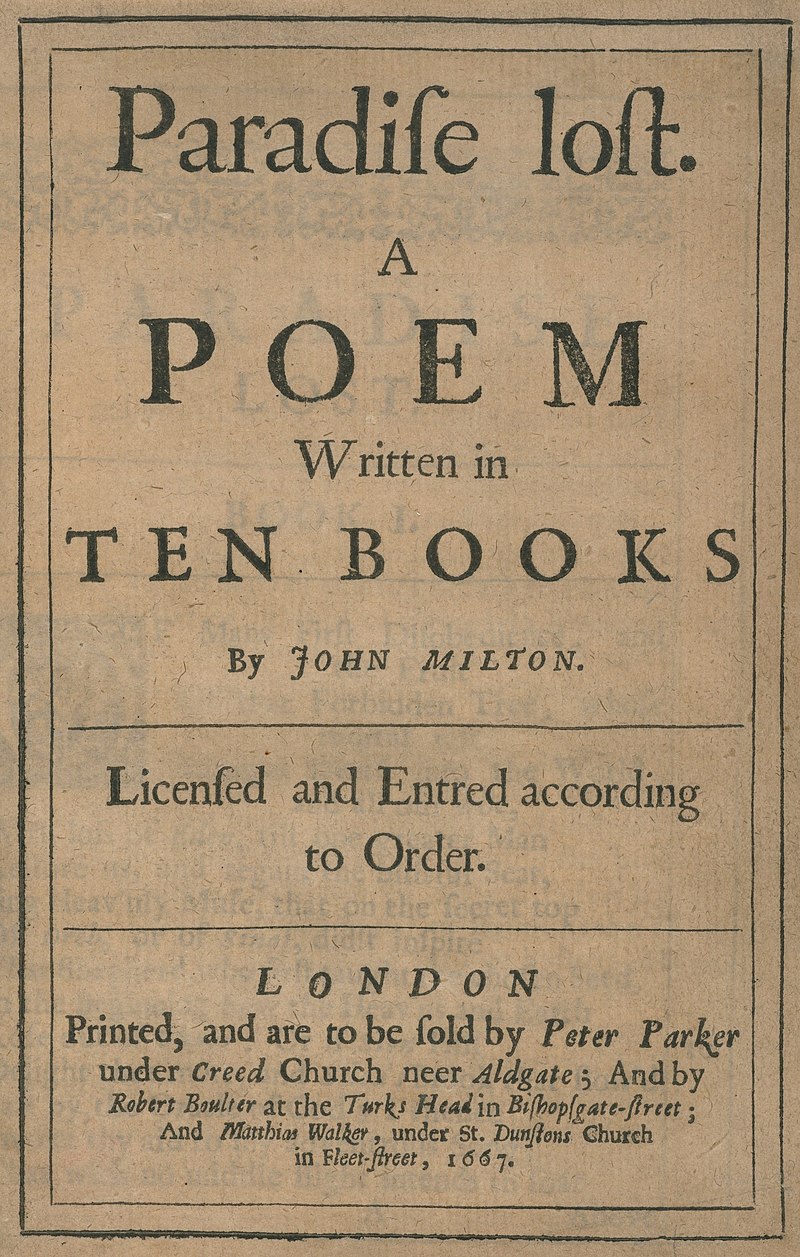
File:Houghton_EC65.M6427P.1667aa_-_Paradise_Lost,_1667.jpg · Wikimedia Commons · See Wikimedia Commons
"Paradise Lost" is an epic poem by John Milton that tells the story of humanity's fall from grace, centered on Satan's rebellion against God and the temptation of Adam and Eve in the Garden of Eden. The work is considered one of the greatest achievements in English literature and has profoundly influenced how Western culture understands and depicts the biblical story of creation and the origin of evil.
AI-generated from the Wikipedia summary — may contain errors.
Wikidata facts
- Instance of
- literary work
- Part of
- Index Librorum Prohibitorum
- Author
- John Milton
- Country of origin
- England
- Followed by
- Paradise Regained
- Image
- Houghton EC65.M6427P.1667aa - Paradise Lost, 1667.jpg
Show 12 more facts
- characters
- Azazel
- Commons category
- Paradise Lost
- publication date
- 1667-00-00
- inception
- 1667-00-00
- language of work or name
- English language
- first line
- Of Mans First Disobedience, and the Fruit
- last line
- Through Eden took thir solitarie way.
- title
- Paradise Lost
- subtitle
- A poem in ten books
- copyright status
- public domain
- form of creative work
- poem
- inspired by
- Book of Genesis
Sources (7)
via Wikidata · CC0
~40 min read
Encyclopedic overview
LibriVox recording by Owen. Book One, Part 1. Paradise Lost is an epic poem in blank verse by the English poet John Milton (1608–1674). The poem concerns the biblical story of the fall of man: the temptation of Adam and Eve by the fallen angel Satan and their expulsion from the Garden of Eden. The first version, published in 1667, consists of ten books with over ten thousand lines of verse. A second edition followed in 1674, arranged into twelve books (in the manner of Virgil's Aeneid) with minor revisions throughout. It is considered to be Milton's masterpiece, and it helped solidify his reputation as one of the greatest English poets.
At the heart of Paradise Lost are the themes of free will and the moral consequences of disobedience. Milton seeks to "justify the ways of God to men" (1.20), addressing questions of predestination, human agency, and the nature of good and evil. The poem begins in medias res, with Satan and his fallen angels cast into Hell after their failed rebellion against God. Milton's Satan, portrayed with both grandeur and tragic ambition, is one of the most complex and debated characters in literary history, particularly for his perceived heroism by some readers.
Excerpted from Wikipedia’s “Paradise Lost” article, available under the CC BY-SA 4.0 licence.
Gallery (13)
Available in 66 languages
- Español
- Français
- Deutsch
- 中文
- 日本語
- Русский
- Português
- Italiano
- العربية
- हिन्दी
- Afrikaans
- Armenian
- Azerbaijani
- Bahasa Indonesia
- Bangla
- Basque
- be_x_old
- Breton
Show 47 more
- Bulgarian
- Catalan
- Croatian
- Czech
- Danish
- Egyptian Arabic
- Esperanto
- Finnish
- Galician
- Georgian
- Greek
- Hebrew
- Hungarian
- Icelandic
- Igbo
- Irish
- Kashmiri
- Latin
- Malagasy
- Malayalam
- Marathi
- Nederlands
- Nepali
- Norwegian
- Norwegian Nynorsk
- Polski
- Punjabi
- Romanian
- Serbian
- Serbian (Latin)
- simple
- Slovak
- Svenska
- Tajik
- Tamil
- Telugu
- Tiếng Việt
- Türkçe
- Ukrainian
- Urdu
- Welsh
- Western Frisian
- Western Panjabi
- zh_yue
- فارسی
- ไทย
- 한국어
via Wikidata sitelinks · CC0