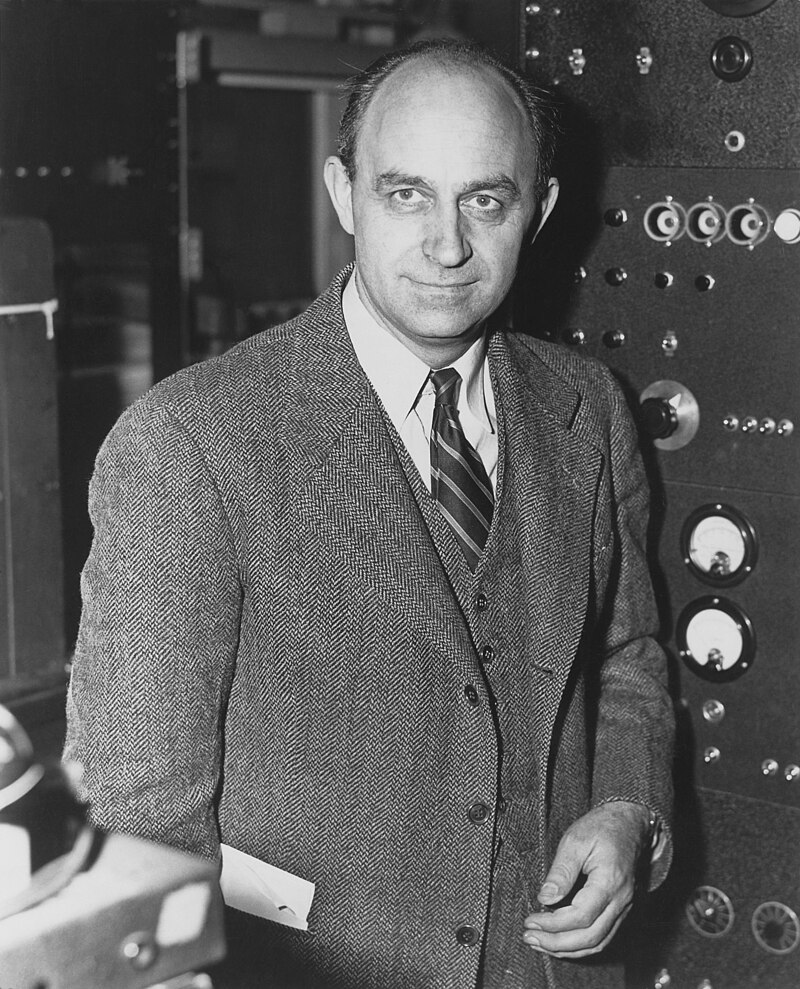
File:Enrico_Fermi_1943-49.jpg · Wikimedia Commons · See Wikimedia Commons
Enrico Fermi
Sign in to saveItalian–American physicist (1901–1954)
OverviewAI-generated
Enrico Fermi was a physicist who received one Nobel Prize. He is recognized in the Royal Society collection, the Nobel Laureates collection, the Nobel Physics collection, and the National Inventors Hall Of Fame collection.
Fermi was born on 1901-09-29 and died on 1954-11-28. He had an Erdős number of 3.
Synthesized by Vinony from 9 facts across 3 sources: Wikidata, Nobel Prize, Vinony collections. Generated from structured data (not the Wikipedia text) and checked against those facts — may still contain errors.
Nobel Prize
- The Nobel Prize in Physics1938
“for his demonstrations of the existence of new radioactive elements produced by neutron irradiation, and for his related discovery of nuclear reactions brought about by slow neutrons”
Wikidata facts
- Instance of
- human
- Given name
- Enrico
- Gender
- male
- Citizenship
- United States
- Place of birth
- Rome
- Place of death
- Chicago
- Spouse
- Laura Fermi
- Occupation
- inventor
- Educated at
- Leiden University
- Employer
- Enrico Fermi Institute
- Languages spoken
- English language
- Native language
- Italian
- Religion
- agnosticism
- Participant in
- Manhattan Project
- Academic degree
- Doctor of Philosophy
- Doctoral advisor
- Luigi Puccianti
- Student of
- Paul Ehrenfest
- Field of work
- experimental physics
- Image
- Enrico Fermi 1943-49.jpg
- Residence
- Italy
Show 19 more facts
- member of
- Royal Academy of Italy
- Commons category
- Enrico Fermi
- date of death
- 1954-11-28
- place of burial
- Oak Woods Cemetery
- Commons gallery
- Enrico Fermi
- cause of death
- stomach cancer
- topic's main category
- Category:Enrico Fermi
- Erdős number
- 3
- manner of death
- natural causes
- nominated for
- Nobel Prize in Chemistry
- name in native language
- Enrico Fermi
- student
- Owen Chamberlain
- influenced by
- Joseph Fourier
- on focus list of Wikimedia project
- Wikipedia:Vital articles/Level/4
- archives at
- University of Chicago Library
- date of birth
- 1901-09-29
- P8168
- Harrison Barnes
- writing language
- English language
- interested in
- physics
Sources (10)
via Wikidata · CC0
~40 min read
Encyclopedic overview
Enrico Fermi ( Italian: [enˈriːko ˈfermi]; 29 September 1901 – 28 November 1954) was an Italian–American physicist, renowned for being the creator of the world's first artificial nuclear reactor, the Chicago Pile-1, and a member of the Manhattan Project. He won the 1938 Nobel Prize in Physics "for his demonstrations of the existence of new radioactive elements produced by neutron irradiation, and for his related discovery of nuclear reactions brought about by slow neutrons". He has been called the "architect of the nuclear age" and the "architect of the atomic bomb". He was one of very few physicists to excel in both theoretical and experimental physics. With his colleagues, Fermi filed several patents related to the use of nuclear power, all of which were taken over by the US government. He made significant contributions to the development of statistical mechanics, quantum theory, and nuclear and particle physics.
Fermi's first major contribution involved the field of statistical mechanics. After Wolfgang Pauli formulated his exclusion principle in 1925, Fermi followed with a paper in which he applied the principle to an ideal gas, employing a statistical formulation now known as Fermi–Dirac statistics. Today, particles that obey the exclusion principle are called "fermions". Pauli later postulated the existence of an uncharged invisible particle emitted along with an electron during beta decay, to satisfy the law of conservation of energy. Fermi took up this idea, developing a model that incorporated the postulated particle, which he named the "neutrino". His theory, later referred to as Fermi's interaction and now called weak interaction, described one of the four fundamental interactions in nature. Through experiments inducing radioactivity with the recently discovered neutron, Fermi discovered that slow neutrons were more easily captured by atomic nuclei than fast ones, and he developed the Fermi age equation to describe this. After bombarding thorium and uranium with slow neutrons, he concluded that he had created new elements. Although he was awarded the Nobel Prize for this discovery, the new elements were later revealed to be nuclear fission products.
Excerpted from Wikipedia’s “Enrico Fermi” article, available under the CC BY-SA 4.0 licence.
Gallery (12)
Available in 149 languages
- Español
- Français
- Deutsch
- 中文
- 日本語
- Русский
- Português
- Italiano
- العربية
- हिन्दी
- abstract
- Afrikaans
- Albanian
- Albanian
- Amharic
- Aragonese
- Armenian
- Assamese
Show 130 more
- Asturian
- azb
- Azerbaijani
- Bahasa Indonesia
- Balinese
- Bangla
- Bashkir
- Basque
- bat_smg
- be_x_old
- Belarusian
- Bikol
- Bosnian
- Breton
- btm
- Bulgarian
- Burmese
- Catalan
- cdo
- Central Kurdish
- Chechen
- Chuvash
- Cornish
- Corsican
- Crimean Tatar
- Croatian
- Czech
- Danish
- Egyptian Arabic
- Esperanto
- Estonian
- Fiji Hindi
- Filipino
- Finnish
- Galician
- Georgian
- Greek
- Guarani
- Haitian Creole
- Hakka Chinese
- Hebrew
- Hungarian
- Icelandic
- Ido
- Iloko
- Interlingua
- Irish
- Javanese
- Kannada
- Kanuri
- Kazakh
- Khmer
- Kurdish
- Kyrgyz
- Ladino
- Latin
- Latvian
- Ligurian
- Limburgish
- Lithuanian
- Lombard
- Low German
- Luxembourgish
- Macedonian
- Madurese
- Malagasy
- Malay
- Malayalam
- Maltese
- Marathi
- Mari
- Mazanderani
- Mingrelian
- Mongolian
- Nederlands
- Newari
- Northern Frisian
- Norwegian
- Norwegian Nynorsk
- Occitan
- Odia
- Ossetic
- Pampanga
- Pashto
- Piedmontese
- Polski
- Punjabi
- Quechua
- Romanian
- Rusyn
- Sanskrit
- Santali
- Scots
- Scottish Gaelic
- Serbian
- Serbian (Latin)
- Sicilian
- simple
- Sindhi
- Slovak
- Slovenian
- Svenska
- Swahili
- szy
- Tajik
- Tamil
- Tatar
- Telugu
- Tiếng Việt
- Türkçe
- Ukrainian
- Urdu
- Uzbek
- Veps
- Volapük
- Waray
- Welsh
- Western Frisian
- Western Panjabi
- Wu Chinese
- Yakut
- Yiddish
- Yoruba
- Zaza
- zh_classical
- zh_min_nan
- zh_yue
- فارسی
- ไทย
- 한국어
via Wikidata sitelinks · CC0