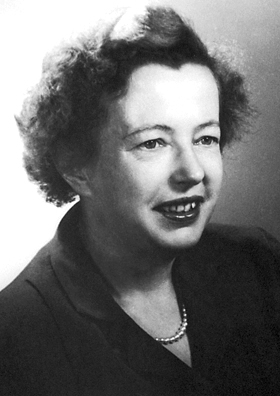
File:Maria_Goeppert-Mayer.jpg · Wikimedia Commons · See Wikimedia Commons
Maria Goeppert Mayer
Sign in to saveAlso known as Maria Göppert, Maria Göppert-Mayer, Maria Goeppert-Mayer, Maria Mayer, Maria G. Mayer, Maria Gertrude Goeppert Mayer
German-born American theoretical physicist (1906-1972)
OverviewAI-generated
Maria Goeppert Mayer was a physicist who lived from 1906 to 1972. She was awarded one Nobel Prize. Her work is recognized in the Nobel Laureates collection, the Nobel Physics collection, and the American Academy Arts Sciences collection.
Mayer had an Erdős number of 4.
Synthesized by Vinony from 8 facts across 3 sources: Wikidata, Nobel Prize, Vinony collections. Generated from structured data (not the Wikipedia text) and checked against those facts — may still contain errors.
Nobel Prize
- The Nobel Prize in Physics1963
“for their discoveries concerning nuclear shell structure”
Shared · 1/4 portion
Wikidata facts
- Instance of
- human
- Family name
- Mayer
- Gender
- female
- Citizenship
- United States
- Place of birth
- Katowice
- Place of death
- San Diego
- Spouse
- Joseph Edward Mayer
- Father
- Friedrich Göppert
- Occupation
- scientist
- Educated at
- University of Göttingen
- Employer
- Argonne National Laboratory
- Languages spoken
- English language
- Notable work
- nuclear shell model
- Participant in
- Manhattan Project
- Doctoral advisor
- Max Born
- Student of
- Max Born
- Field of work
- statistical mechanics
- Image
- Maria Goeppert-Mayer.jpg
- Work location
- San Diego
Show 15 more facts
- maintained by WikiProject
- WikiProject Mathematics
- Commons category
- Maria Goeppert-Mayer
- cause of death
- circulatory collapse
- date of birth
- 1906-01-01
- date of death
- 1972-01-01
- nominated for
- Nobel Prize in Physics
- member of
- National Academy of Sciences
- Erdős number
- 4
- influenced by
- Max Born
- name in native language
- Maria Göppert-Mayer
- married name
- Maria G. Mayer
- manner of death
- natural causes
- interested in
- physics
- birth name
- Maria Göppert
Sources (8)
via Wikidata · CC0
~17 min read
Encyclopedic overview
Maria Goeppert Mayer ( German: [maˈʁiːa ˈɡœpɐt ˈmaɪɐ] ; née Göppert; June 28, 1906 – February 20, 1972) was a German–American theoretical physicist who shared the 1963 Nobel Prize in Physics with J. Hans D. Jensen and Eugene Wigner. One half of the prize was awarded jointly to Goeppert Mayer and Jensen "for their discoveries concerning nuclear shell structure." She was the second woman to win the Nobel Prize in Physics, the first being Marie Curie in 1903. In 1986, the Maria Goeppert Mayer Award for early-career women physicists was established in her honor.
A graduate of the University of Göttingen, Goeppert Mayer wrote her doctoral thesis on the theory of possible two-photon absorption by atoms. At the time, the chances of experimentally verifying her thesis seemed remote, but the development of the laser in the 1960s later permitted this. Today, the unit for the two-photon absorption cross section is called the Goeppert Mayer (GM) unit.
Excerpted from Wikipedia’s “Maria Goeppert Mayer” article, available under the CC BY-SA 4.0 licence.
Gallery (5)
Available in 97 languages
- Español
- Français
- Deutsch
- 中文
- 日本語
- Русский
- Português
- Italiano
- العربية
- हिन्दी
- Afrikaans
- Albanian
- Armenian
- Asturian
- azb
- Azerbaijani
- Bahasa Indonesia
- Bangla
Show 78 more
- Bashkir
- Basque
- Belarusian
- Bulgarian
- Catalan
- Central Kurdish
- Croatian
- Czech
- Danish
- Egyptian Arabic
- Esperanto
- Estonian
- Finnish
- Galician
- Georgian
- Greek
- Haitian Creole
- Hakka Chinese
- Hebrew
- Hungarian
- Icelandic
- Ido
- Interlingua
- Irish
- Javanese
- Kazakh
- Kurdish
- Latin
- Latvian
- Lithuanian
- Macedonian
- Maithili
- Malagasy
- Malay
- Malayalam
- Marathi
- Mazanderani
- Mingrelian
- Nederlands
- Nepali
- Newari
- Northern Frisian
- Norwegian
- Norwegian Nynorsk
- Occitan
- Piedmontese
- Polski
- Punjabi
- Romanian
- Sanskrit
- Scots
- Scottish Gaelic
- Serbian
- Serbian (Latin)
- Silesian
- simple
- Slovak
- Slovenian
- Southern Altai
- Svenska
- Swahili
- Tajik
- Tamil
- Tatar
- Tiếng Việt
- Türkçe
- Tuvinian
- Ukrainian
- Urdu
- Uzbek
- Waray
- Western Panjabi
- Wu Chinese
- Yoruba
- zh_min_nan
- zh_yue
- فارسی
- 한국어
via Wikidata sitelinks · CC0