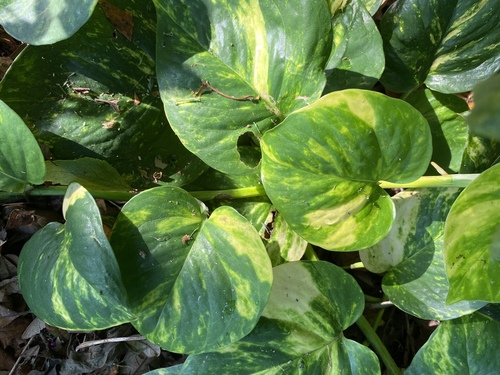
(c) Alex Ambrioso, all rights reserved, uploaded by Alex Ambrioso
Epipremnum
Sign in to saveEpipremnum is a genus of flowering plants in the family Araceae, found in tropical forests from China, the Himalayas, and Southeast Asia to Australia the western Pacific. They are evergreen perennial vines climbing with the aid of aerial roots. They may be confused with other Monstereae such as Rhaphidophora, Scindapsus and Amydrium.
Species
Golden Pothos
GENUS
- KingdomPlantae
- PhylumTracheophyta
- ClassLiliopsida
- OrderAlismatales
- FamilyAraceae
Die Efeututen (Epipremnum) sind eine Pflanzengattung in der Familie der Aronstabgewächse (Araceae). Die etwa 15 Arten sind vom tropischen und subtropischen Asien bis zu pazifischen Inseln verbreitet. Inhaltsverzeichnis 1 Beschreibung 2 Inhaltsstoffe und Giftigkeit 3 Verbreitung und Standorte 4 Systematik 5 Verwendung 6 Quellen 7 Einzelnachweise 8 Weblinks Beschreibung Goldene Efeutute (Epipremnum aureum), verwildert an einem Baumstamm kletternd; je älter die Pflanzen werden, desto größer werden die Blätter Alte Epipremnum pinnatum Epipremnum-Arten sind kletternde oder kriechende, ausdauernde krautige Pflanze, die bis zu Höhen von 20 Meter klettern können. Sie bilden an den Knoten (Nodien) Adventivwurzeln zum Festhalten an Unterlagen, zum Beispiel Baumstämmen. Es ist je Art nur ein Blatttypus (Homophyllie) vorhanden. Die wechselständigen, gestielten, einfachen Laubblätter sind manchmal sekundär geteilt. Manche Sorten sind panaschiert. Die Blattscheiden, Cataphylle und Prophylle sind nicht lange haltbar und verwelken bald.[1][2] Die einzeln und zu einigen zusammenstehenden Blütenstände besitzen bleistiftförmige bis leicht zusammengepresst wirkende, unbeblätterte Blütenstandsschäfte.
via GBIF · Kew POWO
Museum specimens
- Specimen records
- 59
- With media
- 51
- Family
- Araceae
- Collections
- GH, A, US, MICH, NY, BPBM
- Recorded in
- Philippines, Solomon Islands, Micronesia, Federated States Of, Papua New Guinea, China, Palau, Indonesia, Thailand
Wikidata facts
Show 8 more facts
- taxon rank
- genus
- taxon name
- Epipremnum
- Commons category
- Epipremnum
- topic's main category
- Category:Epipremnum
- taxon common name
- 麒麟叶属
- has fruit type
- berry
- taxon synonym
- Anthelia
Sources (3)
via Wikidata · CC0
~3 min read
Encyclopedic overview
6 sectionsContents
- Etymology
- Species
- Fossil record
- References
- Bibliography
- External links
Epipremnum is a genus of flowering plants in the family Araceae, found in tropical forests from China, the Himalayas, and Southeast Asia to Australia the western Pacific. They are evergreen perennial vines climbing with the aid of aerial roots. They may be confused with other Monstereae such as Rhaphidophora, Scindapsus and Amydrium.
All parts of the plants are toxic, mostly due to trichosclereids (long sharp cells) and raphides. Plants can grow to over with leaves up to long, but in containers the size is much reduced. The plants, commonly known as centipede tongavine, pothos or '''devil's ivy', depending on species, are typically grown as houseplants in temperate regions. Juvenile leaves are bright green, often with irregularly variegated patterns of yellow or white. They may find host trees by the use of skototropism.
Excerpted from Wikipedia’s “Epipremnum” article, available under the CC BY-SA 4.0 licence.