
File:Eris_and_moon_Dysnomia_JWST_NIRCam.jpg · Wikimedia Commons · See Wikimedia Commons
Eris
Sign in to saveAlso known as Sol k, Eris (dwarf planet), Xena, 136199 Eris
pianeta nano del sistema solare
OverviewAI-generated
Eris is a trans-Neptunian object and plutoid in the scattered disc. It orbits the Sun with a period of 557.55 years, an eccentricity of 0.43883, and an inclination of 44.1444 degrees. Its orbit has a periapsis of 38.013 and an apparent magnitude of 18.7. The object has a radius of 1163 and an albedo of 0.96.
Eris was discovered on 2003-10-21 at Palomar Observatory by Michael E. Brown, Chadwick Trujillo, and David L. Rabinowitz. It was provisionally designated 2003 UB313. The body has a mass of 16.6 and is accompanied by its child astronomical body, Dysnomia.
Synthesized by Vinony from 26 facts across 3 sources: Wikidata, NASA, Vinony graph. Generated from structured data (not the Wikipedia text) and checked against those facts — may still contain errors.
Picture of the Day · NASA
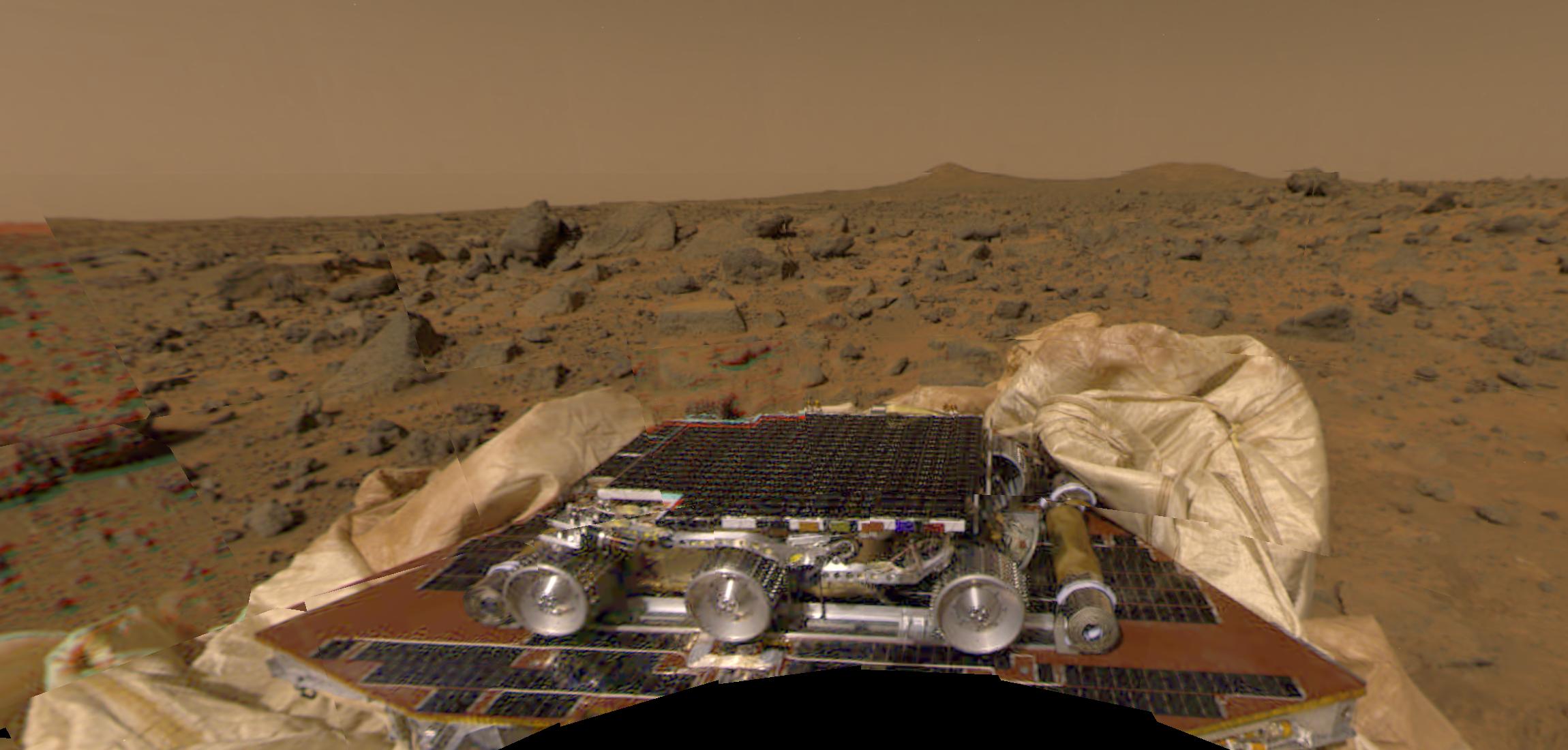
Pathfinder on Mars
2026-07-04
On July 4th, 1997, using its own array of fireworks, a parachute, and a cocoon of airbags, the Mars Pathfinder spacecraft bounced like a giant beach ball at least 15 times before it came to rest on the surface of Mars at 10:07 AM Pacific Daylight Time. After its then novel airbag-assisted landing sequence was completed, Pathfinder transmitted this color mosaic to mission operators on Earth. In the scene from another world, the Mars Sojourner robot rover is visible in the foreground, crouched on top of the unfolded Pathfinder. About the size of a large house cat, the six-wheeled, solar-powered Sojourner became the first successful Martian rover. Surrounding Pathfinder are deflated airbags and the rock-strewn terrain of the Ares Vallis floodplain. In the distance Martian hills appear against a dusty brownish sky. The Pathfinder lander was subsequently renamed the Carl Sagan Memorial Station.
via NASA APOD
Wikidata facts
- Instance of
- astronomical object
- Part of
- scattered disc
- Named after
- Eris
- Official name
- 136199 Eris
- Area
- 17000000
- Location
- Solar System
- Parent body
- Sun
- Child body
- Dysnomia
- Minor-planet group
- plutoid
- Diameter
- 2326
- Radius
- 1163
- Mass
- 16.6
- Orbital period
- 557.55
- Image
- Eris and dysnomia.jpg
Show 28 more facts
- discoverer or inventor
- David L. Rabinowitz
- Commons category
- 136199 Eris
- site of astronomical discovery
- Palomar Observatory
- time of discovery or invention
- 2003-10-21
- provisional designation
- 2003 UB313
- topic's main category
- Category:Eris (dwarf planet)
- orbital eccentricity
- 0.4346554671925892
- orbital inclination
- 44.1444
- longitude of ascending node
- 35.9045
- argument of periapsis
- 151.6871
- albedo
- 0.96
- apparent magnitude
- 18.7
- mean anomaly
- 205.384
- periapsis
- 38.013
- semi-major axis of an orbit
- 67.740
- apoapsis
- 97.468
- density
- 2.52
- periapsis date (DEPRECATED)
- 2258-10-14
- absolute magnitude
- -1.1
- rotation period
- 25.9
- angular diameter
- 34.3
- temperature
- 55
- name
- Xena
- Unicode character
- ⯰
- on focus list of Wikimedia project
- Wikipedia:Vital articles/Level/4
- IPA transcription
- ˈeːʁɪs
- surface gravity
- 0.82
- epoch
- May 5, 2025
Sources (10)
via Wikidata · CC0
Article · Italiano
Eris (nome ufficiale 136199 Eris) è il secondo pianeta nano per diametro medio del sistema solare dopo Plutone, rispetto al quale ha però una massa del 27% superiore. Si tratta di un oggetto ghiacciato orbitante nel sistema solare esterno, fra gli oggetti cosiddetti transnettuniani, quindi un plutoide. Ha un'orbita molto eccentrica che lo porta da una distanza minima dal Sole di 5,6 miliardi di km ad una massima di 14,6 miliardi (quest'ultima circa il doppio della distanza massima di Plutone dal Sole). Eris appartiene al disco diffuso ed al momento della sua scoperta era stato ritenuto il più grande fra gli oggetti transnettuniani; come sottolineato infatti dagli astronomi dell'Osservatorio di Monte Palomar l'oggetto era sicuramente più grande di Plutone. Tuttavia successive misurazioni hanno stabilito il suo diametro in circa 2.326 km, più piccolo di qualche decina di chilometri rispetto a Plutone. Originariamente soprannominato il Decimo Pianeta dagli scopritori, dalla NASA e dai media, l'oggetto è stato classificato come un pianeta nano dall'UAI nella stessa occasione − l'assemblea generale del 24 agosto 2006 − in cui l'organismo ha promulgato definitivamente la definizione ufficiale di pianeta. La stessa UAI ha quindi ufficialmente battezzato l'oggetto, nel mese successivo, con il nome di Eris, personificazione della discordia secondo la mitologia greca. Eris era precedentemente noto mediante la designazione provvisoria 2003 UB313 o con il nome informale di Xena, in onore della principessa guerriera di una nota serie televisiva statunitense. Dal 13 settembre 2006 al 2 aprile 2007, quando 145562 Zurbriggen ricevette la denominazione ufficiale, è stato l'asteroide denominato con il più alto numero ordinale. Prima della sua denominazione, il primato era di 134340 Pluto. Eris possiede un satellite, Disnomia, del diametro di circa 250 km.
Abstract from DBpedia / Wikipedia · CC BY-SA
Gallery (15)
Available in 119 languages
- Español
- Français
- Deutsch
- 中文
- 日本語
- Русский
- Português
- Italiano
- العربية
- हिन्दी
- Afrikaans
- Albanian
- Aragonese
- Armenian
- Asturian
- Azerbaijani
- Bahasa Indonesia
- Bangla
Show 100 more
- Basque
- Bavarian
- be_x_old
- Belarusian
- Bosnian
- Breton
- Bulgarian
- Burmese
- Catalan
- Central Kurdish
- Cornish
- Croatian
- Czech
- Danish
- Egyptian Arabic
- eml
- Esperanto
- Estonian
- Fiji Hindi
- Filipino
- Finnish
- Galician
- Georgian
- Greek
- Guarani
- Hawaiian
- Hebrew
- Hungarian
- Icelandic
- Ido
- Iloko
- Interlingua
- Irish
- Javanese
- Kashubian
- Kazakh
- Khmer
- Komi
- Kurdish
- Latin
- Latvian
- Limburgish
- Lingua Franca Nova
- Lithuanian
- Lombard
- Low German
- Luxembourgish
- Macedonian
- Malay
- Malayalam
- Manx
- map_bms
- Marathi
- Mingrelian
- Mirandese
- Mongolian
- Navajo
- Nederlands
- Norwegian
- Norwegian Nynorsk
- Occitan
- Oromo
- Polski
- Quechua
- Romanian
- Romansh
- Serbian
- Serbian (Latin)
- Sicilian
- simple
- Sinhala
- Slovak
- Slovenian
- Somali
- Svenska
- Swahili
- Tamil
- Telugu
- Tiếng Việt
- Tumbuka
- Türkçe
- Tuvinian
- Tyap
- Ukrainian
- Urdu
- Uyghur
- Uzbek
- Waray
- Welsh
- Western Panjabi
- Wu Chinese
- Yiddish
- Zaza
- zh_classical
- zh_min_nan
- zh_yue
- Zulu
- فارسی
- ไทย
- 한국어
via Wikidata sitelinks · CC0