
File:Eris_and_moon_Dysnomia_JWST_NIRCam.jpg · Wikimedia Commons · See Wikimedia Commons
Eris
Sign in to saveAlso known as Sol k, Eris (dwarf planet), Xena, 136199 Eris
dwarf planet in the Solar System
OverviewAI-generated
Eris is a trans-Neptunian object and plutoid in the scattered disc. It orbits the Sun with a period of 557.55 years, an eccentricity of 0.43883, and an inclination of 44.1444 degrees. Its orbit has a periapsis of 38.013 and an apparent magnitude of 18.7. The object has a radius of 1163 and an albedo of 0.96.
Eris was discovered on 2003-10-21 at Palomar Observatory by Michael E. Brown, Chadwick Trujillo, and David L. Rabinowitz. It was provisionally designated 2003 UB313. The body has a mass of 16.6 and is accompanied by its child astronomical body, Dysnomia.
Synthesized by Vinony from 26 facts across 3 sources: Wikidata, NASA, Vinony graph. Generated from structured data (not the Wikipedia text) and checked against those facts — may still contain errors.
Picture of the Day · NASA
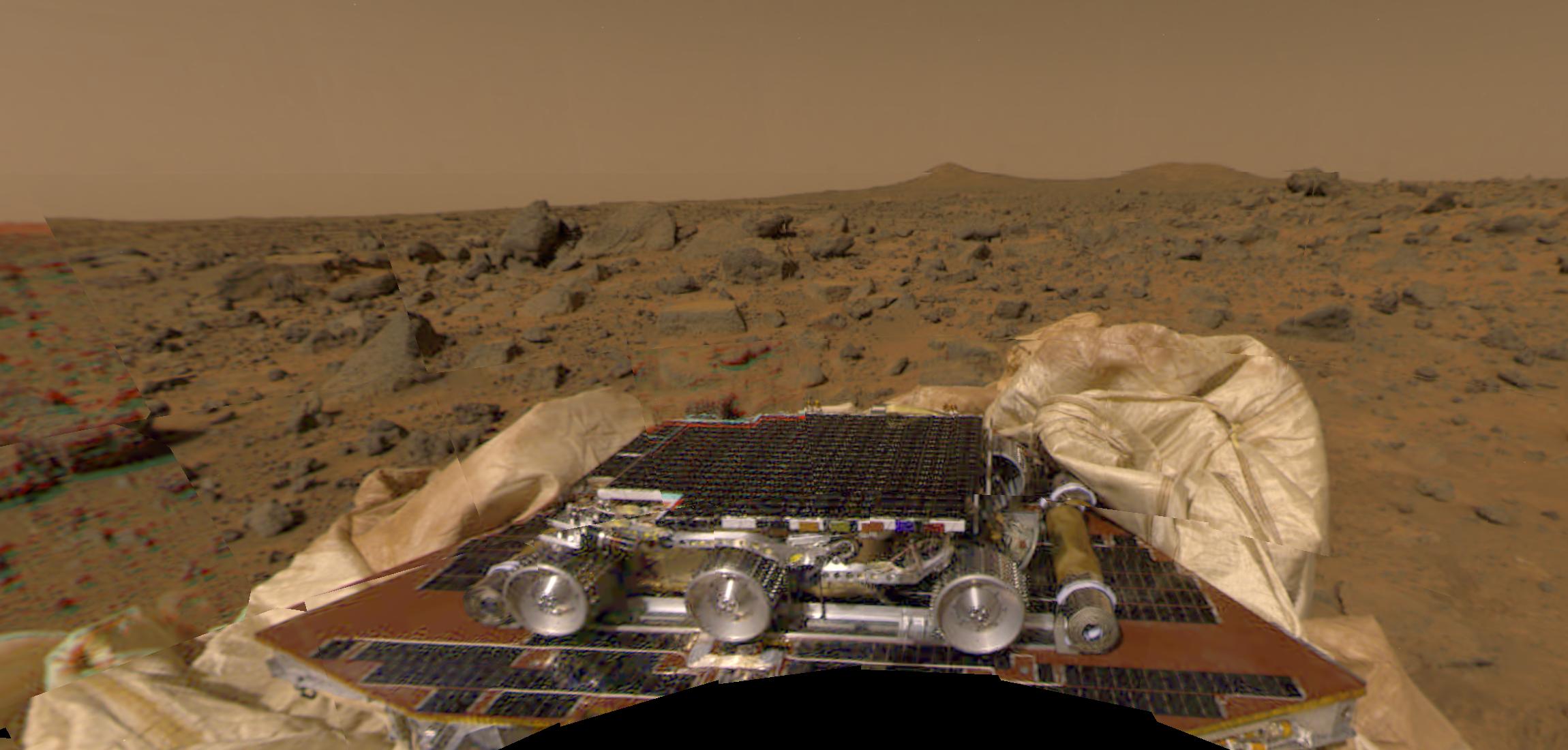
Pathfinder on Mars
2026-07-04
On July 4th, 1997, using its own array of fireworks, a parachute, and a cocoon of airbags, the Mars Pathfinder spacecraft bounced like a giant beach ball at least 15 times before it came to rest on the surface of Mars at 10:07 AM Pacific Daylight Time. After its then novel airbag-assisted landing sequence was completed, Pathfinder transmitted this color mosaic to mission operators on Earth. In the scene from another world, the Mars Sojourner robot rover is visible in the foreground, crouched on top of the unfolded Pathfinder. About the size of a large house cat, the six-wheeled, solar-powered Sojourner became the first successful Martian rover. Surrounding Pathfinder are deflated airbags and the rock-strewn terrain of the Ares Vallis floodplain. In the distance Martian hills appear against a dusty brownish sky. The Pathfinder lander was subsequently renamed the Carl Sagan Memorial Station.
via NASA APOD
Wikidata facts
- Instance of
- astronomical object
- Part of
- scattered disc
- Named after
- Eris
- Official name
- 136199 Eris
- Area
- 17000000
- Location
- Solar System
- Parent body
- Sun
- Child body
- Dysnomia
- Minor-planet group
- plutoid
- Diameter
- 2326
- Radius
- 1163
- Mass
- 16.6
- Orbital period
- 557.55
- Image
- Eris and dysnomia.jpg
Show 28 more facts
- discoverer or inventor
- David L. Rabinowitz
- Commons category
- 136199 Eris
- site of astronomical discovery
- Palomar Observatory
- time of discovery or invention
- 2003-10-21
- provisional designation
- 2003 UB313
- topic's main category
- Category:Eris (dwarf planet)
- orbital eccentricity
- 0.4346554671925892
- orbital inclination
- 44.1444
- longitude of ascending node
- 35.9045
- argument of periapsis
- 151.6871
- albedo
- 0.96
- apparent magnitude
- 18.7
- mean anomaly
- 205.384
- periapsis
- 38.013
- semi-major axis of an orbit
- 67.740
- apoapsis
- 97.468
- density
- 2.52
- periapsis date (DEPRECATED)
- 2258-10-14
- absolute magnitude
- -1.1
- rotation period
- 25.9
- angular diameter
- 34.3
- temperature
- 55
- name
- Xena
- Unicode character
- ⯰
- on focus list of Wikimedia project
- Wikipedia:Vital articles/Level/4
- IPA transcription
- ˈeːʁɪs
- surface gravity
- 0.82
- epoch
- May 5, 2025
Sources (10)
via Wikidata · CC0
~23 min read
Encyclopedic overview
Spectral type B−V=0.78, V−R=0.45 Apparent magnitude 18.7 Absolute magnitude (H) –1.26 Angular diameter 34.4±1.4 milli-arcsec
Eris (minor-planet number 136199) is the most massive and second-largest known dwarf planet in the Solar System. It is a trans-Neptunian object (TNO) in the scattered disk and has a high-eccentricity orbit. Eris was discovered in January 2005 by a Palomar Observatory–based team led by Mike Brown and verified later that year. It was named in September 2006 after the Greco–Roman goddess of strife and discord. Eris is the ninth-most massive known object orbiting the Sun and the sixteenth-most massive in the Solar System (counting moons). It is also the largest known object in the Solar System that has not been visited by a spacecraft. Eris has been measured at 2,326 ± 12 kilometres (1,445 ± 7 mi) in diameter; its mass is 0.28% that of the Earth and 27% greater than that of Pluto, although Pluto is slightly larger by volume. Both Eris and Pluto have a surface area that is comparable to that of Russia or South America.
Excerpted from Wikipedia’s “Eris” article, available under the CC BY-SA 4.0 licence.
Gallery (15)
Available in 119 languages
- Español
- Français
- Deutsch
- 中文
- 日本語
- Русский
- Português
- Italiano
- العربية
- हिन्दी
- Afrikaans
- Albanian
- Aragonese
- Armenian
- Asturian
- Azerbaijani
- Bahasa Indonesia
- Bangla
Show 100 more
- Basque
- Bavarian
- be_x_old
- Belarusian
- Bosnian
- Breton
- Bulgarian
- Burmese
- Catalan
- Central Kurdish
- Cornish
- Croatian
- Czech
- Danish
- Egyptian Arabic
- eml
- Esperanto
- Estonian
- Fiji Hindi
- Filipino
- Finnish
- Galician
- Georgian
- Greek
- Guarani
- Hawaiian
- Hebrew
- Hungarian
- Icelandic
- Ido
- Iloko
- Interlingua
- Irish
- Javanese
- Kashubian
- Kazakh
- Khmer
- Komi
- Kurdish
- Latin
- Latvian
- Limburgish
- Lingua Franca Nova
- Lithuanian
- Lombard
- Low German
- Luxembourgish
- Macedonian
- Malay
- Malayalam
- Manx
- map_bms
- Marathi
- Mingrelian
- Mirandese
- Mongolian
- Navajo
- Nederlands
- Norwegian
- Norwegian Nynorsk
- Occitan
- Oromo
- Polski
- Quechua
- Romanian
- Romansh
- Serbian
- Serbian (Latin)
- Sicilian
- simple
- Sinhala
- Slovak
- Slovenian
- Somali
- Svenska
- Swahili
- Tamil
- Telugu
- Tiếng Việt
- Tumbuka
- Türkçe
- Tuvinian
- Tyap
- Ukrainian
- Urdu
- Uyghur
- Uzbek
- Waray
- Welsh
- Western Panjabi
- Wu Chinese
- Yiddish
- Zaza
- zh_classical
- zh_min_nan
- zh_yue
- Zulu
- فارسی
- ไทย
- 한국어
via Wikidata sitelinks · CC0