
File:Eris_and_moon_Dysnomia_JWST_NIRCam.jpg · Wikimedia Commons · See Wikimedia Commons
OverviewAI-generated
Eris is a trans-Neptunian object and plutoid in the scattered disc. It orbits the Sun with a period of 557.55 years, an eccentricity of 0.43883, and an inclination of 44.1444 degrees. Its orbit has a periapsis of 38.013 and an apparent magnitude of 18.7. The object has a radius of 1163 and an albedo of 0.96.
Eris was discovered on 2003-10-21 at Palomar Observatory by Michael E. Brown, Chadwick Trujillo, and David L. Rabinowitz. It was provisionally designated 2003 UB313. The body has a mass of 16.6 and is accompanied by its child astronomical body, Dysnomia.
Synthesized by Vinony from 26 facts across 3 sources: Wikidata, NASA, Vinony graph. Generated from structured data (not the Wikipedia text) and checked against those facts — may still contain errors.
Picture of the Day · NASA
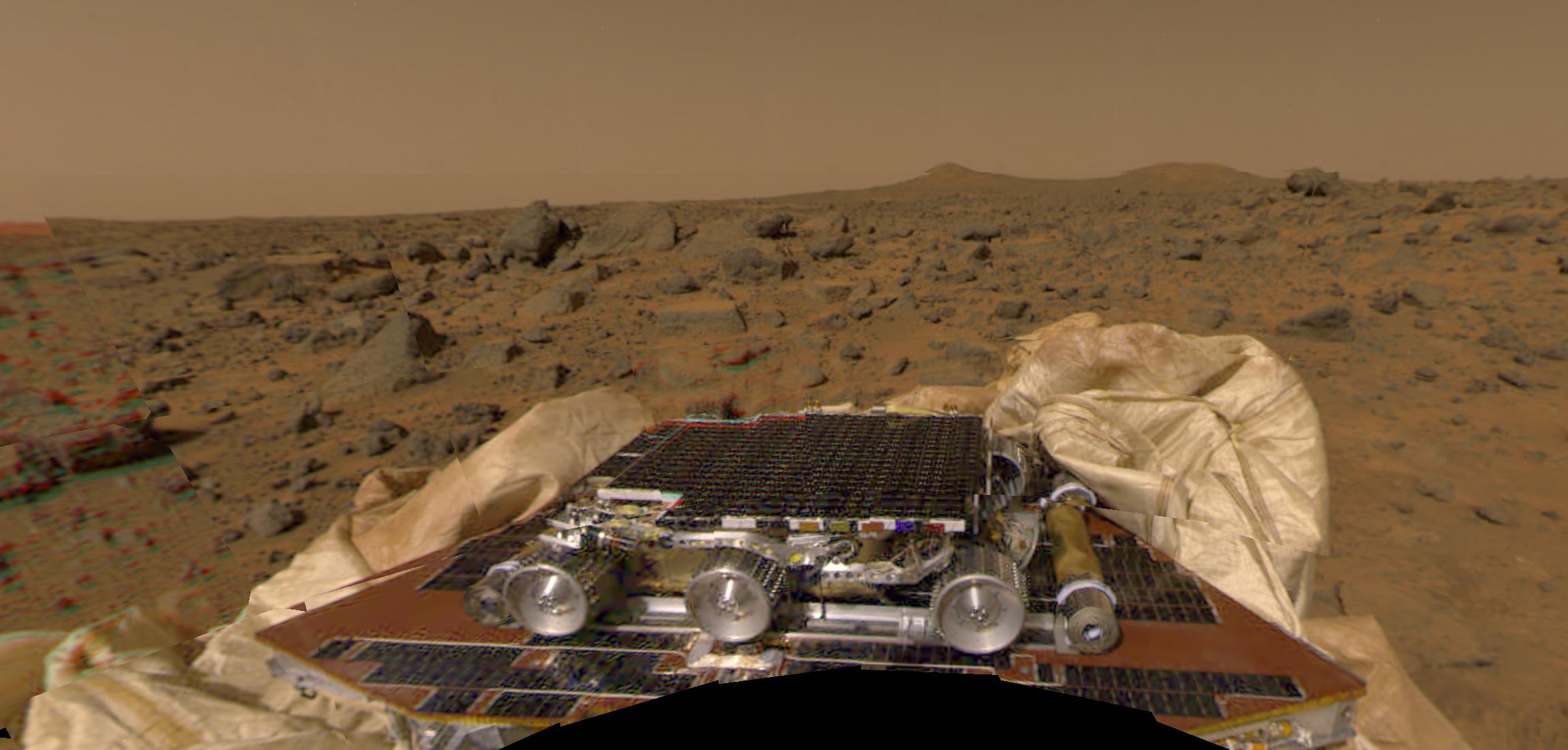
Pathfinder on Mars
2026-07-04
On July 4th, 1997, using its own array of fireworks, a parachute, and a cocoon of airbags, the Mars Pathfinder spacecraft bounced like a giant beach ball at least 15 times before it came to rest on the surface of Mars at 10:07 AM Pacific Daylight Time. After its then novel airbag-assisted landing sequence was completed, Pathfinder transmitted this color mosaic to mission operators on Earth. In the scene from another world, the Mars Sojourner robot rover is visible in the foreground, crouched on top of the unfolded Pathfinder. About the size of a large house cat, the six-wheeled, solar-powered Sojourner became the first successful Martian rover. Surrounding Pathfinder are deflated airbags and the rock-strewn terrain of the Ares Vallis floodplain. In the distance Martian hills appear against a dusty brownish sky. The Pathfinder lander was subsequently renamed the Carl Sagan Memorial Station.
via NASA APOD
Small body data
(136199) Eris
- Orbit class
- Outer (Centaur/TNO)
- Semi-major axis
- 67.935 AU
- Eccentricity
- 0.438
- Inclination
- 43.926 °
- Absolute magnitude
- -1.260 H
via Minor Planet Center
Wikidata facts
- Instance of
- astronomical object
- Part of
- scattered disc
- Named after
- Eris
- Official name
- 136199 Eris
- Area
- 17000000
- Location
- Solar System
- Parent body
- Sun
- Child body
- Dysnomia
- Minor-planet group
- plutoid
- Diameter
- 2326
- Radius
- 1163
- Mass
- 16.6
- Orbital period
- 557.55
- Image
- Eris and dysnomia.jpg
Show 28 more facts
- discoverer or inventor
- David L. Rabinowitz
- Commons category
- 136199 Eris
- site of astronomical discovery
- Palomar Observatory
- time of discovery or invention
- 2003-10-21
- provisional designation
- 2003 UB313
- topic's main category
- Category:Eris (dwarf planet)
- orbital eccentricity
- 0.4346554671925892
- orbital inclination
- 44.1444
- longitude of ascending node
- 35.9045
- argument of periapsis
- 151.6871
- albedo
- 0.96
- apparent magnitude
- 18.7
- mean anomaly
- 205.384
- periapsis
- 38.013
- semi-major axis of an orbit
- 67.740
- apoapsis
- 97.468
- density
- 2.52
- periapsis date (DEPRECATED)
- 2258-10-14
- absolute magnitude
- -1.1
- rotation period
- 25.9
- angular diameter
- 34.3
- temperature
- 55
- name
- Xena
- Unicode character
- ⯰
- on focus list of Wikimedia project
- Wikipedia:Vital articles/Level/4
- IPA transcription
- ˈeːʁɪs
- surface gravity
- 0.82
- epoch
- May 5, 2025
Sources (10)
via Wikidata · CC0
Article · 日本語
エリス(136199 Eris; シンボル: )は、太陽系外縁天体のサブグループである冥王星型天体の1つに属する準惑星である。準惑星に分類されている太陽系内の天体の中では最も質量が大きく、冥王星に次いで2番目に半径が大きい。軌道離心率が大きい楕円軌道を描いて太陽を公転しており、散乱円盤天体にも分類される。ディスノミアと呼ばれる衛星を持っている。2003年10月21日に撮影された画像に写っていたところを、マイケル・ブラウンが率いるパロマー天文台を拠点とする観測グループが2005年1月5日に発見し、2006年9月にギリシア神話に登場する不和と争いの女神の名に因んで命名された。現在、太陽を公転していることが知られている既知の天体の中では9番目に質量が大きく、惑星を公転している衛星も含めると16番目となる。直径は 2,326 ± 12 km と測定されており、まだ宇宙探査機による接近探査が行われたことがない天体の中では最大である。冥王星の方がわずかに体積は大きいが、質量は地球の0.28%、冥王星の126%とされている。自転周期は25.9時間と、地球に近い周期となっているが、エリスの自転周期については意見が分かれている。 発見当初、エリスは冥王星よりも大きいと考えられ、アメリカ航空宇宙局 (NASA) は当初エリスを太陽系の「10番目の惑星」と表現した。この発見はエリスと同等の大きさの天体が将来的にさらに発見される可能性を示すもので、国際天文学連合 (IAU) が初めて「惑星」という言葉を定義するきっかけになった。2006年8月24日に承認された国際天文学連合による定義で、エリスはハウメア、マケマケ、ケレスおよび当時は惑星とされていた冥王星と共に「準惑星」という新たな分類に属することになり、1930年の冥王星の発見以前と同様に太陽系の既知の惑星の数は8個に減った。 なお、日本語表記が同じで紛らわしいが、ラテン文字で“Ellis”と綴られる小惑星の (11980) エリスとは別の天体である。
Abstract from DBpedia / Wikipedia · CC BY-SA
Gallery (15)
Available in 119 languages
- Español
- Français
- Deutsch
- 中文
- 日本語
- Русский
- Português
- Italiano
- العربية
- हिन्दी
- Afrikaans
- Albanian
- Aragonese
- Armenian
- Asturian
- Azerbaijani
- Bahasa Indonesia
- Bangla
Show 100 more
- Basque
- Bavarian
- be_x_old
- Belarusian
- Bosnian
- Breton
- Bulgarian
- Burmese
- Catalan
- Central Kurdish
- Cornish
- Croatian
- Czech
- Danish
- Egyptian Arabic
- eml
- Esperanto
- Estonian
- Fiji Hindi
- Filipino
- Finnish
- Galician
- Georgian
- Greek
- Guarani
- Hawaiian
- Hebrew
- Hungarian
- Icelandic
- Ido
- Iloko
- Interlingua
- Irish
- Javanese
- Kashubian
- Kazakh
- Khmer
- Komi
- Kurdish
- Latin
- Latvian
- Limburgish
- Lingua Franca Nova
- Lithuanian
- Lombard
- Low German
- Luxembourgish
- Macedonian
- Malay
- Malayalam
- Manx
- map_bms
- Marathi
- Mingrelian
- Mirandese
- Mongolian
- Navajo
- Nederlands
- Norwegian
- Norwegian Nynorsk
- Occitan
- Oromo
- Polski
- Quechua
- Romanian
- Romansh
- Serbian
- Serbian (Latin)
- Sicilian
- simple
- Sinhala
- Slovak
- Slovenian
- Somali
- Svenska
- Swahili
- Tamil
- Telugu
- Tiếng Việt
- Tumbuka
- Türkçe
- Tuvinian
- Tyap
- Ukrainian
- Urdu
- Uyghur
- Uzbek
- Waray
- Welsh
- Western Panjabi
- Wu Chinese
- Yiddish
- Zaza
- zh_classical
- zh_min_nan
- zh_yue
- Zulu
- فارسی
- ไทย
- 한국어
via Wikidata sitelinks · CC0