
Érythrée
Also known as State of Eritrea, Ertrā, Iritriyā, er, ERI, IRI
pays de l'Afrique de l'Est depuis 1993
AI overview
Eritrea is a country located in the Horn of Africa, bordered by Ethiopia, Sudan, and Djibouti, with its capital in Asmara and a coastline along the Red Sea. It matters as a strategic location in East Africa that includes significant territory and island groups in the Red Sea region.
AI-generated from the Wikipedia summary — may contain errors.
Weather now
cached 19h ago24°scattered clouds
43% 0.6 m/s OpenWeatherMap
7-day forecast
via Open-Meteo
Country

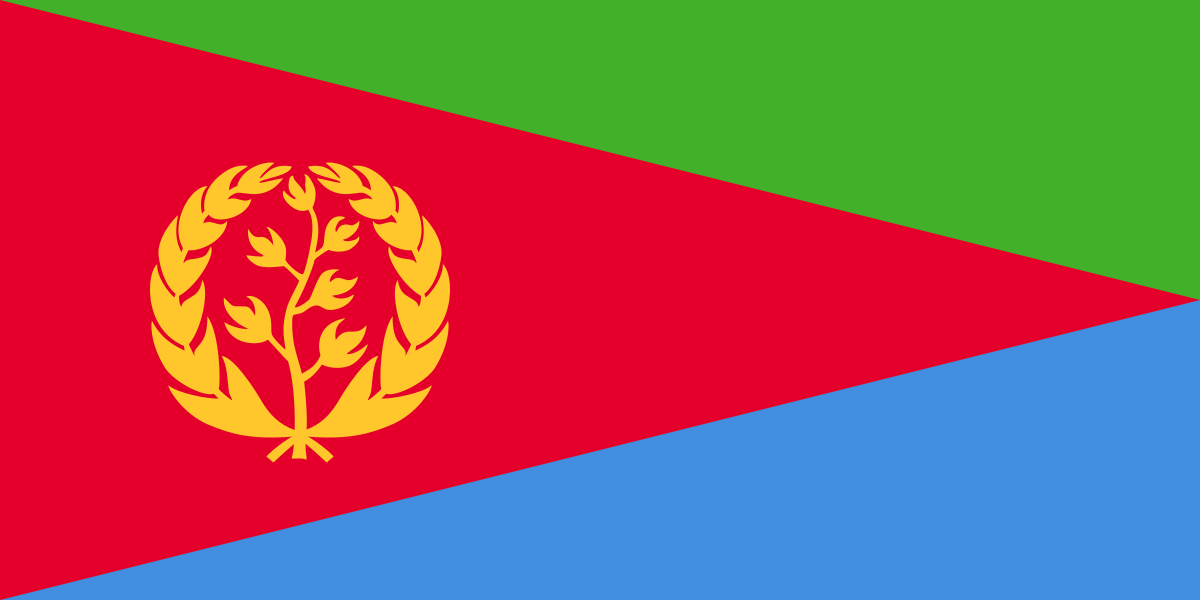
- Capital
- Asmara
- Population
- 3,607,000
- Region
Travel guide
Get in
thumb|375px|A map showing the visa requirements of Eritrea, with countries in green having visa-free access, countries in lime having visa on arrival
Get around
thumbnail|Busy street in Keren
While it may be tempting to explore all that Eritrea has to offer, you must obtain a travel permit from the Eritrean government if you wish to travel outside Asmara, the capital city. It can take 24 hours or more to obtain a travel permit, so plan your trip well ahead in advance.
Foreign governments recommend getting a travel permit from the Ministry of Tourism office on Harnet Avenue in Asmara.
If you are flying in to Asmara, you will need a permit from the Tourist Bureau on Liberation Avenue if you consider travelling outside Asmara's city limits. This permit needs to be applied for several days before travel. There are few places other than Asmara, Keren and Massawa/Dahlak Islands that foreigners can travel to as of September 2017 (other than those on a designated mission working with the Eritrean government) depending on the time of the year (therefore the conditions of the roads) and mostly, the decisions of the government. If you are coming by land (or ferry/private boat to Massawa), you can get a travel permit at the locality of your arrival, to transit the country, given you have a valid entry visa to Eritrea. As long as you notify and consult with the Eritrean mission issuing your entry visa about your point of entry and travel plans well ahead of time, getting the travel permit is no problem.
See
thumb|300px|Church of Our Lady of the Rosary Church of Our Lady of the Rosary. With a bell tower that reaches high into the sky, this building, which was the principal church of the Italian colonials, is a sterling piece of Lombard-Romanesque architecture and a useful bearing point for lost travellers. Enda Mariam Orthodox Cathedral. The ancient church is located at the center of the city and symbolizes the four directions of the earth (east, west, north and south) the four gates on each direction have an equal number of worshippers passing through them every day. At the compound of this church you will find a tree called "Berberestelim". Long ago priests use to wash dead bodies by adding these tree leaves into the water and the body stays as it is for years. Asmara Theatre and Opera House. Constructed in 1920, the Asmara Opera House is an amazing Italian Architectural piece. Al Khulafa Al Rashidin Mosque. One of the most elegant mosques in Africa. The architecture is eclectic, a mix of Italian and local Moorish styles. Fiat Tagliero. One a very few futuristic architectural pieces ever built in the world. It is an old service station designed to look like an airplane. It has two cantilevered wings, acting as a cover for each side.
Article · Français
L'Érythrée, en forme longue l'État d'Érythrée (en tigrigna : ኤርትራ, Ertra et ሃገረ ኤርትራ, Hagere Ertra ; en arabe : إرتريا, Iritrīyā et دولة إرتريا, Dawlat Iritriya) est un État souverain situé en Afrique de l'Est. Il s'agit du pays le plus septentrional de la Corne de l'Afrique. Le pays a des frontières terrestres longues de 1 840 km avec Djibouti au sud-est, l'Éthiopie au sud et le Soudan à l'ouest, auxquelles s'ajoutent les frontières maritimes avec l'Arabie Saoudite et le Yémen, en plus de celles avec Djibouti et le Soudan. L'Érythrée est, de jure, une république unitaire à parti unique mais est, de facto, une dictature totalitaire. Il a pour capitale Asmara et pour langues officielles le tigrigna, l'arabe et l'anglais et comme langues nationales vernaculaires, le tigrigna, le tigré, l'arabe, l'afar, le saho, le bilen, le bedja, le kunama et le nara. Sa monnaie est le nakfa érythréen depuis 1997. Les premières occurrences du terme « Érythrée » proviennent du grec ancien Ερυθραία (Erythraía) signifiant « rouge » et latinisé Erythræa. Ce terme, désignant originellement toutes les côtes de la mer Rouge, sera donné à l'actuel territoire en 1890 par le roi Humbert Ier d'Italie juste après en avoir fait une colonie italienne. L'Érythrée connaît une histoire à part entière dès le XIIe siècle av. J.-C. avec le royaume de Saba ; deux siècles plus tard, le royaume D'mt s'établit au centre de l'actuel territoire sur une période de cinq siècles. C'est avec l'empire d'Aksoum, dès le Ier siècle av. J.-C., que les prémices d'un territoire érythréen voient le jour dans un espace territorial s'étalant du sud-est de l'actuel Égypte à l'actuel Somaliland. Le territoire fut rattaché par la suite à l'empire éthiopien jusqu'à l'arrivée des italiens en Afrique orientale. À la suite de l'achat par les Italiens de la baie d'Assab, au sultan local en 1869, puis de leur occupation de Massaoua en 1885, l’Érythrée est constituée en 1890 en territoire particulier. Après la défaite italienne durant la Seconde Guerre mondiale, l'ONU décide en 1952 de fédérer l’Érythrée à l'Éthiopie, qui l'annexe en 1962. C'est le début de la guerre d'indépendance qui se termine en mai 1991 par la victoire du mouvement indépendantiste, le Front populaire de libération de l'Érythrée (FPLE) mené par Isaias Afwerki, et donc par la défaite du gouvernement éthiopien. L'Érythrée accède ainsi à l'indépendance en 1993. Les deux pays restent en état de guerre jusqu'à la signature d'un traité de paix en 2018. Depuis le début des années 2000, l'Érythrée, toujours dirigée par Isaias Afwerki, adopte une attitude répressive et autoritaire, notamment via le service militaire à durée indéterminée (6,5 ans en moyenne), qui provoque un mouvement d'émigration important et aboutit à plusieurs descriptions du pays comme une « prison à ciel ouvert ». De nombreux médias décrivent le pays comme un État gouverné par un régime totalitaire. Il n'existe pas réellement d'institution dans le pays et l'essentiel du pouvoir est concentré entre les mains de son président, Isaias Afwerki. L’Érythrée a souffert des sanctions draconiennes imposées par l’ONU en décembre 2009 et renforcées en décembre 2011. Le pays est membre de plusieurs organisations internationales : l'Union africaine (UA) depuis 1993, la Ligue arabe depuis 2003 (en tant que pays observateur), l'Organisation des Nations unies (ONU) depuis 1993, le Programme des Nations unies pour le développement (PNUD), le Marché commun de l'Afrique orientale et australe (COMESA) depuis 1994, l'Organisation des Nations unies pour l'éducation, la science et la culture (UNESCO) depuis 1993, le Groupe des 77 (G77), la Banque africaine de développement (BAD), la Communauté des États sahélo-sahariens (CEN-SAD) depuis 1999 et l'Organisation internationale sur le bambou et le rotin (INBAR) depuis 2013. Avec vingt-neuf ambassades et six consulats, c'est l'un des pays au monde avec la moins forte représentation diplomatique au monde. L'Érythrée est, avec un PIB nominal de 6,72 milliards de dollars US en 2018 selon le FMI, la 151e économie mondiale (derrière le Malawi et devant le Monténégro). Le pays affiche un niveau de vie « faible » (176e sur 191 au classement IDH en 2021) avec l'un des indices de développement humain les plus faibles du monde (0,492), entre l'Éthiopie et la Guinée-Bissau. Son économie est basée sur deux secteurs : les minerais et les métaux rares (plus de 40 % de l'économie tourne autour de l'exploitation de l'or, près de 30 % autour du cuivre et 25 % autour du zinc). La population du pays est difficile à évaluer, avec une estimation comprise en 3,6 et 6,7 million d'habitants en 2019 ; elle est comparable à la population de l'Uruguay dans son évaluation la plus basse ou à celle du Kirghizistan ou du Liban dans son évaluation la plus haute. La densité de population du pays n'a fait que croître, passant de 11,3 hab./km2 en 1950 à 51,4 hab./km2 en 2018 ; en 2100, il est estimé que la densité de population atteindra les 146,3 hab./km2 et dépassera la densité de population française.
Gallery (39)
On the map
4 mapped locations