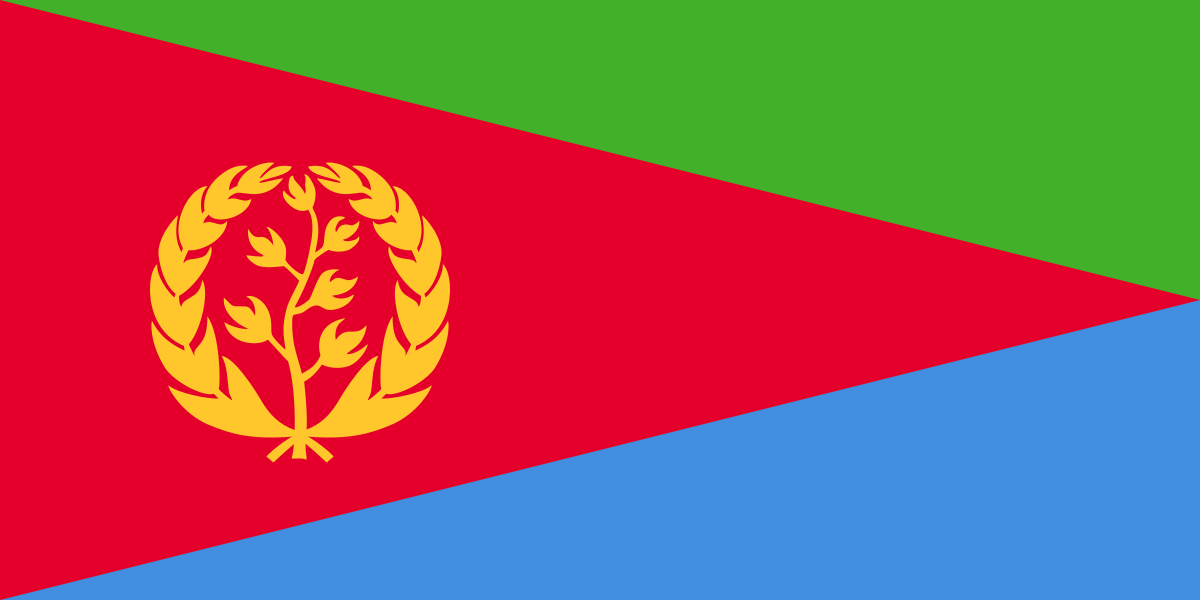
Also known as State of Eritrea, Ertrā, Iritriyā, er, ERI, IRI
아프리카의 나라
Eritrea is a country located in the Horn of Africa, bordered by Ethiopia, Sudan, and Djibouti, with its capital in Asmara and a coastline along the Red Sea. It matters as a strategic location in East Africa that includes significant territory and island groups in the Red Sea region.
AI-generated from the Wikipedia summary — may contain errors.
via Open-Meteo
thumb|375px|A map showing the visa requirements of Eritrea, with countries in green having visa-free access, countries in lime having visa on arrival
thumbnail|Busy street in Keren
While it may be tempting to explore all that Eritrea has to offer, you must obtain a travel permit from the Eritrean government if you wish to travel outside Asmara, the capital city. It can take 24 hours or more to obtain a travel permit, so plan your trip well ahead in advance.
Foreign governments recommend getting a travel permit from the Ministry of Tourism office on Harnet Avenue in Asmara.
If you are flying in to Asmara, you will need a permit from the Tourist Bureau on Liberation Avenue if you consider travelling outside Asmara's city limits. This permit needs to be applied for several days before travel. There are few places other than Asmara, Keren and Massawa/Dahlak Islands that foreigners can travel to as of September 2017 (other than those on a designated mission working with the Eritrean government) depending on the time of the year (therefore the conditions of the roads) and mostly, the decisions of the government. If you are coming by land (or ferry/private boat to Massawa), you can get a travel permit at the locality of your arrival, to transit the country, given you have a valid entry visa to Eritrea. As long as you notify and consult with the Eritrean mission issuing your entry visa about your point of entry and travel plans well ahead of time, getting the travel permit is no problem.
thumb|300px|Church of Our Lady of the Rosary Church of Our Lady of the Rosary. With a bell tower that reaches high into the sky, this building, which was the principal church of the Italian colonials, is a sterling piece of Lombard-Romanesque architecture and a useful bearing point for lost travellers. Enda Mariam Orthodox Cathedral. The ancient church is located at the center of the city and symbolizes the four directions of the earth (east, west, north and south) the four gates on each direction have an equal number of worshippers passing through them every day. At the compound of this church you will find a tree called "Berberestelim". Long ago priests use to wash dead bodies by adding these tree leaves into the water and the body stays as it is for years. Asmara Theatre and Opera House. Constructed in 1920, the Asmara Opera House is an amazing Italian Architectural piece. Al Khulafa Al Rashidin Mosque. One of the most elegant mosques in Africa. The architecture is eclectic, a mix of Italian and local Moorish styles. Fiat Tagliero. One a very few futuristic architectural pieces ever built in the world. It is an old service station designed to look like an airplane. It has two cantilevered wings, acting as a cover for each side.
4 mapped locations
Discovered by embedding cosine similarity (sentence-transformers MiniLM, 384-dim).
via REST Countries
via World Bank Open Data · CC BY 4.0
via Wikimedia Pageviews API
via Wikipedia infobox
via PubMed
via Wikidata · CC0
thumb|upright|200px|Eritrean injera with various stews Eritrean cuisine in the highlands (around Asmara) consists largely of spicy dishes and is very similar to Ethiopian food. The staple is a flat, spongy crepe or bread called injera, made from a batter of fermented grains. Spicy stews with meat and vegetables are served on top of it and eaten with the hands. This cuisine is generally found in many restaurants in the country. Pork is rare as the Eritrean church forbids its followers from consuming pork.
Middle Eastern dishes such as shahan-ful (bean stew) served with pitas are also readily available everywhere but more commonly eaten for breakfast or brunch in modest establishments.
Lowland cuisine is not readily available in many restaurants, but in the old town (outermost island) of Massawa, adjacent to the freeport area, there are some simple restaurants that serve cuisine typical to the Red Sea area such as grilled spicy fish and "khobzen" (pitas drenched in goats butter and honey).
Owing to its colonial history, Italian food is abundant, albeit not too varied all across Eritrea. You will always find a restaurant that serves good pasta, lasagna, steak, grilled fish, etc.
In Asmara, there are also several Chinese restaurants, a Sudanese restaurant, and an Indian restaurant (Rooftop).
The most common beverage in Eritrea by far is beer. There is only one (state-owned) brand in the country so there is not much choice, but it is quite good. Beer is consumed cold in Eritrea. Beer's popularity is closely followed by various soft drinks, and the most common flavours are as elsewhere in the world: orange, lemon/lime and cola, produced by one of the most recognizable brands in the world. The same company that holds the beer monopoly also holds the monopoly on producing the local form of Sambouca, colloquially called "Araqi", as well as Vermouth and other spirits. International brands of the same spirits, as well as others, are readily available at most bars for a cheap price. Sophisticated cocktails are not known in Eritrea (as of yet) outside of the Intercontinental Hotel which charges a steep price. On a side note, there is an Irish bar in that hotel.
Traditionally Eritreans also drink the local form of mead called "suwa", which consists of old bread fermented in water with honey, as well as a sweet honeywine called "mies".
Tap water should not be drunk by foreigners. There is plenty of bottled mineral water, both carbonated and non-carbonated in Eritrea costing around 20 to 30 nakfa.
Cafes in some towns offer fresh fruit juices, very common and cheap is seytun = guava, others like orange juice or mango juice are more expensive. To avoid food poisoning unpeeled fruits can be eaten or squeezed fresh by you. Avoid ice creams and all types of salads. Stick to b…
There are hotels at all prices and standard ranges in Asmara, from cheap pensions for 100 nakfa to the modest ones for 200 nakfa, and the overpriced Intercontinental Hotel Asmara, the only international hotel in the country (a little over US$150 per night). Some hotels have one price for foreigners and another for locals.
In most smaller towns, the lodging is quite modest and priced accordingly. The only expensive hotels outside of Asmara would be the two hotels on the sea in Massawa, neither of which exceeds US$65 per night as of 2007. Modest in Eritrean terms usually means shared bathroom with several other guests, no room-service, a common room TV, no air-conditioning and no change of sheets or cleaning throughout occupancy unless asked for (and then you might be charged extra just as if you had your clothes washed and ironed, which is also readily available for an additional price).
The middle-range hotels will have all these missing amenities (private bathroom, TV, air-conditioning, etc.) but no room-service nor inclusive laundering of sheets or clothes during occupancy. Restaurants and/or cafes are available at most mid-range hotels are regular hangout places for non-guests. In a hot place like Massawa, it is very highly recommended to stay at least at a middle-range hotel where air-conditioning is available. The only hotel that accepts credit cards in Eritrea is the Intercontinental (for a fee) and it is also the only hotel in the entire country with a swimming poo…
Watch out for bicycle riders, vehicle drivers and pedestrians. People don’t look when crossing streets and bike riding accidents are common. Eritrea is generally safe though and you can walk about at night and anywhere in the cities and not worry about crime. There are sometimes children that aggressively beg and throw rocks but usually leave you alone if you are stern with them. Homosexuality is illegal and can get up to 3 years in prison or even death.
Travelling near the borders of any country surrounding Eritrea is extremely dangerous, and should be avoided. The towns of Teseney, Barentu and Assab should also be avoided due to the dangerous situation there. Tensions remain high with neighbouring states, and violence can erupt at any time.
Do not fall prey to those willing to offer you a better exchange rate for your hard currency or some other "shady economic deal". Chances are, you might land in severe trouble with the zero-tolerance Eritrean legal system.
Do not drink the tap water and even check bottled water to make sure the cap is sealed. Be very careful what you eat. Many people get sick here. There is a Jordanian UN hospital that will treat foreigners. Local hospitals have inadequate facilities. Be healthy if you come here. Avoid uncooked food and unbottled drinks.
Adult HIV/AIDS is more than 0.8%.
Eritreans are polite, hospitable and soft-spoken but, due to the language barrier, may keep their distance from foreigners. If approached by an English speaker, try to maintain an innocent topic of conversation and use universal common sense. Avoid displaying disdain, arrogance or harsh criticism towards the country, culture, religion or politics of the country, although most will be tolerant of your "mistakes" as you are a passing foreigner. You are in a police state, don't forget it!
It is rude to take pictures of people or their property without asking for permission. When taking pictures of public buildings beware of government buildings, especially police and military buildings. Taking pictures of these is not always illegal, but, done without permission or supervision, it can be viewed as highly suspect and can result in an uncomfortable arrest and interrogation. Ask the closest official (receptionist or police) for permission.
Public displays of affection are considered immodest. Like in many East African and Middle Eastern countries, use of the left hand to greet, eat or hand something to someone is considered very dirty. When handing something over, using both hands is accepted and even seen as respectful, but not using the left hand alone.
Dress code is generally Western: women are not required to cover up or wear veils. That said, revealing clothing — low necklines, short skirts or shorts — will attract unwanted attention and be poorly received. Women who ap…
Eritrea's country code is 291.
To circumvent heavy censorship, use the free, open-source TOR Project. This workaround may become steadily less effective as the repressive regime gets aid and advice from China.
Travel guide from Wikivoyage (CC BY-SA 4.0)
via Wikidata sitelinks · CC0