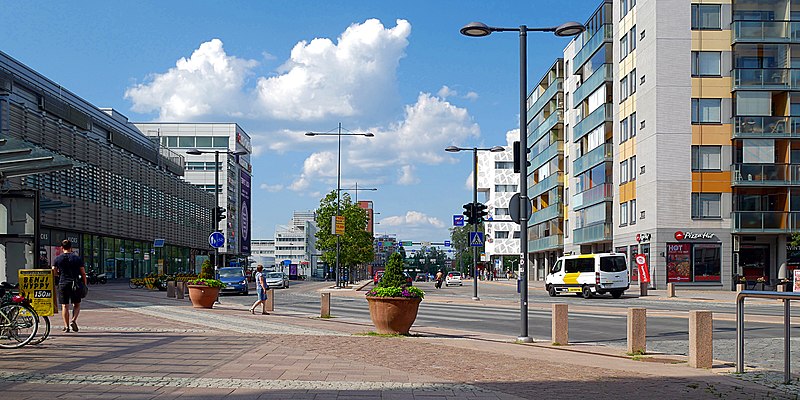
File:Piispansilta_Matinkylä_Espoo_Iso_Omena_280719.jpg · Wikimedia Commons · See Wikimedia Commons
Espoo
Sign in to saveAlso known as Esbo, Espoon kaupunki
Espoo (, ; ) is a city in Finland. It is located to the west of the capital, Helsinki, in southern Uusimaa. The population is approximately . It is the most populous municipality in Finland. Espoo is part of the Helsinki Metropolitan Area, which has approximately million inhabitants. Espoo is on the northern shore of the Gulf of Finland and borders Helsinki, Vantaa, Kirkkonummi, Vihti and Nurmijärvi. The city includes the enclave of Kauniainen. Espoo covers an area of . Espoo is a bilingual municipality with Finnish and Swedish as its official languages. The population consists of Finnish spea
Espoo is Finland's most populous municipality, located just west of the capital Helsinki on the northern shore of the Gulf of Finland. As a major part of the Helsinki Metropolitan Area, it serves as an important urban center in southern Finland with both Finnish and Swedish as its official languages.
AI-generated from the Wikipedia summary — may contain errors.
Weather now
7-day forecast
via Open-Meteo
Key facts
- Settlement.name
- Espoo
- Settlement.official_name
- City of Espoo
- Settlement.native_name_lang
- sv
- Settlement.settlement_type
- City
- Settlement.image_caption
- From top, left to right: Downtown Matinkylä; street in Espoonlahti; Aalto University Auditorium; Accountor Tower; Espoo Cathedral; Tapiola with Espoo Cultural Centre
- Settlement.image_shield
- Espoo.vaakuna.svg
- Settlement.shield_size
- 120x80px
- Settlement.image_map
- Espoo sijainti Suomi.svg
- Settlement.map_caption
- Location within Finland
- Settlement.mapframe
- yes
- Settlement.mapframe point
- City
- Settlement.subdivision_type
- Country
- Settlement.subdivision_type1
- Region
- Settlement.subdivision_name1
- 15px|link=Uusimaa Uusimaa
- Settlement.subdivision_type2
- Sub-region
- Settlement.subdivision_name2
- Helsinki sub-region
- Settlement.subdivision_type3
- Metropolitan area
- Settlement.subdivision_name3
- Helsinki metropolitan area
via Wikipedia infobox
Wikidata facts
- Instance of
- geographical feature
- Part of
- Helsinki capital region
- Official name
- Esbo köping
- Country
- Finland
- Located in
- Helsinki sub-region
- Official language
- Swedish
- Population
- 325716
- Area
- 312.35
- Elevation
- 27
- Time zone
- UTC+02:00
- Shares border with
- Kauniainen
- Legal form
- municipality of Finland
- Official website
- www.espoo.fi
- Image
- Keilaniemi ranta Espoo 191021.png
Show 20 more facts
- twinned administrative body
- Nõmme
- Commons category
- Espoo
- postal code
- 02100–02980
- topic's main category
- Category:Espoo
- category for people born here
- Category:Births in Espoo
- category for people who died here
- Category:Deaths in Espoo
- category of associated people
- Category:People from Espoo
- Commons gallery
- Espoo
- inception
- 1458-00-00
- P8168
- Otto Schilling
- associated electoral district
- Uusimaa
- located in the statistical territorial entity
- Helsinki capital region
- time of earliest written record
- 1431-00-00
- office held by head of government
- mayor
- native label
- Esbo
- citizens' initiative URL
- www.kuntalaisaloite.fi/sv/sok?municipalities=49
- member of
- Union of the Baltic Cities
- P12749
- 1984 Summer Olympics
- number of viewers/listeners
- 4362911
- topic has template
- Template:Espoo
Sources (13)
via Wikidata · CC0
Travel guide
Understand
300px|thumbnail|Shopping at Iso Omena
Espoo has several local regional centres, thus divided into seven major areas: Vanha-Espoo, Espoonlahti, Espoo, Kauklahti, Leppävaara, Matinkylä and Tapiola. The Espoo center (Espoon keskus) is the administrative centre, but doesn't rise above its peers with respect to population. The population is concentrated in an inverted F-shaped area defined by the railway to Espoo centre (north) and the highway Länsiväylä (south) up to Espoonlahti. The rest is sparsely populated, and north of Espoo centre, the area is mostly forested. While Kauniainen is an independent municipality, in practice it is contiguous with Espoo and has no notable sights or services to travellers besides a small shopping center.
The science and technology-related campuses of the Aalto University are based in Otaniemi, Espoo, along with a thriving science community that includes numerous startups and organizations such as VTT – the Technical Research Centre of Finland. Nokia is headquartered in Karakallio, Espoo. Other high-tech companies such as KONE, Tekla and Fortum have their headquarters in Keilaniemi, Espoo, along with Microsoft's Finnish headquarters.
Get around
Espoo is part of the capital region's HSL public transport cooperation. See Helsinki#Get around for tickets, fares and some other general information. You may want to use HSL's journey planner or Google Maps.
See
thumbnail|Aalto University auditorium in Otaniemi thumbnail|"Hip flask" houses in Tapiola thumb|right|Mikes in Otaniemi. In the centre is Finland's most accurate clock, with an inaccuracy of only a few nanoseconds per year.
Do
thumb|right|"Mini-Tapiola" in autumn 2006 thumbnail|Outdoor half-pipe water slide at Serena
. This is a "go to" place in Espoo, being probably the most accessible "true Finnish forest" near Helsinki. There is parking and footpaths. Although one has a metalled path up to a beautiful lakeshore, none are completely accessible by wheelchairs or prams, since all include unmaintained sections with rocky slopes and/or tree roots blocking the way. Cinema Swimming pool
Eat
thumbnail|Hanasaari cultural centre, also has a restaurant with Scandinavian cuisine
Drink
thumbnail|Bemböle coffee house
Sleep
thumbnail|View towards Keilaniemi waterfront. Left: Fortum head office and Otaniemi water tower. Right: Life Science Center business park.
Stay safe
Although a part of the Helsinki metropolitan area, Espoo has few or no problem spots and is exceptionally safe. There are various reasons. The population of Espoo is affluent, with few low-income neighborhoods. Population is simply less concentrated, with few high-rise districts, traffic junctions or concentrations of nightlife. Thus, partygoers are more likely to head to Helsinki to cause trouble.
Caution is warranted in urban districts (along the railway) with nightlife during Friday or Saturday nights, for instance in Leppävaara and Espoon keskus. Suvela and Kirstinmäki, next to Espoon keskus, is often mentioned as the only "ghetto" in Espoo, although this is more reputation than fact if compared to districts in Central or Eastern Helsinki.
Go next
West: Kirkkonummi–Siuntio–Ingå–Raseborg (Karis–Ekenäs–Pojo)–Hanko — The next cities westwards accessible by bus, train or car. North: Vantaa–Klaukkala–Hyvinkää
Travel guide from Wikivoyage (CC BY-SA 4.0)
~92 min read
Encyclopedic overview
78 sectionsContents
- History
- Etymology
- Prehistory
- Swedish rule
- Medieval Espoo
- Gräsa manor
- Early modern period
- Grand Duchy of Finland and early industrialisation
- World War I
- Finnish Civil War
- Power vacuum
- Red and White Guards in Espoo
- Red Espoo
- After the war
- 20th century
- Market town and city
- 21st century
- Geography
- General
- Bedrock
- Sea area
- Shoreline
- Continental area
- Inland waters
- Features
- Flora and fauna
- Climate
- Temperature and rainfall
- Snow conditions
- Winds
- Air quality
- Lighting conditions
- Growth season
- Administration
- Subdivisions
- Municipal annexations
- Organisation
- City and municipal managers
- City Council
- Demographics
- Population
- Language
- Immigration
- Religion
- Economy
- Economic history
- Companies
- City of Espoo
- Income level
- Culture
- Events
- Food culture
- Cultural history
- Sports
- Sportsperson of the year in Espoo
- Basketball
- Ice hockey
- Football
- Floorball
- Running
- Athletes from Espoo
- Parks and recreation
- Government and politics
- Services
- Education
- Healthcare
- Infrastructure
- Public transport
- Metro transport
- Railway transport
- Bus transport
- International relations
- Notable people
- See also
- Notes
- References
- Citations
- External links
Espoo (, ; ) is a city in Finland. It is located to the west of the capital, Helsinki, in southern Uusimaa. The population is approximately . It is the most populous municipality in Finland. Espoo is part of the Helsinki Metropolitan Area, which has approximately million inhabitants. Espoo is on the northern shore of the Gulf of Finland and borders Helsinki, Vantaa, Kirkkonummi, Vihti and Nurmijärvi. The city includes the enclave of Kauniainen. Espoo covers an area of . Espoo is a bilingual municipality with Finnish and Swedish as its official languages. The population consists of Finnish speakers, Swedish speakers, and speakers of other languages, well above the national average.
Espoo was settled in the Prehistoric Era, with evidence of human settlements dating back 8,000 years. However, the population disappeared during the early Iron Age. During the Early Middle Ages, the region was populated by Tavastians and Southwestern Finns. Following the Northern Crusades, Swedish settlers began to emigrate to the coastal regions of modern-day Finland. Espoo was founded as an autonomous Catholic parish in the 15th century. Following the conclusion of the Finnish War, the decision to make Helsinki the new capital of the Russian-controlled Grand Duchy of Finland in 1812 had a significant positive impact on the municipality's growth and development. Nevertheless, the territory continued to be mainly agrarian until the 20th century. After World War II, Espoo underwent swift urbanization and significant demographic shifts, with Finnish becoming the majority language around 1950, replacing Swedish. The municipality attained market town status in 1963 and was granted city status in 1972.
Excerpted from Wikipedia’s “Espoo” article, available under the CC BY-SA 4.0 licence.
Gallery (52)
On the map
3 mapped locations
Available in 96 languages
- Español
- Français
- Deutsch
- 中文
- 日本語
- Русский
- Português
- Italiano
- العربية
- Afrikaans
- Albanian
- Aragonese
- Armenian
- Asturian
- Azerbaijani
- Bahasa Indonesia
- Balinese
- Bashkir
Show 77 more
- Basque
- bat_smg
- be_x_old
- Belarusian
- Bosnian
- Breton
- Bulgarian
- Catalan
- Cebuano
- Chechen
- Cornish
- Croatian
- Czech
- Danish
- Egyptian Arabic
- Esperanto
- Estonian
- Fijian
- Finnish
- Galician
- Georgian
- Greek
- Hebrew
- Hungarian
- Icelandic
- Ido
- Inari Sami
- Interlingue
- Komi-Permyak
- Kotava
- Kurdish
- Latin
- Latvian
- Lithuanian
- Lombard
- Malagasy
- Maltese
- Manx
- Māori
- Marathi
- Mari
- Mingrelian
- Moksha
- Nederlands
- Northern Frisian
- Northern Sami
- Norwegian
- Norwegian Nynorsk
- Ossetic
- Polski
- Quechua
- Romanian
- Scots
- Serbian
- Serbian (Latin)
- Silesian
- simple
- Slovak
- Slovenian
- Svenska
- Tamil
- Tatar
- Tiếng Việt
- Türkçe
- Ukrainian
- Urdu
- Venetian
- Veps
- Volapük
- Waray
- Western Mari
- Wu Chinese
- zh_yue
- Zulu
- فارسی
- ไทย
- 한국어
via Wikidata sitelinks · CC0