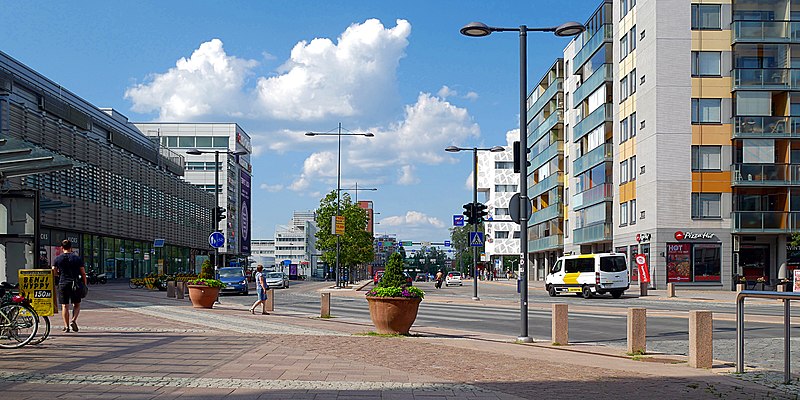
File:Piispansilta_Matinkylä_Espoo_Iso_Omena_280719.jpg · Wikimedia Commons · See Wikimedia Commons
Espoo is Finland's most populous municipality, located just west of the capital Helsinki on the northern shore of the Gulf of Finland. As a major part of the Helsinki Metropolitan Area, it serves as an important urban center in southern Finland with both Finnish and Swedish as its official languages.
AI-generated from the Wikipedia summary — may contain errors.
Weather now
7-day forecast
via Open-Meteo
Place details
- Locality
- Espoo
- Region
- Uusimaa
- Country
- Suomi / Finland
- Population
- 256,760
- Timezone
- Europe/Helsinki
via OpenStreetMap · GeoNames
Key facts
- Settlement.name
- Espoo
- Settlement.official_name
- City of Espoo
- Settlement.native_name_lang
- sv
- Settlement.settlement_type
- City
- Settlement.image_caption
- From top, left to right: Downtown Matinkylä; street in Espoonlahti; Aalto University Auditorium; Accountor Tower; Espoo Cathedral; Tapiola with Espoo Cultural Centre
- Settlement.image_shield
- Espoo.vaakuna.svg
- Settlement.shield_size
- 120x80px
- Settlement.image_map
- Espoo sijainti Suomi.svg
- Settlement.map_caption
- Location within Finland
- Settlement.mapframe
- yes
- Settlement.mapframe point
- City
- Settlement.subdivision_type
- Country
- Settlement.subdivision_type1
- Region
- Settlement.subdivision_name1
- 15px|link=Uusimaa Uusimaa
- Settlement.subdivision_type2
- Sub-region
- Settlement.subdivision_name2
- Helsinki sub-region
- Settlement.subdivision_type3
- Metropolitan area
- Settlement.subdivision_name3
- Helsinki metropolitan area
via Wikipedia infobox
Wikidata facts
- Instance of
- geographical feature
- Part of
- Helsinki capital region
- Official name
- Esbo köping
- Country
- Finland
- Located in
- Helsinki sub-region
- Official language
- Swedish
- Population
- 325716
- Area
- 312.35
- Elevation
- 27
- Time zone
- UTC+02:00
- Shares border with
- Kauniainen
- Legal form
- municipality of Finland
- Official website
- www.espoo.fi
- Image
- Keilaniemi ranta Espoo 191021.png
Show 20 more facts
- twinned administrative body
- Nõmme
- Commons category
- Espoo
- postal code
- 02100–02980
- topic's main category
- Category:Espoo
- category for people born here
- Category:Births in Espoo
- category for people who died here
- Category:Deaths in Espoo
- category of associated people
- Category:People from Espoo
- Commons gallery
- Espoo
- inception
- 1458-00-00
- P8168
- Otto Schilling
- associated electoral district
- Uusimaa
- located in the statistical territorial entity
- Helsinki capital region
- time of earliest written record
- 1431-00-00
- office held by head of government
- mayor
- native label
- Esbo
- citizens' initiative URL
- www.kuntalaisaloite.fi/sv/sok?municipalities=49
- member of
- Union of the Baltic Cities
- P12749
- 1984 Summer Olympics
- number of viewers/listeners
- 4362911
- topic has template
- Template:Espoo
Sources (13)
via Wikidata · CC0
Travel guide
Understand
300px|thumbnail|Shopping at Iso Omena
Espoo has several local regional centres, thus divided into seven major areas: Vanha-Espoo, Espoonlahti, Espoo, Kauklahti, Leppävaara, Matinkylä and Tapiola. The Espoo center (Espoon keskus) is the administrative centre, but doesn't rise above its peers with respect to population. The population is concentrated in an inverted F-shaped area defined by the railway to Espoo centre (north) and the highway Länsiväylä (south) up to Espoonlahti. The rest is sparsely populated, and north of Espoo centre, the area is mostly forested. While Kauniainen is an independent municipality, in practice it is contiguous with Espoo and has no notable sights or services to travellers besides a small shopping center.
The science and technology-related campuses of the Aalto University are based in Otaniemi, Espoo, along with a thriving science community that includes numerous startups and organizations such as VTT – the Technical Research Centre of Finland. Nokia is headquartered in Karakallio, Espoo. Other high-tech companies such as KONE, Tekla and Fortum have their headquarters in Keilaniemi, Espoo, along with Microsoft's Finnish headquarters.
Get around
Espoo is part of the capital region's HSL public transport cooperation. See Helsinki#Get around for tickets, fares and some other general information. You may want to use HSL's journey planner or Google Maps.
See
thumbnail|Aalto University auditorium in Otaniemi thumbnail|"Hip flask" houses in Tapiola thumb|right|Mikes in Otaniemi. In the centre is Finland's most accurate clock, with an inaccuracy of only a few nanoseconds per year.
Do
thumb|right|"Mini-Tapiola" in autumn 2006 thumbnail|Outdoor half-pipe water slide at Serena
. This is a "go to" place in Espoo, being probably the most accessible "true Finnish forest" near Helsinki. There is parking and footpaths. Although one has a metalled path up to a beautiful lakeshore, none are completely accessible by wheelchairs or prams, since all include unmaintained sections with rocky slopes and/or tree roots blocking the way. Cinema Swimming pool
Eat
thumbnail|Hanasaari cultural centre, also has a restaurant with Scandinavian cuisine
Drink
thumbnail|Bemböle coffee house
Sleep
thumbnail|View towards Keilaniemi waterfront. Left: Fortum head office and Otaniemi water tower. Right: Life Science Center business park.
Stay safe
Although a part of the Helsinki metropolitan area, Espoo has few or no problem spots and is exceptionally safe. There are various reasons. The population of Espoo is affluent, with few low-income neighborhoods. Population is simply less concentrated, with few high-rise districts, traffic junctions or concentrations of nightlife. Thus, partygoers are more likely to head to Helsinki to cause trouble.
Caution is warranted in urban districts (along the railway) with nightlife during Friday or Saturday nights, for instance in Leppävaara and Espoon keskus. Suvela and Kirstinmäki, next to Espoon keskus, is often mentioned as the only "ghetto" in Espoo, although this is more reputation than fact if compared to districts in Central or Eastern Helsinki.
Go next
West: Kirkkonummi–Siuntio–Ingå–Raseborg (Karis–Ekenäs–Pojo)–Hanko — The next cities westwards accessible by bus, train or car. North: Vantaa–Klaukkala–Hyvinkää
Travel guide from Wikivoyage (CC BY-SA 4.0)
Article · Polski
Espoo (szw. Esbo, ros. Э́споо) – miasto w południowej Finlandii, na wschodzie graniczące bezpośrednio z miastem stołecznym Helsinki; drugi pod względem wielkości ośrodek miejski w Finlandii; wraz z miastami Helsinki, Vantaa i Kauniainen tworzy zespół miejski Helsinek. Espoo obejmuje obszar 528 km², z czego 312 km² stanowi teren lądowy. Populacja Espoo liczy 244,9 tys. mieszkańców (według danych z 2010). Od 1972 roku, czyli od momentu utworzenia miasta, jego celem był rozwój przy jednoczesnym zachowaniu w nienaruszonej formie środowiska naturalnego, przez co miasto rozwijało się wokół kilku ośrodków. Skutkiem tego jest obecny podział Espoo na okręgi: Espoon Keskus (Centrum Espoo), Espoonlahti, Kalajärvi, Kauklahti, Leppävaara, Matinkylä-Olari oraz Tapiola. W dzielnicy Otaniemi mieści się jeden z kampusów Uniwersytetu Aalto (dawny Helsiński Uniwersytet Technologii – Teknillinen korkeakoulu) wraz z doskonale prosperującymi ośrodkami i organizacjami naukowymi, takimi jak VTT – Fińskie Centrum Badań Technologicznych. W dzielnicy Keilaranta działa firma telekomunikacyjna Nokia oraz inne korporacje oparte na nowoczesnych technologiach, m.in. Kone (producent wind i schodów ruchomych), Fortum (branża energetyczna) i spółka telekomunikacyjna Elisa. W mieście działa również polski konsulat honorowy kierowany przez byłego wiceprezesa Nokii, Stefana Widomskiego. W mieście znajduje się stacja kolejowa Espoo.
Abstract from DBpedia / Wikipedia · CC BY-SA
Gallery (52)
On the map
3 mapped locations
Available in 96 languages
- Español
- Français
- Deutsch
- 中文
- 日本語
- Русский
- Português
- Italiano
- العربية
- Afrikaans
- Albanian
- Aragonese
- Armenian
- Asturian
- Azerbaijani
- Bahasa Indonesia
- Balinese
- Bashkir
Show 77 more
- Basque
- bat_smg
- be_x_old
- Belarusian
- Bosnian
- Breton
- Bulgarian
- Catalan
- Cebuano
- Chechen
- Cornish
- Croatian
- Czech
- Danish
- Egyptian Arabic
- Esperanto
- Estonian
- Fijian
- Finnish
- Galician
- Georgian
- Greek
- Hebrew
- Hungarian
- Icelandic
- Ido
- Inari Sami
- Interlingue
- Komi-Permyak
- Kotava
- Kurdish
- Latin
- Latvian
- Lithuanian
- Lombard
- Malagasy
- Maltese
- Manx
- Māori
- Marathi
- Mari
- Mingrelian
- Moksha
- Nederlands
- Northern Frisian
- Northern Sami
- Norwegian
- Norwegian Nynorsk
- Ossetic
- Polski
- Quechua
- Romanian
- Scots
- Serbian
- Serbian (Latin)
- Silesian
- simple
- Slovak
- Slovenian
- Svenska
- Tamil
- Tatar
- Tiếng Việt
- Türkçe
- Ukrainian
- Urdu
- Venetian
- Veps
- Volapük
- Waray
- Western Mari
- Wu Chinese
- zh_yue
- Zulu
- فارسی
- ไทย
- 한국어
via Wikidata sitelinks · CC0