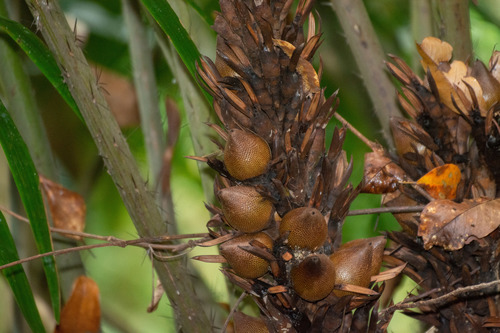
(c) Vatcharavee Sriprasertsil, some rights reserved (CC BY-NC), uploaded by Vatcharavee Sriprasertsil · cc-by-nc
Eugeissona
Sign in to saveEugeissona is a clustering genus of flowering plant in the palm family native to Borneo, Thailand and Malaysia. The six monoecious species provide a wide range of local uses and are commonly called bertam or wild Bornean sago. The genus is the sole representative of the Eugeissoninae having very few obvious relatives; the hermaphrodite and staminate flowers are also found in Metroxylon, however the other specialized characteristics are unique suggesting an early split and differentiation from other members of the Calameae. Fossilized pollen belonging to these plants has been recovered in the l
Species
GENUS
- KingdomPlantae
- PhylumTracheophyta
- ClassLiliopsida
- OrderArecales
- FamilyArecaceae
鳞皮椰属(学名:Eugeissona)为棕榈目棕榈科的一属,係省藤亚科之下的一個單系群,也是鳞皮椰族(Eugeissoneae)仅有的一属,只產於東南亞的婆罗洲、泰国及马来西亚。其下共6个物种,雌雄同株。在当地其通常被称为野生婆罗洲西米。其叶片被用作屋顶草料。
via GBIF · Kew POWO
Museum specimens
- Specimen records
- 7
- With media
- 4
- Family
- Arecaceae
- Collections
- A, B
- Recorded in
- Malaysia, Malaysia/Sarawak, Malaysia/Sabah, Malaysia/Malaya, Brunei, India
Wikidata facts
- Instance of
- taxon
- Parent taxon
- Arecaceae
- Image
- COLLECTIE TROPENMUSEUM Nangkapalmen (Eugeissona spec) langs de rivier Telèn bij de Long Meloe in Midden-Oost-Borneo TMnr 10011253.jpg
Show 6 more facts
- taxon common name
- eugeissona
- taxon rank
- genus
- taxon name
- Eugeissona
- topic's main category
- Category:Eugeissona
- Commons category
- Eugeissona
Sources (1)
via Wikidata · CC0
~3 min read
Encyclopedic overview
6 sectionsContents
- Description
- Floral microbiome
- Distribution and habitat
- Cultivation and uses
- References
- External links
Eugeissona is a clustering genus of flowering plant in the palm family native to Borneo, Thailand and Malaysia. The six monoecious species provide a wide range of local uses and are commonly called bertam or wild Bornean sago. The genus is the sole representative of the Eugeissoninae having very few obvious relatives; the hermaphrodite and staminate flowers are also found in Metroxylon, however the other specialized characteristics are unique suggesting an early split and differentiation from other members of the Calameae. Fossilized pollen belonging to these plants has been recovered in the lower and middle Miocene deposits in Sarawak. The name is from two Greek words meaning "good" and "roof", due to their common use in roof thatching.
==Description== All of the Eugeissona palms will form above-ground stems where the apical inflorescence will appear toward the final year of the palm life. For the highland natives of Borneo they let the E. utilis palm grow trunk and harvest it just before flowering for its palm heart and the starch (sago) found inside. Amongst the lowland native, the much sought-after palm heart is harvested before the trunk has been formed. During trunk-forming they are supported by tall masses of stilt roots in which detritus and leaf matter collect, providing nesting to various biota. The large leaves are carried on long, spiny petioles, and the rachises and trunks are also spine-bearing. The erect inflorescence bears some of the largest flowers in the palm family, emerging within the leaf crown featuring both male and bisexual flowers. The fruit is a beaked, ovoid drupe carrying one seed.
Excerpted from Wikipedia’s “Eugeissona” article, available under the CC BY-SA 4.0 licence.