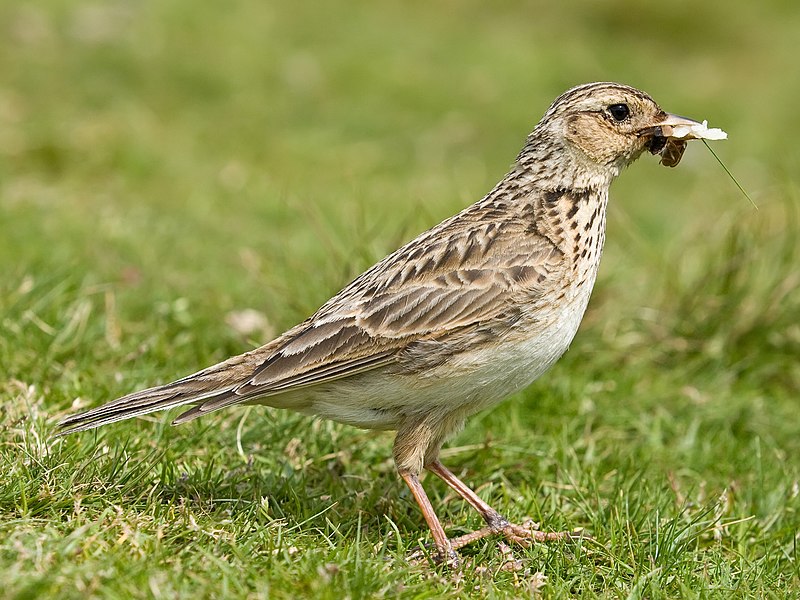
File:Skylark_2,_Lake_District,_England_-_June_2009.jpg · Wikimedia Commons · See Wikimedia Commons
OverviewAI-generated
The Eurasian Skylark, scientifically named *Alauda arvensis*, is a species of bird within the family Alaudidae. It belongs to the genus *Alauda* and is classified under the order Passeriformes, class Aves, and phylum Chordata. The species was described by Linnaeus in 1758 and is currently accepted as a valid taxon. It is diurnal and has a wingspan of 0.35.
The Eurasian Skylark has a range that includes the Nanling Mountains, Africa, and Poland. Its IUCN conservation status is listed as Least Concern, a designation recorded in 2018. The bird has also received the award of Bird of the Year. Common names for the species include Feldlerche, Alouette des champs, and Allodola.
Synthesized by Vinony from 24 facts across 4 sources: Wikidata, IUCN Red List, WoRMS, Vinony graph. Generated from structured data (not the Wikipedia text) and checked against those facts — may still contain errors.
Species
Least ConcernEurasian sky lark
Species
- PhylumChordata
- ClassAves
- OrderPasseriformes
- FamilyAlaudidae
この項目では、鳥類の種(Alauda arvensis)について説明しています。その他の用法については「ひばり」をご覧ください。 ヒバリ ヒバリ Alauda arvensis 保全状況評価[a 1][a 2] LEAST CONCERN (IUCN Red List Ver.3.1 (2001)) 分類 界 : 動物界 Animalia 門 : 脊索動物門 Chordata 亜門 : 脊椎動物亜門 Vertebrata 綱 : 鳥綱 Aves 目 : スズメ目 Passeriformes 亜目 : スズメ亜目 Oscines 科 : ヒバリ科 Alaudidae 属 : ヒバリ属 Alauda 種 : ヒバリ A. arvensis 学名 Alauda arvensis Linnaeus, 1758 和名 ヒバリ 英名 Eurasian skylark Skylark ヒバリ(雲雀[1]、Alauda arvensis)は、スズメ目ヒバリ科ヒバリ属に分類される鳥類。春を告げる鳥として古より洋の東西を問わず親しまれている。 目次 1 地方名 2 分布 3 形態 4 生態 5 分類 6 種の保全状況評価 7 人間との関係 8 ヒバリをシンボルとする自治体 8.1 都道府県 8.2 市町村 9 脚注 10 出典 11 参考文献 12 関連項目 13 外部リンク 地方名[編集] 古来から人の目に触れる機会が多い種であるため多くの地方名がある。主なものは、告天子(こうてんし、こくてんし、ひばり)[2][脚注 1] 、叫天子(きょうてんし)、天雀(てんじゃく)、姫雛鳥(ひめひなどり)、噪天(そうてん)、日晴鳥(ひばり)[3]など。 分布[編集] アフリカ大陸北部、ユーラシア大陸、イギリス、日本[a 1]。 日本では亜種ヒバリが周年生息(留鳥)し、亜種カラフトチュウヒバリや亜種オオヒバリが冬季に越冬のため本州以南へ飛来(冬鳥)する[4][5][6]。 A. a. japonica ヒバリ 日本[a 2] 北部個体群や積雪地帯に分布する個体群は冬季になると南下する[7][8][9]。 形態[編集] 全長17センチメートル[1][7][8][9][5][6]。翼開長32センチメートル[7][10]。後頭の羽毛は伸長(冠羽)する[7][4][5]。上面の羽衣は褐色で、羽軸に黒褐色の斑紋(軸斑)が入る[7][5]。下面の羽衣は白く、側頸から胸部にかけて黒褐色の縦縞が入る[7][5]。胸部から体側面にかけての羽衣は褐色[5]。外側尾羽の色彩は白い[9][5]。初列風切は長く突出する[7]。次列風切後端が白い[8][9][5]。 嘴は黄褐色で、先端が黒い[5]。後肢はピンクがかった褐色[7][5]。 卵の殻は灰白色で、灰色や暗褐色の斑点が入る[8]。オスは頭部の冠羽をよく立てるが、
via IUCN
Wikidata facts
- Instance of
- taxon
- Parent taxon
- Alauda
- Award
- Bird of the Year
- Image
- Alouette des champs Zaghouan001.jpg
Show 10 more facts
- taxon rank
- species
- IUCN conservation status
- Least Concern
- taxon name
- Alauda arvensis
- Commons category
- Alauda arvensis
- Commons gallery
- Alauda arvensis
- wingspan
- 0.35
- taxon common name
- calandra
- diel cycle
- diurnality
- short name
- A. arvensis
- taxon range
- Poland
Sources (12)
via Wikidata · CC0
~12 min read
Encyclopedic overview
The Eurasian skylark (Alauda arvensis), commonly referred to in Europe as the lark, is a passerine bird in the lark family, Alaudidae. It is a widespread species found across Europe and the Palearctic with introduced populations in Australia, New Zealand, Canada, and on the Hawaiian Islands. It is a bird of open farmland and heath, known for the song of the male, which is delivered in hovering flight from heights of 50 to 100 metres (160 to 330 ft). The sexes are alike. It is streaked greyish-brown above and on the breast and has a buff-white belly.
The female Eurasian skylark builds an open nest in a shallow depression on open ground well away from trees, bushes and hedges. She lays three to five eggs which she incubates for around 11 days. The chicks are fed by both parents but leave the nest after eight to ten days, well before they can fly. They scatter and hide in the vegetation but continue to be fed by the parents until they can fly at 18 to 20 days of age. Nests are subject to high predation rates by larger birds and small mammals. The parents can have several broods in a single season.
Excerpted from Wikipedia’s “Eurasian Skylark” article, available under the CC BY-SA 4.0 licence.
Gallery (8)
Available in 87 languages
- Español
- Français
- Deutsch
- 中文
- 日本語
- Русский
- Português
- Italiano
- العربية
- Aragonese
- Armenian
- Asturian
- Azerbaijani
- Bahasa Indonesia
- Balinese
- Bashkir
- Basque
- bat_smg
Show 68 more
- Belarusian
- Breton
- Bulgarian
- Burmese
- Catalan
- Cebuano
- Chuvash
- Corsican
- Croatian
- Czech
- Danish
- Egyptian Arabic
- eml
- Esperanto
- Estonian
- Faroese
- Finnish
- Galician
- Georgian
- Hebrew
- Hungarian
- Irish
- Kabardian
- Kashubian
- Kazakh
- Kurdish
- Latvian
- Lithuanian
- lld
- Luxembourgish
- Macedonian
- Mongolian
- Navajo
- Neapolitan
- Nederlands
- Nepali
- Northern Frisian
- Northern Sami
- Norwegian
- Norwegian Nynorsk
- olo
- Picard
- Piedmontese
- Polski
- Romanian
- rsk
- Rusyn
- Scottish Gaelic
- Serbian
- Slovak
- Slovenian
- Svenska
- szy
- Tatar
- Tiếng Việt
- Türkçe
- Ukrainian
- Veps
- Walloon
- Waray
- Welsh
- Western Frisian
- Western Mari
- Wu Chinese
- Yakut
- zh_yue
- فارسی
- 한국어
via Wikidata sitelinks · CC0