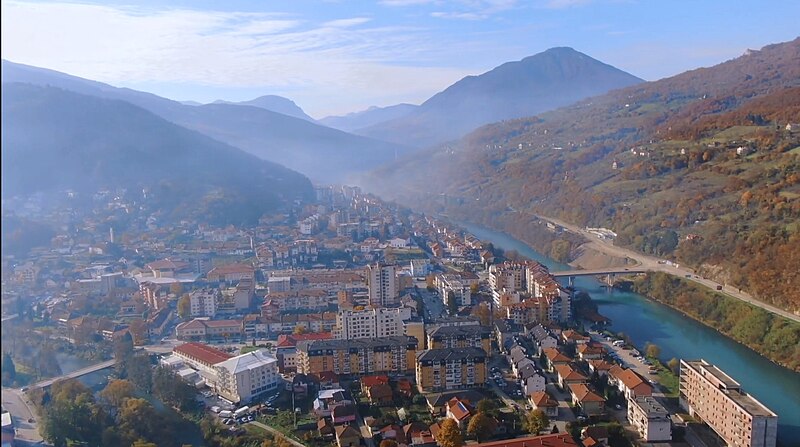
File:Foča_-_Panorama.jpg · Wikimedia Commons · See Wikimedia Commons
Foča
Sign in to saveAlso known as Foca, Hvoča, Srbinje
Foča (, ) is a town and municipality in Republika Srpska, Bosnia and Herzegovina, located in the south-east on the banks of Drina river. As of 2013, the town has a population of 12,234 inhabitants, while the municipality has 18,288 inhabitants. Foča houses some faculties (including the Medical and Orthodox Theological Faculty of Saint Basil of Ostrog) from the Istočno Sarajevo University. It is also home to the "Seminary of Saint Peter of Sarajevo and Dabar-Bosna", one of seven seminaries in the Serbian Orthodox Church. Foča was, before the ethnic cleansing in 1992-1994, home to one of Bosnia'
OverviewAI-generated
Foča is a city in Bosnia and Herzegovina, serving as the capital of Foča Municipality. It is situated within the Republika Srpska entity and lies next to the Drina river. The city has a population of 12,334 and covers an area of 208 square kilometers. Its elevation above sea level is recorded as 442 meters.
The local postal code is 73300, and the dialing code is 58. Foča operates on Central European Time (UTC+01:00). The city is twinned with Nikšić. It is distinct from the location known as Foča-Ustikolina.
Synthesized by Vinony from 51 facts across 7 sources: Wikidata, Openweathermap, Open Meteo, OpenStreetMap, GeoNames, Vinony graph, Geo. Generated from structured data (not the Wikipedia text) and checked against those facts — may still contain errors.
Weather now
7-day forecast
via Open-Meteo
Place details
- Locality
- Foča
- Region
- Република Српска / Republika Srpska
- Country
- Bosna i Hercegovina / Босна и Херцеговина
- Population
- 14,615
- Timezone
- Europe/Sarajevo
via OpenStreetMap · GeoNames
Key facts
- Settlement <! more fields are available for this Infobox See Template:Infobox Settlement >.settlement_type
- Town and municipality
- Settlement <! more fields are available for this Infobox See Template:Infobox Settlement >.subdivision_type
- Country
- Settlement <! more fields are available for this Infobox See Template:Infobox Settlement >.subdivision_type1
- Entity
- Settlement <! more fields are available for this Infobox See Template:Infobox Settlement >.subdivision_type2
- Geographical region
- Settlement <! more fields are available for this Infobox See Template:Infobox Settlement >.subdivision_name2
- Podrinje
- Settlement <! more fields are available for this Infobox See Template:Infobox Settlement >.timezone
- CET
- Settlement <! more fields are available for this Infobox See Template:Infobox Settlement >.utc_offset
- +1
- Settlement <! more fields are available for this Infobox See Template:Infobox Settlement >.timezone_DST
- CEST
- Settlement <! more fields are available for this Infobox See Template:Infobox Settlement >.utc_offset_DST
- +2
- Settlement <! more fields are available for this Infobox See Template:Infobox Settlement >.map_caption
- Location of Foča within Bosnia and Herzegovina
- Settlement <! more fields are available for this Infobox See Template:Infobox Settlement >.native_name
- Фоча
- Settlement <! more fields are available for this Infobox See Template:Infobox Settlement >.official_name
- Foča
- Settlement <! more fields are available for this Infobox See Template:Infobox Settlement >.image_shield
- Foča_Coat_of_Arms.jpg
- Settlement <! more fields are available for this Infobox See Template:Infobox Settlement >.image_map
- Foča municipality.svg
- Settlement <! more fields are available for this Infobox See Template:Infobox Settlement >.area_blank1_title
- Town
- Settlement <! more fields are available for this Infobox See Template:Infobox Settlement >.area_blank2_title
- Municipality
- Settlement <! more fields are available for this Infobox See Template:Infobox Settlement >.area_blank2_km2
- 1134.58
- Settlement <! more fields are available for this Infobox See Template:Infobox Settlement >.population_as_of
- 2013 census
via Wikipedia infobox
Wikidata facts
- Instance of
- city
- Country
- Bosnia and Herzegovina
- Located in
- Foča Municipality
- Population
- 12334
- Area
- 208
- Elevation
- 442
- Time zone
- UTC+01:00
- Body of water
- Drina
- Capital of
- Foča Municipality
- Official website
- opstinafoca.rs.ba
- Image
- Foča – Panorama.jpg
- Dialing code
- 58
Show 11 more facts
- Commons category
- Foča
- topic's main category
- Category:Foča
- postal code
- 73300
- native label
- Foča
- category for people born here
- Q32650577
- category of associated people
- Category:People from Foča
- described by source
- Encyclopædia Britannica 11th edition
- different from
- Foča-Ustikolina
- P8168
- Otto Crusius
- twinned administrative body
- Nikšić
- P12749
- Bogotá
Sources (8)
via Wikidata · CC0
Travel guide
Understand
The city lies close to the border with Montenegro and Serbia.
Do
Foča is a good base to explore nature from. For example, to go rafting on the Tara river, running through the deepest canyon in Europe, or go hiking through Perućica forest, one of the last first-growth forests left on the continent, with trees measuring up to 60 m. Also a challenge is to try to climb Maglić Mountain, right on the border with Montenegro. Maglić ("fog") is the highest peak of BiH, and if you make the ascent without a guide, you will probably need 2 days to reach the peak.
The road to Montenegro is used by long distance cyclists. Especially the continuation in Montenegro to Plužine has magnificent views onto the blue river.
Travel guide from Wikivoyage (CC BY-SA 4.0)
~13 min read
Encyclopedic overview
16 sectionsContents
- History
- Early history
- World War II
- Bosnian War
- Post-war period
- Settlements
- Demographics
- Population
- Ethnic composition
- Economy
- Culture
- Twin towns – sister cities
- Notable people
- References
- Works cited
- External links
Foča (, ) is a town and municipality in Republika Srpska, Bosnia and Herzegovina, located in the south-east on the banks of Drina river. As of 2013, the town has a population of 12,234 inhabitants, while the municipality has 18,288 inhabitants. Foča houses some faculties (including the Medical and Orthodox Theological Faculty of Saint Basil of Ostrog) from the Istočno Sarajevo University. It is also home to the "Seminary of Saint Peter of Sarajevo and Dabar-Bosna", one of seven seminaries in the Serbian Orthodox Church. Foča was, before the ethnic cleansing in 1992-1994, home to one of Bosnia's most important Islamic high schools, the Madrasa of Mehmed Pasha Kukavica. The Sutjeska National Park, which is the oldest National Park in Bosnia and Herzegovina, is located in the municipality.
==History== ===Early history=== thumb|The old clock tower of Foča is a symbol of the town built in the 18th century thumb|Old part of the town thumb|Hadživuković house, built in the 19th century The first written traces of the name Foča date back to 1336. The town was known as Hotča or Hoča during medieval times. It was then known as a trading centre on route between Ragusa (now Dubrovnik) and Constantinople (now Istanbul, Turkey). Alongside the rest of Gornje Podrinje, Foča was part of the Serbian Empire until 1376, when it was attached to the Kingdom of Bosnia under King Tvrtko, king of Serbs, Bosnia, Coastal Lands and Zachlumia. After Tvrtko's death, the town was ruled by the dukes of Zachlumia, most notably was Herzog Šćepan. Foča was the seat of the Ottoman Sanjak of Herzegovina established in 1470, and served as such until 1572, when the seat was moved to Pljevlja.
Excerpted from Wikipedia’s “Foča” article, available under the CC BY-SA 4.0 licence.
Gallery (34)
On the map
3 mapped locations