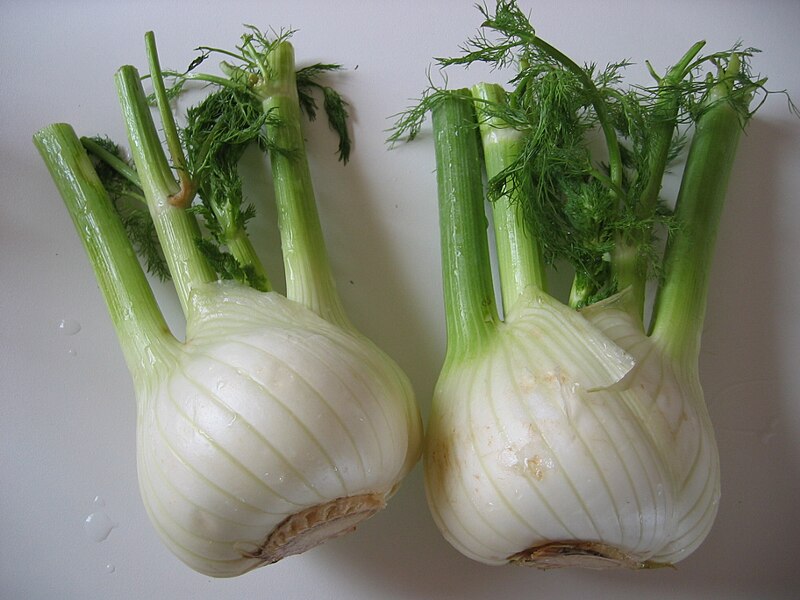
File:Fenouil.jpg · Wikimedia Commons · See Wikimedia Commons
Foeniculum vulgare
Sign in to saveAlso known as Fennel
Fennel (Foeniculum vulgare) is a flowering plant species in the carrot family. It is a hardy, perennial herb with yellow flowers and feathery leaves. It is indigenous to the shores of the Mediterranean but has become widely naturalized in many parts of the world, especially on dry soils near the sea coast and on riverbanks.
OverviewAI-generated
Foeniculum vulgare, commonly known as fennel, is a species of plant in the family Apiaceae. It is classified within the kingdom Plantae, phylum Tracheophyta, class Magnoliopsida, and order Apiales. The taxon was described by Mill. Common names for the species include purple fennel, Echter Fenchel, 茴香, and Venkel. It is also referred to by the short name F. vulgare.
The organism is used as a spice, fodder, medicinal plant, and vegetable. It is categorized as an herb, food ingredient, and useful plant. The IUCN Red List status is Least Concern, recorded in 2014. Native ranges include Afghanistan, Albania, Algeria, Baleares, Bulgaria, Corse, Cyprus, East Aegean Is., Egypt, Eritrea, Ethiopia, and France. Taxon ranges also list China, Fujian, Tianjin, and the Tibet Autonomous Region.
Synthesized by Vinony from 53 facts across 9 sources: Wikidata, GBIF, Firecrawl, IUCN Red List, Gbif Occ, Plants of the World, WoRMS, iDigBio, Vinony graph. Generated from structured data (not the Wikipedia text) and checked against those facts — may still contain errors.
Species
Least Concernfennel
Foeniculum vulgare
SPECIES
- KingdomPlantae
- PhylumTracheophyta
- ClassMagnoliopsida
- OrderApiales
- FamilyApiaceae
Foeniculum vulgare • Fenouil Le Fenouil ou Fenouil commun (Foeniculum vulgare, syn. Foeniculum officinale) est une plante généralement vivace mais parfois bisannuelle de la famille des apiacées (ombellifères). Les variétés cultivées de cette espèce de fenouil sont utilisées en alimentation pour le renflement bulbeux et charnu de leurs feuilles imbriquées les unes dans les autres. Ce n'est pas un bulbe véritable (comme l'oignon). Cette plante s'est naturalisée à travers le monde principalement dans les biomes au climat méditerranéen.
via GBIF · IUCN · Kew POWO
Museum specimens
- Specimen records
- 3,887
- With media
- 2,390
- Family
- Apiaceae
- Collections
- INECOL, SEMAHN, FCF-UANL, DERN-IMECBIO-CUCSUR-UDG, DCBS-DICTUS-USON, FA-UAS
- Recorded in
- Mexico
Described at
Foeniculum: 7 Usos Tradicionales + Evidencia
¿Para qué sirve foeniculum? El Foeniculum vulgare es una de las plantas con mayor carga histórica y cultural en el mundo, con 18 estudios.
yerbateca.org →Las hojas son de un verde intenso, extremadamente finas, plumosas y altamente divididas, lo que les da una textura suave y delicada al tacto; estas hojas se ramifican de forma alterna a lo largo del tallo. Las flores se organizan en inflorescencias de tipo umbela, que son agrupaciones circulares que parecen paraguas, con pequeñas flores de color amarillo brillante que florecen generalmente durante la primavera y el verano. Los frutos son pequeñas estructuras ovoides de color verde que maduran hacia tonos marrones, conteniendo las semillas que son el elemento más apreciado por su aroma. Para alguien que nunca ha visto esta planta, imagine una estructura verde y aireada que parece hecha de hilos finos, con un aroma dulce y anisado que emana de su follaje y flores. En tercer lugar, se ha estudiado la actividad antimicrobiana de los subproductos de la planta. Un estudio de caracterización fitoquímica (PMID 39732951 ) utilizó métodos de difusión en disco para probar la eficacia de los aceites esenciales (EOs) contra bacterias comunes como Escherichia coli y Staphylococcus aureus. Los resultados demostraron que los aceites esenciales resultaron activos contra casi todas las cepas bacterianas probadas, mientras que los extractos hidroalcohólicos (HEs) resultaron inactivos. Para cultivar Foeniculum vulgare con éxito, es ideal proporcionar un clima templado con buena exposición solar, ya que requiere luz directa para desarrollar su aroma característico. La temperatura óptima se sitúa entre los 15°C y 25°C, con una humedad ambiental moderada. El suelo debe ser profundo, con un excelente drenaje para evitar la pudrición de las raíces, y preferiblemente rico en materia orgánica. Puede cultivarse desde el nivel del mar hasta altitudes de 2000 metros. La siembra de semillas es la forma más común de propagación y debe realizarse en primavera. Los efectos secundarios pueden incluir reacciones alérgicas cutáneas o gastrointestinales, náuseas o mareos. Se deben observar contraindicaciones específicas en pacientes con patologías sensibles a estrógenos (como ciertos cánceres dependientes de hormonas), insuficiencia hepática severa o insuficiencia renal, donde el metabolismo de los compuestos fenólicos y volátiles podría verse comprometido.
Excerpt from a page describing this subject · 18,917 chars · not written by Vinony
Wikidata facts
- Instance of
- taxon
- Subclass of
- useful plant
- Parent taxon
- Foeniculum
- Image
- Fennel (Foeniculum vulgare) - Parc Natural de s'Albufera, Spain 2022-04-18 (02).jpg
- Has use
- vegetable
Show 14 more facts
- taxon rank
- species
- taxon name
- Foeniculum vulgare
- Commons category
- Foeniculum vulgare
- Commons gallery
- Foeniculum vulgare
- described by source
- Pauly–Wissowa
- taxon range
- Myanmar
- on focus list of Wikimedia project
- Wikipedia:Vital articles/Level/4
- short name
- F. vulgare
- Flora of the Hawaiian Islands URL
- naturalhistory2.si.edu/botany/hawaiianflora/speciesdescr.cfm?genus=Foeniculum&species=vulgare
- taxon common name
- Fenchel
- taxon author citation
- Mill.
- external data available at URL
- www.gbif.org/dataset/93725bf2-6ada-47f9-bd5e-0e679e3d245e
- described at URL
- yerbateca.org/plantas/foeniculum-vulgare
Sources (13)
via Wikidata · CC0
~11 min read
Encyclopedic overview
13 sectionsContents
- Description
- Chemistry
- Similar species
- Etymology
- Cultivation
- Production
- Uses
- Nutrition
- Culinary
- Other uses
- In culture
- References
- External links
Fennel (Foeniculum vulgare) is a flowering plant species in the carrot family. It is a hardy, perennial herb with yellow flowers and feathery leaves. It is indigenous to the shores of the Mediterranean but has become widely naturalized in many parts of the world, especially on dry soils near the sea coast and on riverbanks.
It is a highly flavorful herb used in cooking and, along with the similar-tasting anise, is one of the primary ingredients of absinthe. Florence fennel or finocchio (, , ) is a selection with a swollen, bulb-like stem base (sometimes called bulb fennel) that is used as a vegetable.
Excerpted from Wikipedia’s “Foeniculum vulgare” article, available under the CC BY-SA 4.0 licence.
Gallery (21)
Available in 118 languages
- Español
- Français
- Deutsch
- 中文
- 日本語
- Русский
- Português
- Italiano
- العربية
- हिन्दी
- Achinese
- Afrikaans
- Albanian
- Aragonese
- Armenian
- Assamese
- Asturian
- azb
Show 99 more
- Azerbaijani
- Bahasa Indonesia
- Balinese
- Bangla
- Banjar
- Bashkir
- Basque
- Belarusian
- Bosnian
- Breton
- Bulgarian
- Burmese
- Catalan
- Cebuano
- Chechen
- Corsican
- Croatian
- Czech
- Danish
- Divehi
- Egyptian Arabic
- eml
- Esperanto
- Estonian
- Filipino
- Finnish
- Galician
- Georgian
- Gilaki
- Goan Konkani
- Gorontalo
- Greek
- Gujarati
- Haitian Creole
- Hausa
- Hebrew
- Hungarian
- Icelandic
- Ido
- Irish
- Javanese
- Kabyle
- Kannada
- Kazakh
- Kurdish
- Latin
- Latvian
- Ligurian
- Lithuanian
- Lombard
- Macedonian
- Madurese
- Maithili
- Malay
- Malayalam
- Marathi
- Mazanderani
- Minangkabau
- nds_nl
- Neapolitan
- Nederlands
- Nepali
- Northern Frisian
- Norwegian
- Norwegian Nynorsk
- Occitan
- Ossetic
- Piedmontese
- Polski
- Punjabi
- Quechua
- Romanian
- Sardinian
- Scots
- Serbian
- Serbian (Latin)
- simple
- Sindhi
- Sinhala
- Slovak
- Slovenian
- Sundanese
- Svenska
- szy
- Tajik
- Tamil
- Telugu
- Tiếng Việt
- Türkçe
- Ukrainian
- Urdu
- Uzbek
- Waray
- Welsh
- Wu Chinese
- zh_yue
- فارسی
- ไทย
- 한국어
via Wikidata sitelinks · CC0