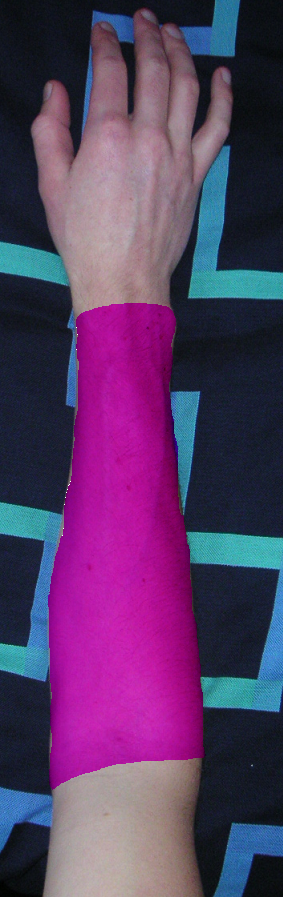
File:Forearm_labeled.png · Wikimedia Commons · See Wikimedia Commons
forearm
Sign in to saveAlso known as lower arm
The forearm is the region of the upper limb between the elbow and the wrist. The term forearm is used in anatomy to distinguish it from the arm, a word which is used to describe the entire appendage of the upper limb, but which in anatomy, technically, means only the region of the upper arm, whereas the lower "arm" is called the forearm. It is homologous to the region of the leg that lies between the knee and the ankle joints, the crus.
The forearm is the section of your upper limb that stretches between your elbow and wrist. It's an important anatomical term because it helps distinguish this specific region from the broader "arm," which in everyday language refers to your entire upper limb but in anatomy technically means only the upper arm above the elbow.
AI-generated from the Wikipedia summary — may contain errors.
Key facts
- Anatomy.Name
- Forearm
- Anatomy.Latin
- antebrachium
- Anatomy.Image
- Forearm labeled.png
- Anatomy.Caption
- The forearm is highlighted in magenta
- Anatomy.Width
- 150px
via Wikipedia infobox
Research
55,752 papers- Forearm Shortening Impact on Pronation and Supination.The journal of hand surgery Asian-Pacific volume · 2019Schnapp L, Colakoglu S, Couceiro J et al.DOI: 10.1142/S242483551950036X
- Biomechanics of the elbow and forearm.ReviewHand clinics · 1994Werner FW, An KN
- Return to Sport After Fasciotomy for Chronic Exertional Compartment Syndrome of the Forearm: A Systematic Review.The American journal of sports medicine · 2024Gawel RJ, Wang Y, Kemler BR et al.DOI: 10.1177/03635465231216368
- Forearm deformity in multiple hereditary exostosis. Radiologic predictors of radial head dislocation.Orthopaedics & traumatology, surgery & research : OTSR · 2023Bom F, Barbier O, Libouton X et al.DOI: 10.1016/j.otsr.2022.103445
- Bilateral symmetry assessment of healthy forearm kinematics using 4D-CT.Journal of biomechanics · 2024Oonk JGM, Dobbe JGG, van der Zeeuw FT et al.DOI: 10.1016/j.jbiomech.2024.112417
- Volumetry of Hand and Forearm: A 3D Volumetric Approach.Hand (New York, N.Y.) · 2024Oezel L, Latz D, Gehrmann SV et al.DOI: 10.1177/15589447221141492
- Forearm bone mineral density as a predictor of adjacent vertebral refracture after percutaneous kyphoplasty in patients with osteoporotic vertebral compression fracture: a retrospective analysis.Journal of orthopaedic surgery and research · 2024Wang J, Xie X, Gou Y et al.DOI: 10.1186/s13018-024-05258-x
- Added forearm weights for gait pattern normalization in patients with Parkinson's disease.Journal of clinical neuroscience : official journal of the Neurosurgical Society of Australasia · 2023Yu X, Wang HJ, Zhen QX et al.DOI: 10.1016/j.jocn.2023.05.025
via PubMed
Wikidata facts
- Part of
- free upper limb
- Image
- Human arm bones diagram.jpg
- Connects with
- upper arm
Show 6 more facts
- Commons category
- Forearms
- topic's main category
- Category:Forearm
- arterial supply
- brachial artery
- venous drainage
- brachial veins
- Commons gallery
- Forearm
- NCI Thesaurus ID
- C32628
Sources (7)
via Wikidata · CC0
~7 min read
Encyclopedic overview
13 sectionsContents
- Structure
- Bones and joints
- Radius
- Ulna
- Muscles
- Nerves
- Vessels
- Other structures
- Function
- Clinical significance
- Additional images
- See also
- References
The forearm is the region of the upper limb between the elbow and the wrist. The term forearm is used in anatomy to distinguish it from the arm, a word which is used to describe the entire appendage of the upper limb, but which in anatomy, technically, means only the region of the upper arm, whereas the lower "arm" is called the forearm. It is homologous to the region of the leg that lies between the knee and the ankle joints, the crus.
The forearm contains two long bones, the radius and the ulna, forming the two radioulnar joints. The interosseous membrane connects these bones. Ultimately, the forearm is covered by skin, the anterior surface usually being less hairy than the posterior surface.
Excerpted from Wikipedia’s “forearm” article, available under the CC BY-SA 4.0 licence.