File:Forearm_labeled.png · Wikimedia Commons · See Wikimedia Commons
antebraço
Sign in to saveAlso known as lower arm
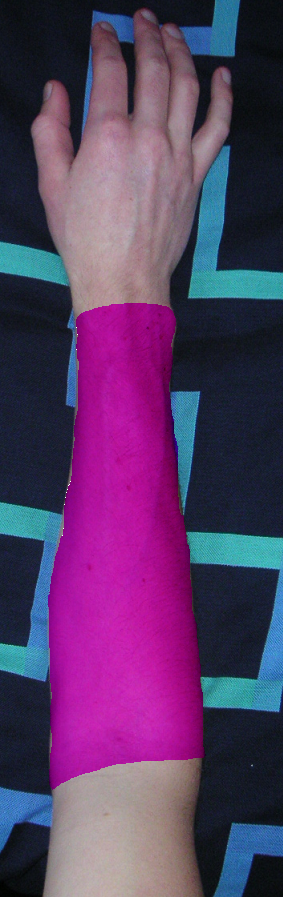
The forearm is the region of the upper limb between the elbow and the wrist. The term forearm is used in anatomy to distinguish it from the arm, a word which is used to describe the entire appendage of the upper limb, but which in anatomy, technically, means only the region of the upper arm, whereas the lower "arm" is called the forearm. It is homologous to the region of the leg that lies between the knee and the ankle joints, the crus.
The forearm is the section of your upper limb that stretches between your elbow and wrist. It's an important anatomical term because it helps distinguish this specific region from the broader "arm," which in everyday language refers to your entire upper limb but in anatomy technically means only the upper arm above the elbow.
AI-generated from the Wikipedia summary — may contain errors.
Key facts
- Anatomy.Name
- Forearm
- Anatomy.Latin
- antebrachium
- Anatomy.Image
- Forearm labeled.png
- Anatomy.Caption
- The forearm is highlighted in magenta
- Anatomy.Width
- 150px
via Wikipedia infobox
Research
55,752 papers- Forearm Shortening Impact on Pronation and Supination.The journal of hand surgery Asian-Pacific volume · 2019Schnapp L, Colakoglu S, Couceiro J et al.DOI: 10.1142/S242483551950036X
- Biomechanics of the elbow and forearm.ReviewHand clinics · 1994Werner FW, An KN
- Return to Sport After Fasciotomy for Chronic Exertional Compartment Syndrome of the Forearm: A Systematic Review.The American journal of sports medicine · 2024Gawel RJ, Wang Y, Kemler BR et al.DOI: 10.1177/03635465231216368
- Forearm deformity in multiple hereditary exostosis. Radiologic predictors of radial head dislocation.Orthopaedics & traumatology, surgery & research : OTSR · 2023Bom F, Barbier O, Libouton X et al.DOI: 10.1016/j.otsr.2022.103445
- Bilateral symmetry assessment of healthy forearm kinematics using 4D-CT.Journal of biomechanics · 2024Oonk JGM, Dobbe JGG, van der Zeeuw FT et al.DOI: 10.1016/j.jbiomech.2024.112417
- Volumetry of Hand and Forearm: A 3D Volumetric Approach.Hand (New York, N.Y.) · 2024Oezel L, Latz D, Gehrmann SV et al.DOI: 10.1177/15589447221141492
- Forearm bone mineral density as a predictor of adjacent vertebral refracture after percutaneous kyphoplasty in patients with osteoporotic vertebral compression fracture: a retrospective analysis.Journal of orthopaedic surgery and research · 2024Wang J, Xie X, Gou Y et al.DOI: 10.1186/s13018-024-05258-x
- Added forearm weights for gait pattern normalization in patients with Parkinson's disease.Journal of clinical neuroscience : official journal of the Neurosurgical Society of Australasia · 2023Yu X, Wang HJ, Zhen QX et al.DOI: 10.1016/j.jocn.2023.05.025
via PubMed
Wikidata facts
- Part of
- free upper limb
- Image
- Human arm bones diagram.jpg
- Connects with
- upper arm
Show 6 more facts
- Commons category
- Forearms
- topic's main category
- Category:Forearm
- arterial supply
- brachial artery
- venous drainage
- brachial veins
- Commons gallery
- Forearm
- NCI Thesaurus ID
- C32628
Sources (7)
via Wikidata · CC0
Article · Português
Em anatomia, chama-se antebraço à parte da extremidade superior ou membro superior do ser humano situada entre o cotovelo e o carpo (ou punho). O antebraço é formado pelos ossos cúbito (ou ulna) e rádio, ligados por uma membrana interóssea. Para além de se articular com o cotovelo, o antebraço tem dois movimentos próprios, a pronação e a supinação e, por essa razão, tem músculos específicos para esses movimentos, para além de albergar os músculos e dos dedos. O movimento em relação ao cotovelo é realizado pelo músculo braquiorradial. Em secção transversal, o antebraço encontra-se dividido em dois : o compartimento posterior contém os extensores das mãos, que são comandados pelo nervo radial; o compartimento anterior contém os flexores, comandados pelo nervo mediano. As artérias radial e ulnar e as suas ramificações fornecem o sangue ao antebraço e normalmente encontram-se na face anterior do rádio e da ulna, ao longo de todo o membro. As principais veias superficiais do antebraço são a veia cefálica, a a basílica. Estas veias são muitas vezes usadas para a ou , embora a fossa cubital seja o lugar preferido para a extração de sangue.
Abstract from DBpedia / Wikipedia · CC BY-SA