Described at
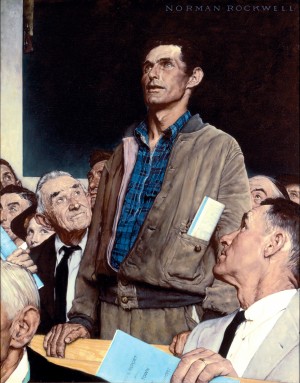
Collections: Four Freedoms - Norman Rockwell Museum - The Home for American Illustration
Rockwell's vivid interpretations of Roosevelt's Four Freedoms, used for the most successful war bond drive in US history., Norman Rockwell's Four Freedoms Norman Rockwell (1894-1978), "Freedom of Speech," 1943. Illustration for "The Saturday Evening Post", February 20, 1943. From the collection of Norman Rockwell Museum. © 1943 SEPS: Licensed by Curtis Licensing, Indianapolis, IN. All rights reserved. In his January 1941
nrm.org →In his January 1941 address to Congress, President Franklin Delano Roosevelt articulated his vision for a postwar world founded on four basic human freedoms: freedom of speech, freedom of worship, freedom from want, and freedom from fear. In the spring of 1942, Norman Rockwell was working on a piece commissioned by the Ordnance Department of the U.S. Army, a painting of a machine gunner in need of ammunition. Posters of the gunner, titled Let’s Give Him Enough and On Time , were distributed to ordnance plants throughout the country to encourage production. But Rockwell wanted to do more for the war effort and decided he would illustrate Roosevelt’s four freedoms. Finding new ideas for paintings never came easily, but this was a greater challenge. “It was so darned high-blown,” Rockwell said, “Somehow I just couldn’t get my mind around it.” While mulling it over, Rockwell, by chance, attended a town meeting where one man rose among his neighbors and voiced an unpopular view. That night Rockwell awoke with the realization that he could paint the freedoms best from the perspective of his own hometown experiences using everyday, simple scenes such as his own town meeting. Rockwell made some rough sketches and, accompanied by fellow Post cover artist Mead Schaeffer, went to Washington to propose his poster idea. The timing was wrong. The Ordnance Department didn’t have the resources for another commission. On his way back to Vermont, Rockwell stopped at Curtis Publishing Company, publisher of The Saturday Evening Post , and showed his sketches to editor Ben Hibbs. Hibbs immediately made plans to use the illustrations in the Post . Rockwell was given permission to interrupt his work for the magazine—typically one cover per month—for three months. But Rockwell “got a bad case of stage fright,” and it was two and a half months before he even began the project. “It was a job that should have been tackled by Michelangelo,” he said in a New Yorker interview three years later. The paintings were a phenomenal success. After their publication, the Post received 25,000 requests for reprints. In May 1943, representatives from the Post and the U.S. Department of the Treasury announced a joint campaign to sell war bonds and stamps. They would send the Four Freedoms paintings along with 1,000 original cartoons and paintings by other illustrators and original manuscripts from The Saturday Evening Post on a national tour. The Four Freedoms are now part of the permanent collection of Norman Rockwell Museum and reside in their own specially designed gallery space, inviting visitors to reflect on their inspiring message. This series of Town Hall conversations inspired by Norman Rockwell’s Four Freedoms paintings will explore aspects of our democracy in a rapidly changing and increasingly global world. Noted commentators will offer observations and inspire community discourse, with a reception to follow.
Article · 中文
《免于匮乏的自由》(英語:Freedom from Want)又名《感恩节图画》(The Thanksgiving Picture)或《我会回家过圣诞》(I'll Be Home for Christmas),是美国画家诺曼·洛克威尔《四大自由》系列油画的第三幅。这四幅油画代表的理念都源自第32任美国总统富兰克林·德拉诺·罗斯福1941年1月6日国情咨文中的四大自由。 画作于1942年11月创作完成,1943年3月6日经《星期六晚邮报》首发。画中所有人物都是洛克威尔在佛蒙特州本宁顿县的亲朋好友,画家先单独拍下每个人的照片,再把他们绘入油画,画作内容是许多人围在餐桌前享用节日大餐。《免于匮乏的自由》有相当一部分就是在感恩节当天创作,描绘庆祝节日的喜庆场景,之后画作不但成为庆祝感恩节假期的标志画面,也成为其他家庭节日聚会的标志。同《四大自由》的另外三幅作品一样,《免于匮乏的自由》也是作为文章插图在《星期六晚邮报》刊登,文章作者是菲律宾移民卡洛斯·卜娄杉,他以美国国内长期存在的社会经济困境为切入点,而不是像当时许多人那样畅谈其他国家的社会政治困境,这种思路为他打响名气。 洛克威尔的这幅画广为流传,之后还成为戏仿和恶搞的对象,在各类媒体上反复亮相,还是1946年出版书籍《插画家诺曼·洛克威尔》的封面。虽然画作在美国一直很得民心,但在经历二战创伤的欧洲却激起反感。从艺术角度而言,画作对白上加白的应用成为艺术评鉴焦点,是洛克威尔最富盛名的作品之一。
Abstract from DBpedia / Wikipedia · CC BY-SA