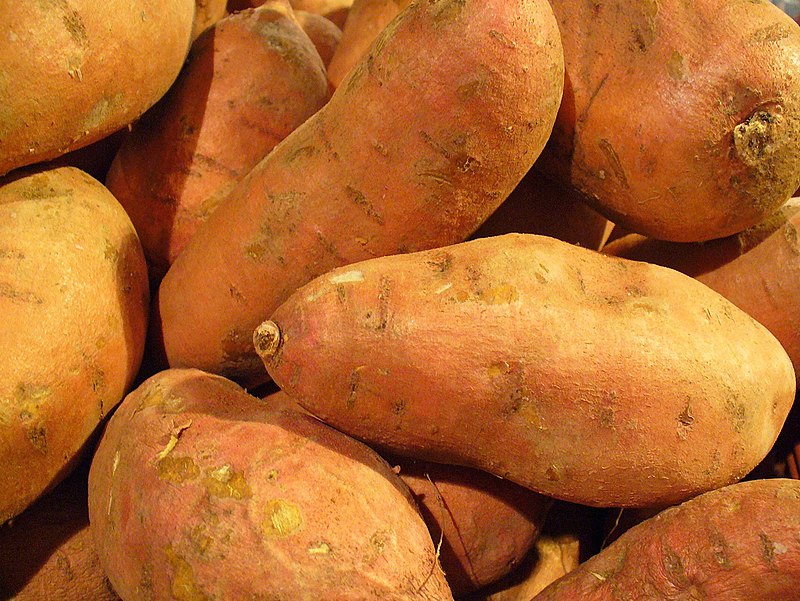
File:Ipomoea_batatas_006.JPG · Wikimedia Commons · See Wikimedia Commons
OverviewAI-generated
Ipomoea batatas, commonly known as sweet potato, is a species within the genus Ipomoea. It belongs to the family Convolvulaceae and is classified as an annual plant and a useful plant. The organism is widely cultivated for its edible root tubers. Its taxon range includes Beijing, China, the Tibet Autonomous Region, and Guangdong.
The sweet potato serves as a vegetable, fodder, and medicinal plant. It provides 86 units of food energy. The International Union for Conservation of Nature lists its conservation status as Data Deficient, a designation recorded in 2019. The species was described by L. Lam. and has been referenced by 2,047 other encyclopedia articles.
Synthesized by Vinony from 29 facts across 5 sources: Wikidata, PubMed, IUCN Red List, Plants of the World, Vinony graph. Generated from structured data (not the Wikipedia text) and checked against those facts — may still contain errors.
Species
Data Deficient「番薯」重定向至此。關於与此名称相似的其他条目,詳見「番薯 (消歧义)」。 番薯(学名:Ipomoea batatas),又名地瓜、甘薯、红薯、白薯,为旋花科番薯属的一种,是常见的多年生双子叶植物,草本,其蔓细长,茎匍匐地面。也指其块根。块根无氧呼吸产生乳酸,皮色发白或发红,肉大多为黄白色,但也有紫色,除供食用外,还可以製糖和釀酒、製酒精。 目录 1 历史 2 植物学 3 種植方法 3.1 明朝 3.2 今時臺灣 4 食用方法 5 營養 6 谚语及逸事 6.1 中國大陆 6.2 臺湾 6.3 日本 7 参见 8 参考文献 9 外部連結 历史 番薯原生長于美洲的热带地区,最先由印第安人人工種植成功,抗病蟲害強,對土壤質素要求較低,栽培容易。 1493年,哥倫布初見西班牙女王伊莎貝拉時,曾將由美洲新大陸帶回的甘藷獻給女王,西班牙水手又將番薯傳至殖民地呂宋(今菲律宾)。 16世纪初,西班牙已普遍种植甘薯。西班牙水手把甘薯携带至菲律宾和摩鹿加群島,再传至亚洲各地。甘薯传入中国通过多条渠道,时间约在16世纪末叶,明代的《闽书》、《农政全书》、清代的《闽政全书》、《福州府志》等均有有关记载。 1563年(明朝嘉靖四十二年)之前,中國雲南已經引種甘薯。李元陽《大理府志》(嘉靖1563年)卷二,列舉“薯蕷”之屬五:“山藥、山薯、紫蕷、白蕷、紅蕷。”[1]這其中就提到紫薯(紫蕷)。11年後李元陽在他主撰的萬曆1574年版的《雲南通志》裡更紀錄全省9個府和州已經有別於“山藥、山薯”的各種顏色的“蕷”的種植。可見甘薯由印緬入滇應較由海路入閩,以及較由陸路從安南入廣東,要早至少二三十年。 1582年(明朝萬曆十年),東莞人陳益從安南首先引入廣東[2]。 1593年5月(万历二十一年),《金薯传习录》记述:明朝万历二十一年5月下旬,福建长乐县华侨陈振龙冒着生命危险将红薯从吕宋带回中国,试种后,“甫及四月,启土开掘,子母钩连,大者如臂,小者如拳”,時值福建饑荒,福建巡抚金學曾大力推广,并撰《海外新传七则》。[3][4] 1596年(萬曆二十三年)李时珍在正式刊行的《本草纲目》中記載:「南人用當米穀果餐,蒸炙皆香美……,海中之人多壽,亦由不食五穀而食甘藷故也。」中医学认为甘薯補虛乏、益氣力、健脾胃、強腎陰[5]。 1608年(萬曆三十六年),徐光啟上《甘薯疏》,後來在《農政全書》其中的〈卷二十七·樹藝〉詳細記述了番薯的種植、貯藏、加工法,並提到番薯育苗越冬、剪莖分種、扦插、窖藏干藏等技術,可知先民於引進番薯不到廿年已經總結出種植的方法,完成本地馴種。 1995年美国生物学家瑟施瓦茨教授發現,番薯中含有一種化學物質叫脫氫表雄酮(DHEA),可以用於預防心血管疾病、糖尿病、結腸癌和乳腺癌[來源請求]。 當前,世界各地都广泛栽种番薯。 植物学 染色体为六倍体。多倍体基因组学揭示:在甘薯的90条
via IUCN · Kew POWO
Research
4,474 papers- Sweet potato study in China: Stress response mechanisms, molecular breeding, and productivity.Journal of plant physiology · 2020Liu Y, Chen Q, Zhou M et al.DOI: 10.1016/j.jplph.2020.153283
- Sweet potato (Ipomoea batatas [L.] Lam)--a valuable medicinal food: a review.ReviewJournal of medicinal food · 2014Mohanraj R, Sivasankar SDOI: 10.1089/jmf.2013.2818
- Engineering Properties of Sweet Potato Starch for Industrial Applications by Biotechnological Techniques including Genome Editing.ReviewInternational journal of molecular sciences · 2021Lyu R, Ahmed S, Fan W et al.DOI: 10.3390/ijms22179533
- Sweet potato: a review of its past, present, and future role in human nutrition.ReviewAdvances in food and nutrition research · 2007Bovell-Benjamin ACDOI: 10.1016/S1043-4526(06)52001-7
- Potential impacts of bioprocessing of sweet potato: Review.ReviewCritical reviews in food science and nutrition · 2017El Sheikha AF, Ray RCDOI: 10.1080/10408398.2014.960909
- Advances in valorization of sweet potato peels: A comprehensive review on the nutritional compositions, phytochemical profiles, nutraceutical properties, and potential industrial applications.ReviewComprehensive reviews in food science and food safety · 2024Jiang H, Wang F, Ma R et al.DOI: 10.1111/1541-4337.13400
- Enhancing sweet potato production: a comprehensive analysis of the role of auxins and cytokinins in micropropagation.ReviewPlanta · 2025Adu Donyina G, Szarvas A, Opoku VA et al.DOI: 10.1007/s00425-025-04650-z
- Research Progress in the Mechanisms of Resistance to Biotic Stress in Sweet Potato.ReviewGenes · 2023Yang Y, Chen Y, Bo Y et al.DOI: 10.3390/genes14112106
via PubMed
Wikidata facts
- Instance of
- taxon
- Subclass of
- vegetable
- Parent taxon
- Ipomoea
- Image
- Ipomoea batatas (Sweet Potato) Flower.jpg
- Has use
- vegetable
Show 15 more facts
- Unicode character
- 🍠
- Commons category
- Ipomoea batatas
- taxon rank
- species
- taxon name
- Ipomoea batatas
- Commons gallery
- Ipomoea batatas
- taxon common name
- 番薯(甘薯)
- IUCN conservation status
- Data Deficient
- taxon range
- Gabon
- on focus list of Wikimedia project
- Wikipedia:Vital articles/Level/4
- short name
- I. batatas
- taxon author citation
- L. Lam.
- food energy
- 86
- hashtag
- sweet_potato
- external data available at URL
- www.gbif.org/dataset/31dc1507-a6e1-4233-a8df-c7a78596a7e4
Sources (8)
via Wikidata · CC0
~36 min read
Encyclopedic overview
The sweet potato or sweetpotato (Ipomoea batatas) is a dicotyledonous plant in the morning glory family, Convolvulaceae. Its sizeable, starchy, sweet-tasting tuberous roots are used as a root vegetable, which is a staple food in parts of the world. Cultivars of the sweet potato have been bred to bear tubers with flesh and skin of various colors. Moreover, the young shoots and leaves are occasionally eaten as greens. The sweet potato and the potato are only distantly related, both being in the order Solanales. Although darker sweet potatoes are often known as yams in parts of North America, they are even more distant from actual yams, which are monocots in the order Dioscoreales.
The sweet potato is native to the tropical regions of South America in modern Ecuador. Of the approximately 50 genera and more than 1,000 species of Convolvulaceae, I. batatas is the only crop plant of major importance—some others are used locally (e.g., I. aquatica 'kangkong' as a green vegetable), but many are poisonous. The genus Ipomoea that contains the sweet potato also includes several garden flowers called morning glories, but that term is not usually extended to I. batatas. Some cultivars of I. batatas are grown as ornamental plants under the name tuberous morning glory and sometimes used in a horticultural context. Sweet potatoes can also be called yams in North America.
Excerpted from Wikipedia’s “sweet potato” article, available under the CC BY-SA 4.0 licence.
Gallery (15)
Available in 147 languages
- Español
- Français
- Deutsch
- 中文
- 日本語
- Русский
- Português
- Italiano
- العربية
- हिन्दी
- Afrikaans
- Albanian
- Amharic
- ami
- Aragonese
- Armenian
- Asturian
- Aymara
Show 128 more
- azb
- Azerbaijani
- Bahasa Indonesia
- Balinese
- Bangla
- Banjar
- Basque
- Belarusian
- Bikol
- Bosnian
- Bulgarian
- Catalan
- cdo
- Cebuano
- Central Dusun
- Central Kurdish
- Croatian
- Czech
- dag
- Danish
- Egyptian Arabic
- Esperanto
- Estonian
- Fijian
- Filipino
- Finnish
- Galician
- Gan Chinese
- Ganda
- Georgian
- Greek
- Guarani
- Gujarati
- Haitian Creole
- Hakka Chinese
- Hausa
- Hawaiian
- Hebrew
- Hungarian
- Icelandic
- Ido
- Iloko
- Irish
- Javanese
- Kannada
- Kanuri
- Kazakh
- kge
- Kikuyu
- kus
- Kyrgyz
- Latin
- Latvian
- Lingala
- Lithuanian
- Macedonian
- Madurese
- Maithili
- Malagasy
- Malay
- Malayalam
- Māori
- Marathi
- Minangkabau
- Mingrelian
- nah
- Nederlands
- Nepali
- Nias
- Northern Sotho
- Norwegian
- Norwegian Nynorsk
- nup
- Old English
- Ossetic
- Pampanga
- Polski
- Punjabi
- pwn
- Quechua
- Romanian
- Samoan
- Sango
- Sanskrit
- Santali
- Scots
- Serbian
- Serbian (Latin)
- Shona
- simple
- Sindhi
- Sinhala
- Slovak
- Slovenian
- Somali
- Sundanese
- Svenska
- Swahili
- szy
- Tahitian
- Tajik
- Tamil
- tay
- Telugu
- Tibetan
- Tiếng Việt
- Tok Pisin
- Tongan
- Tulu
- Türkçe
- Tuvinian
- Tyap
- Ukrainian
- Upper Sorbian
- Urdu
- Uyghur
- Uzbek
- Waray
- Wayuu
- Western Panjabi
- Wu Chinese
- Yiddish
- zh_min_nan
- zh_yue
- Zhuang
- فارسی
- ไทย
- 한국어
via Wikidata sitelinks · CC0