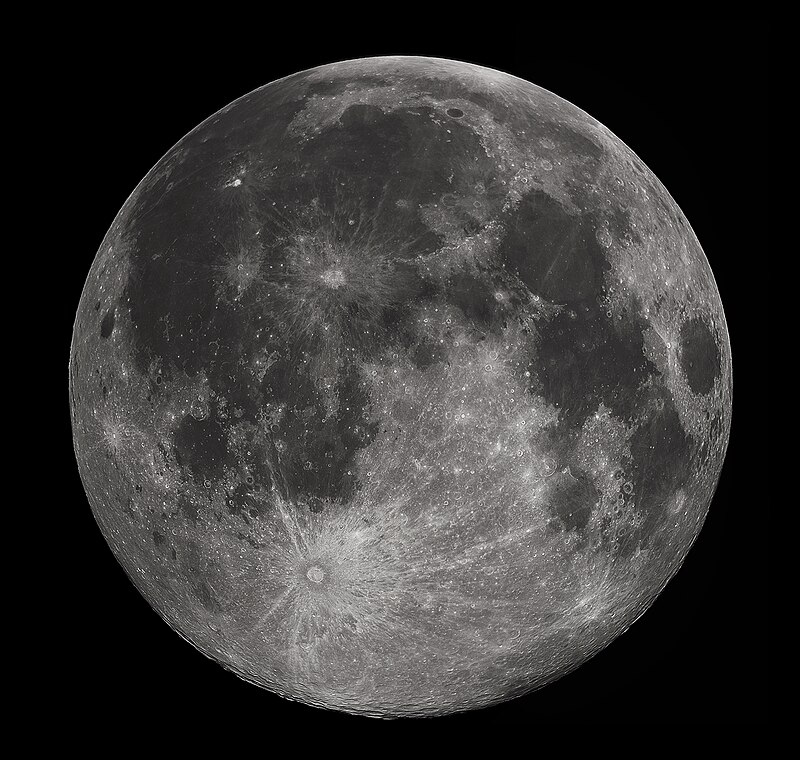
File:FullMoon2010.jpg · Wikimedia Commons · See Wikimedia Commons
AI overview
A full moon is when the entire face of the moon that we can see from Earth is lit up by the sun, appearing as a complete bright circle in the sky. It occurs once every lunar month and has been important to humans throughout history for timekeeping, cultural practices, and navigation.
AI-generated from the Wikipedia summary — may contain errors.
Wikidata facts
- Instance of
- phase of the moon
- Subclass of
- planetary phase
- Image
- Phase-180.jpg
- Said to be same as
- Purnima
Show 4 more facts
- Unicode character
- 🌝
- Commons category
- Full moon
- topic's main category
- Category:Full moon
- opposite of
- new moon
via Wikidata · CC0
Gallery (7)
Available in 89 languages
- Español
- Français
- Deutsch
- 中文
- 日本語
- Русский
- Português
- Italiano
- العربية
- हिन्दी
- Afrikaans
- Albanian
- Armenian
- Asturian
- azb
- Azerbaijani
- Bahasa Indonesia
- Balinese
Show 70 more
- Bangla
- Belarusian
- Betawi
- Bulgarian
- Burmese
- Catalan
- Central Kurdish
- Chuvash
- Colognian
- Czech
- dag
- Danish
- Esperanto
- Estonian
- Finnish
- fiu_vro
- Galician
- Georgian
- Greek
- Haitian Creole
- Irish
- Kashubian
- Kurdish
- Latin
- Latvian
- Lithuanian
- Low German
- Luxembourgish
- Malagasy
- Malay
- Malayalam
- Manipuri
- Nederlands
- Norwegian
- Occitan
- Polski
- Punjabi
- Quechua
- Romanian
- Santali
- Serbian
- Shona
- Sinhala
- Slovak
- Slovenian
- Standard Moroccan Tamazight
- Sundanese
- Svenska
- Swahili
- Tajik
- Tamil
- Telugu
- Tiếng Việt
- Türkçe
- Ukrainian
- Urdu
- Uzbek
- Veps
- Walloon
- Waray
- Welsh
- Western Frisian
- Western Panjabi
- Wu Chinese
- zh_min_nan
- zh_yue
- Zhuang
- فارسی
- ไทย
- 한국어
via Wikidata sitelinks · CC0