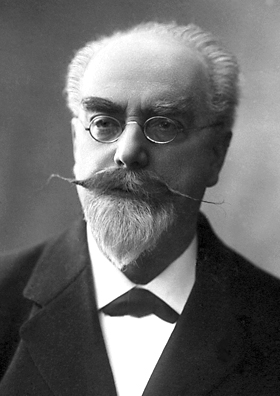
File:Gabriel_Lippmann2.jpg · Wikimedia Commons · See Wikimedia Commons
Gabriel Lippmann
Sign in to saveAlso known as Gabriel J. F. Lippmann, M. Lippmann, Joseph Ferdinand Gabriel Lippmann, Jonas Ferdinand Gabriel Lippmann
Luxembourgish physicist nationalized French (1845-1921)
OverviewAI-generated
Gabriel Lippmann was a male figure associated with the United States. He was born on August 16, 1845, and died on July 13, 1921. His recorded works include "Untersuchungen uber den Sauregrad des Mageninhaltes bei Anwendung verschiedener Indikatoren" and "Unités électriques absolues."
Lippmann received one Nobel Prize. He is recognized in the Nobel Physics collection, the Nobel Laureates collection, and the Royal Society collection.
Synthesized by Vinony from 20 facts across 7 sources: Wikidata, Crossref, MusicBrainz, Open Library, Nobel Prize, Vinony collections, Vinony graph. Generated from structured data (not the Wikipedia text) and checked against those facts — may still contain errors.
Nobel Prize
- The Nobel Prize in Physics1908
“for his method of reproducing colours photographically based on the phenomenon of interference”
Wikidata facts
- Instance of
- human
- Given name
- Gabriel
- Gender
- male
- Citizenship
- Luxembourg
- Place of birth
- Bonnevoie
- Place of death
- Atlantic Ocean
- Occupation
- professor
- Educated at
- University of Paris
- Employer
- University of Paris
- Languages spoken
- French
- Doctoral advisor
- Hermann von Helmholtz
- Student of
- Joseph-Charles d'Almeida
- Field of work
- photography
- Image
- Gabriel Lippmann2.jpg
- Residence
- France
Show 11 more facts
- member of
- Accademia Nazionale dei Lincei
- Commons category
- Gabriel Lippmann
- date of birth
- 1845-08-16
- date of death
- 1921-07-13
- nominated for
- Nobel Prize in Physics
- name in native language
- Gabriel Lippmann
- has works in the collection
- Société française de photographie
- maintained by WikiProject
- WikiProject Mathematics
- place of burial
- Cimetière Notre-Dame
- interested in
- physics
- Commons Creator page
- Gabriel Lippmann
Sources (8)
via Wikidata · CC0
~13 min read
Encyclopedic overview
Gabriel Lippmann (/ˈlɪpmən/ LIP-muhn; French: [ɡabʁijɛl lipman]; 16 August 1845 – 12 July 1921) was a French applied physicist who received the Nobel Prize in Physics in 1908 for his invention of the Lippmann plate, a method of photographically reproducing colours based on the interference phenomenon.
Biography
Excerpted from Wikipedia’s “Gabriel Lippmann” article, available under the CC BY-SA 4.0 licence.
Gallery (6)
Available in 90 languages
- Español
- Français
- Deutsch
- 中文
- 日本語
- Русский
- Português
- Italiano
- العربية
- हिन्दी
- Afrikaans
- Aragonese
- Armenian
- Assamese
- azb
- Azerbaijani
- Bahasa Indonesia
- Bangla
Show 71 more
- Basque
- be_x_old
- Belarusian
- Bosnian
- Bulgarian
- Catalan
- Central Kurdish
- Croatian
- Czech
- Danish
- Egyptian Arabic
- Esperanto
- Estonian
- Filipino
- Finnish
- Galician
- Georgian
- Greek
- Haitian Creole
- Hakka Chinese
- Hebrew
- Hungarian
- Ido
- Iloko
- Javanese
- Kannada
- Kazakh
- Kurdish
- Latin
- Latvian
- Lithuanian
- Luxembourgish
- Macedonian
- Malagasy
- Malay
- Malayalam
- Marathi
- Mazanderani
- Mingrelian
- Nederlands
- Newari
- Norwegian
- Norwegian Nynorsk
- Occitan
- Piedmontese
- Polski
- Romanian
- Sanskrit
- Scots
- Serbian
- simple
- skr
- Slovak
- Slovenian
- Svenska
- Swahili
- Tamil
- Tatar
- Tiếng Việt
- Türkçe
- Ukrainian
- Urdu
- Uzbek
- Waray
- Western Panjabi
- Wu Chinese
- Yoruba
- zh_min_nan
- فارسی
- ไทย
- 한국어
via Wikidata sitelinks · CC0