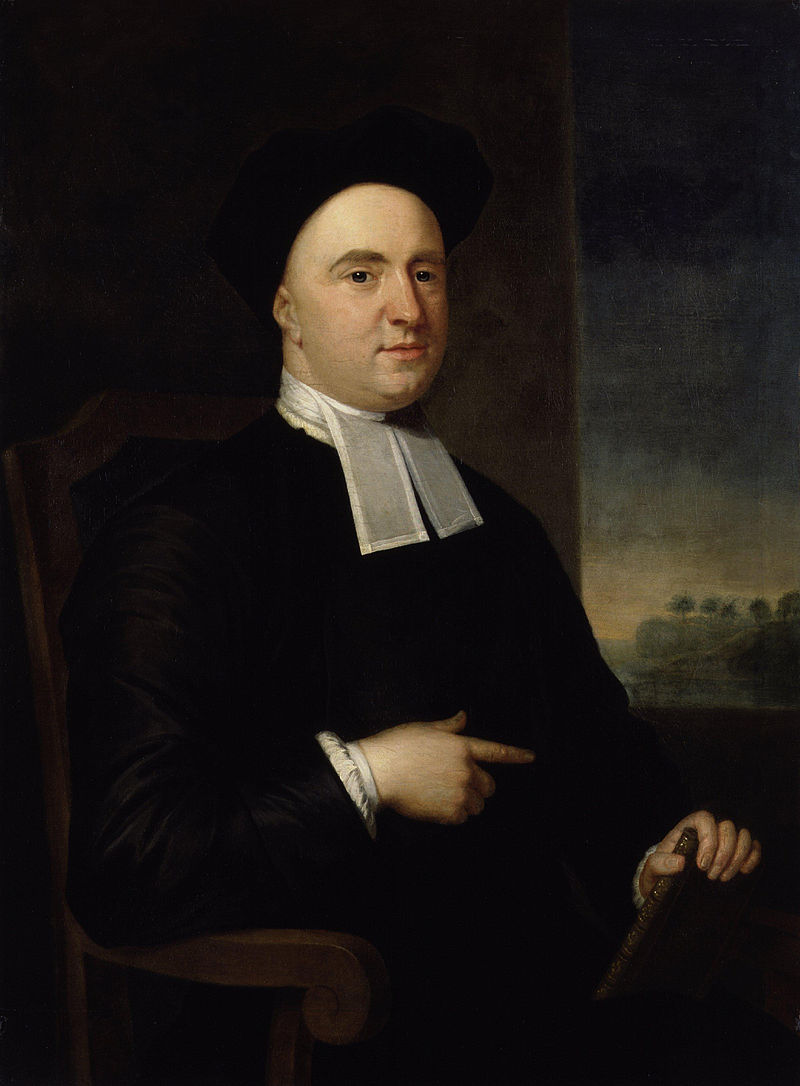
File:George_Berkeley_by_John_Smibert.jpg · Wikimedia Commons · See Wikimedia Commons
George Berkeley
Sign in to saveAlso known as Bishop Berkeley, Bishop George Berkeley
Irish idealist philosopher and Anglican bishop (1685–1753)
George Berkeley was an Irish philosopher and Anglican bishop who lived from 1685 to 1753 and developed a major philosophical position called idealism, which holds that reality consists of minds and their ideas rather than physical matter. His work fundamentally challenged how people think about the nature of existence and perception, making him one of the most influential thinkers in Western philosophy.
AI-generated from the Wikipedia summary — may contain errors.
Wikidata facts
- Instance of
- human
- Given name
- George
- Gender
- male
- Citizenship
- Kingdom of Ireland
- Place of death
- Oxford
- Occupation
- Christian minister
- Languages spoken
- English language
- Religion
- Episcopal Church
- Field of work
- theology
- Movement
- Immaterialism
- Image
- George Berkeley by John Smibert.jpg
Show 11 more facts
- date of death
- 1753-01-01
- place of burial
- Christ Church Cathedral, Oxford
- Commons category
- George Berkeley
- date of birth
- 1684-01-01
- topic's main category
- Category:George Berkeley
- influenced by
- Nicolas Malebranche
- name in native language
- George Berkeley
- writing language
- English language
- different from
- George Berkeley
- Commons Creator page
- George Berkeley
- maintained by WikiProject
- WikiProject Mathematics
Sources (9)
via Wikidata · CC0
Works in European collections
11 objects attributed to George Berkeley, held across European museums, libraries & archives · via Europeana
Siris a chain of philosophical reflexions and inquiries concerning the virtues of tar water ..
Recherches sur les vertus de l'eau de goudron où l'on a joint des reflexions philosophiques sur divers autres sujets importants
Recherches sur les vertus de l'eau de goudron où l'on a joint des reflexions philosophiques sur divers autres sujets importants
Untitled
Untitled
Untitled
Untitled
Untitled
Untitled

Untitled

Untitled
~40 min read
Encyclopedic overview
George Berkeley (/ˈbɑːrkli/ BARK-lee; 12 March 1685 – 14 January 1753), known as Bishop Berkeley (Bishop of Cloyne of the Anglican Church of Ireland), was an Anglo-Irish philosopher, writer, and clergyman who is regarded as the founder of immaterialism, a philosophical theory he developed which later came to be known as subjective idealism. He has also been called "the father of idealism" by German philosopher Arthur Schopenhauer. Berkeley played a leading role in the empiricism movement and was one of its pioneers. He was among the most cited philosophers of 18th-century Europe, and his works deeply influenced later thinkers such as Immanuel Kant and David Hume.
In 1709, Berkeley published his first major work An Essay Towards a New Theory of Vision, in which he discussed the limitations of human vision and advanced the theory that the proper objects of sight are not material objects, but light and colour. This foreshadowed his most well-known philosophical work A Treatise Concerning the Principles of Human Knowledge, published in 1710, which, after its poor reception, he rewrote in dialogue form and published under the title Three Dialogues Between Hylas and Philonous in 1713. In this book, Berkeley's views were represented by Philonous (Greek: "lover of mind"), while Hylas ("hyle", Greek: "matter") embodies Berkeley's opponents, in particular John Locke.
Excerpted from Wikipedia’s “George Berkeley” article, available under the CC BY-SA 4.0 licence.
Gallery (5)
Available in 88 languages
- Español
- Français
- Deutsch
- 中文
- 日本語
- Русский
- Português
- Italiano
- العربية
- हिन्दी
- Afrikaans
- Albanian
- Armenian
- Asturian
- Azerbaijani
- Bahasa Indonesia
- Bangla
- Basque
Show 69 more
- Belarusian
- Bosnian
- Bulgarian
- Catalan
- Central Kurdish
- Chuvash
- Cornish
- Croatian
- Czech
- Danish
- Egyptian Arabic
- Esperanto
- Estonian
- Finnish
- Galician
- Georgian
- Greek
- Hebrew
- Hungarian
- Icelandic
- Irish
- Kazakh
- Kurdish
- Kyrgyz
- Latin
- Latvian
- Lingua Franca Nova
- Lithuanian
- Lombard
- Macedonian
- Malagasy
- Malayalam
- Nederlands
- Newari
- Norwegian
- Norwegian Nynorsk
- Occitan
- Papiamento
- Pashto
- Piedmontese
- Polski
- Punjabi
- Romanian
- Scots
- Serbian
- Serbian (Latin)
- simple
- Sindhi
- Slovak
- Slovenian
- Svenska
- Swahili
- Tajik
- Tamil
- Tatar
- Tiếng Việt
- Türkçe
- Ukrainian
- Uzbek
- Volapük
- Waray
- Welsh
- Western Panjabi
- Wu Chinese
- Yoruba
- zh_yue
- فارسی
- ไทย
- 한국어
via Wikidata sitelinks · CC0