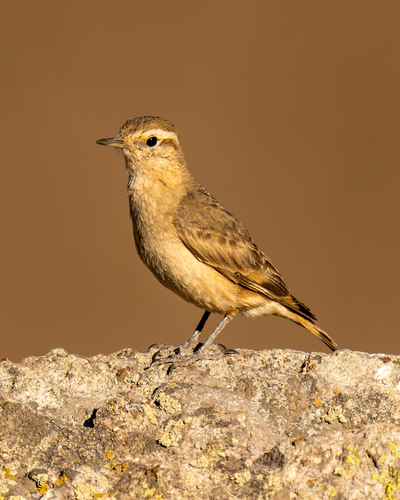
(c) Juan Rodolfo Lillo Lobos, some rights reserved (CC BY-NC), uploaded by Juan Rodolfo Lillo Lobos · cc-by-nc
Geositta
Sign in to saveGeositta is a genus of passerine birds in the ovenbird family, Furnariidae. They are known as miners (not to be confused with the unrelated miners, Manorina, of Australia) due to the tunnels they dig for nesting. There are 11 species including the campo miner (Geositta poeciloptera) which was formerly classified in a genus of its own, Geobates. They inhabit open country in South America, particularly the Andean and Patagonian regions. They are ground-dwelling birds, somewhat resembling the larks and wheatears of other continents. They are mostly drab brown in coloration and often have a fairly
Species
Rufous-banded Miner
GENUS
- KingdomAnimalia
- PhylumChordata
- ClassAves
- OrderPasseriformes
- FamilyFurnariidae
Царство: Животные Подцарство: Эуметазои Без ранга: Двусторонне-симметричные Без ранга: Вторичноротые Тип: Хордовые Подтип: Позвоночные Инфратип: Челюстноротые Надкласс: Четвероногие Класс: Птицы Подкласс: Настоящие птицы Инфракласс: Новонёбные Отряд: Воробьинообразные Подотряд: Кричащие воробьиные Семейство: Печниковые Род: Печники-землекопы Международное научное название Geositta (Swainson, 1837) Синонимы Geobates Swainson, 1838[1] Систематикана ВикивидахИзображенияна Викискладе ITIS 557699NCBI 265633EOL 34632 Печники-землекопы, минеры, пещерные поползни (лат. Geositta) — род воробьиных птиц из семейства печниковые. Виды Geositta antarctica Landbeck, 1880 — Короткоклювый печник-землекоп Geositta crassirostris P. L. Sclater, 1866 — Толстоклювый печник-землекоп Geositta cunicularia (Vieillot, 1816) — Кроличий печник-землекоп Geositta isabellina (Philippi et Landbeck, 1864) — Светлопоясничный печник-землекоп Geositta maritima (Orbigny et Lafresnaye, 1837) — Серый печник-землекоп Geositta peruviana Lafresnaye, 1847 — Береговой печник-землекоп Geositta poeciloptera (Wied-Neuwied, 1830) — Бразильский печник-землекоп Geositta punensis Dabbene, 1917 — Пунский печник-землекоп Geositta rufi
via GBIF
Museum specimens
- Specimen records
- 14
- Family
- Furnariidae
- Collections
- USNM, ROM, WFVZ, UMZC, NHMUK
- Recorded in
- Argentina, Ecuador, Brazil, Bolivia
Wikidata facts
- Instance of
- taxon
- Parent taxon
- Furnariidae
- Image
- Slender-billed Miner (Geositta tenuirostris) from side.jpg
Show 5 more facts
- Commons category
- Geositta
- taxon rank
- genus
- topic's main category
- Category:Geositta
- taxon name
- Geositta
- Commons gallery
- Geositta
Sources (1)
via Wikidata · CC0
~3 min read
Encyclopedic overview
3 sectionsContents
- Taxonomy
- Species list
- References
Geositta is a genus of passerine birds in the ovenbird family, Furnariidae. They are known as miners (not to be confused with the unrelated miners, Manorina, of Australia) due to the tunnels they dig for nesting. There are 11 species including the campo miner (Geositta poeciloptera) which was formerly classified in a genus of its own, Geobates. They inhabit open country in South America, particularly the Andean and Patagonian regions. They are ground-dwelling birds, somewhat resembling the larks and wheatears of other continents. They are mostly drab brown in coloration and often have a fairly long and slender bill.
==Taxonomy== The genus Geositta was introduced in 1837 by the English naturalist William Swainson to accommodate a single species, Geositta anthoides which is therefore the type species by monotypy. Swainson formally described the type species in the following year in his Animals in Menageries. The name Geositta anthoides is considered as a junior synonym of Alauda fissirostris which had been described in 1835 by the German naturalist Heinrich von Kittlitz. The taxon is now treated as a subspecies of the common miner with the trinomial name Geositta cunicularia fissirostris. The genus name Geositta combines the Ancient Greek γεω-/geō- meaning "ground-" or "earth-" with the genus Sitta that had been introduced for the Eurasian nuthatch in 1758 by Carl Linnaeus.
Excerpted from Wikipedia’s “Geositta” article, available under the CC BY-SA 4.0 licence.
Gallery (13)
Available in 28 languages
- Español
- Français
- 中文
- Русский
- Português
- Azerbaijani
- Basque
- Breton
- Catalan
- Cebuano
- Egyptian Arabic
- Esperanto
- Finnish
- Hungarian
- Kotava
- Lithuanian
- Navajo
- Nederlands
via Wikidata sitelinks · CC0