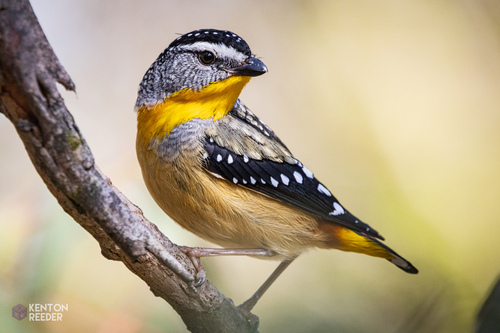
(c) Kenton, some rights reserved (CC BY-NC), uploaded by Kenton · cc-by-nc
Pardalotus
Sign in to saveAlso known as Pardalote
Pardalotes or peep-wrens are a family, Pardalotidae, of very small, brightly coloured birds native to Australia, with short tails, strong legs, and stubby blunt beaks. This family is composed of four species in one genus, Pardalotus, and several subspecies. The name derives from a Greek word meaning "spotted". The family once contained several other species now split into the family Acanthizidae.
Species
Spotted Pardalote
GENUS
- KingdomAnimalia
- PhylumChordata
- ClassAves
- OrderPasseriformes
- FamilyPardalotidae
Die Panthervögel (Pardalotus) sind eine Gattung von sehr kleinen, farbenfrohen Sperlingsvögeln, die in Australien und Tasmanien heimisch sind. Sie ist die einzige Gattung der gleichnamigen Familie (Pardalotidae) und setzt sich aus vier Arten zusammen. Der wissenschaftliche Name „pardalotus“ stammt aus dem Griechischen und bedeutet „gefleckt“. Der Lebensraum umfasst offenes Waldland und Wälder, die vornehmlich von Eukalypten dominiert sind. Inhaltsverzeichnis 1 Merkmale 2 Fortpflanzung 3 Arten 4 Systematik 5 Literatur 6 Weblinks 7 Einzelnachweise Merkmale Die Panthervögel erreichen Körperlängen von 8,5 bis 12 cm. Ihre Körper sind klein bis sehr klein, eiförmig und gedrungen. Die Flügel sind lang und gespitzt. Der Schwanz ist kurz. Der Schnabel ist kurz und kräftig. Der Kopf ist groß. Der Hals ist kurz und dick. Die Beine sind mittellang, die Füße sind kräftig. Das Gefieder ist farbenfroh, meist mit einem weißen oder gelben Überaugenstreif. Die Kappe ist schwarz mit weißen Stricheln oder Flecken. Die Flügel zeigen eine weiße Fleckenmusterung und der Körper ist stellenweise gelblich getönt. Fortpflanzung Panthervögel nisten in Erd- oder Baumhöhlen. Ihre drei bis fünf Eier werden 14 bi
via GBIF
Museum specimens
- Specimen records
- 230
- With media
- 43
- Family
- Pardalotidae
- Collections
- CUMV, ROM, USNM, FMNH, CMNH, NMV
- Recorded in
- Australia
Wikidata facts
- Instance of
- taxon
- Parent taxon
- Pardalotidae
- Image
- Pardalotus with nesting material.jpg
Show 5 more facts
- Commons category
- Pardalotus
- taxon rank
- genus
- taxon name
- Pardalotus
- topic's main category
- Category:Pardalote
- described by source
- New International Encyclopedia
Sources (2)
via Wikidata · CC0
~8 min read
Encyclopedic overview
8 sectionsContents
- Taxonomy and systematics
- Description
- Distribution and habitat
- Behaviour and ecology
- Movements
- Status and conservation threats
- References
- External links
Pardalotes or peep-wrens are a family, Pardalotidae, of very small, brightly coloured birds native to Australia, with short tails, strong legs, and stubby blunt beaks. This family is composed of four species in one genus, Pardalotus, and several subspecies. The name derives from a Greek word meaning "spotted". The family once contained several other species now split into the family Acanthizidae.
Pardalotes spend most of their time high in the outer foliage of trees, feeding on insects, spiders, and above all lerps (a type of sap-sucking insect). Their role in controlling lerp infestations in the eucalyptus forests of Australia may be significant. They generally live in pairs in small tunnels or in small family groups but sometimes come together into flocks after breeding.
Excerpted from Wikipedia’s “Pardalotus” article, available under the CC BY-SA 4.0 licence.