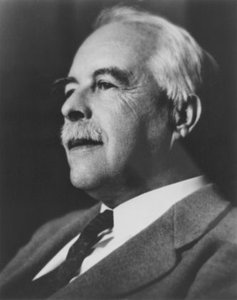
File:Gilbert_N_Lewis.jpg · Wikimedia Commons · See Wikimedia Commons
Gilbert N. Lewis
Sign in to saveAlso known as Gilbert Lewis, Gilbert Newton Lewis
American physical chemist
Gilbert N. Lewis was an American physical chemist who made important contributions to the understanding of chemical bonding and energy. His work laid foundational knowledge that influenced how scientists understand and predict how atoms combine to form molecules.
AI-generated from the Wikipedia summary — may contain errors.
Person · Open Library
- Works
- 2
Top works
- The Anatomy of Science
- L'Àtom i la molècula / Gilbert N. Lewis ; traducció i introducció a càrrec de Josep Castells i Guardiola
via Open Library + Wikidata
Wikidata facts
- Instance of
- human
- Family name
- Lewis
- Gender
- male
- Citizenship
- United States
- Place of birth
- Weymouth
- Place of death
- University of California, Berkeley
- Occupation
- physicist
- Educated at
- Massachusetts Institute of Technology
- Doctoral advisor
- Theodore William Richards
- Doctoral student
- Michael Kasha
- Field of work
- physical chemistry
Show 12 more facts
- member of
- Russian Academy of Sciences
- date of birth
- 1875-10-23
- date of death
- 1946-03-23
- nominated for
- Nobel Prize in Chemistry
- name in native language
- Gilbert Newton Lewis
- Commons Creator page
- Gilbert Newton Lewis
- Commons category
- Gilbert Newton Lewis
- birth name
- Gilbert Newton Lewis
- influenced by
- Irving Langmuir
- different from
- Lewis Gilbert
- on focus list of Wikimedia project
- Wikipedia:Vital articles/Level/4
- maintained by WikiProject
- WikiProject Mathematics
via Wikidata · CC0
~17 min read
Encyclopedic overview
Gilbert Newton Lewis (October 23 or October 25, 1875 – March 23, 1946) was an American physical chemist and a dean of the college of chemistry at University of California, Berkeley. Lewis was best known for his discovery of the covalent bond and his concept of electron pairs; his Lewis dot structures and other contributions to valence bond theory have shaped modern theories of chemical bonding. Lewis successfully contributed to chemical thermodynamics, photochemistry, and isotope separation, and is also known for his concept of acids and bases. Lewis also researched on relativity and quantum physics, and in 1926 he coined the term "photon" for the smallest unit of radiant energy.
G. N. Lewis was born in 1875 in Weymouth, Massachusetts. After receiving his PhD in chemistry from Harvard University and studying abroad in Germany and the Philippines, Lewis moved to California in 1912 to teach chemistry at the University of California, Berkeley, where he became the dean of the college of chemistry and spent the rest of his life. As a professor, he incorporated thermodynamic principles into the chemistry curriculum and reformed chemical thermodynamics in a mathematically rigorous manner accessible to ordinary chemists. He began measuring the free energy values related to several chemical processes, both organic and inorganic. In 1916, he also proposed his theory of bonding and added information about electrons in the periodic table of the chemical elements. In 1933, he started his research on isotope separation. Lewis worked with hydrogen and managed to purify a sample of heavy water. He then came up with his theory of acids and bases, and did work in photochemistry during the last years of his life.
Excerpted from Wikipedia’s “Gilbert N. Lewis” article, available under the CC BY-SA 4.0 licence.
Gallery (2)
Available in 61 languages
- Español
- Français
- Deutsch
- 中文
- 日本語
- Русский
- Português
- Italiano
- العربية
- हिन्दी
- Albanian
- Asturian
- azb
- Azerbaijani
- Bahasa Indonesia
- Bangla
- Basque
- Belarusian
Show 42 more
- Bulgarian
- Catalan
- Czech
- Danish
- Egyptian Arabic
- Esperanto
- Filipino
- Finnish
- Galician
- Georgian
- Greek
- Hebrew
- Hungarian
- Ido
- Irish
- Lithuanian
- Malagasy
- Malay
- Mingrelian
- Nederlands
- Norwegian
- Norwegian Nynorsk
- Novial
- Polski
- Punjabi
- Romanian
- Scottish Gaelic
- Serbian
- Serbian (Latin)
- simple
- Slovenian
- Svenska
- Tamil
- Tiếng Việt
- Türkçe
- Ukrainian
- Urdu
- Uzbek
- Western Panjabi
- zh_yue
- فارسی
- 한국어
via Wikidata sitelinks · CC0