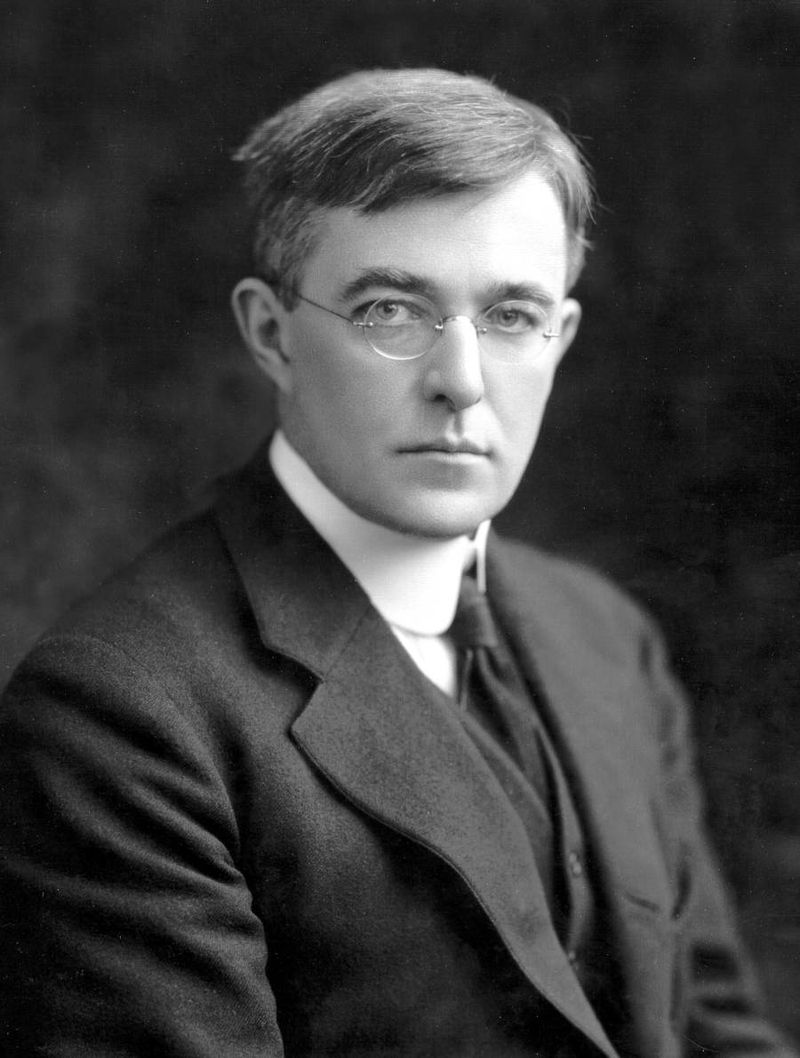
Irving Langmuir
American chemist and physicist (1881–1957)
AI overview
Irving Langmuir was an American chemist and physicist who lived from 1881 to 1957 and made significant contributions to our understanding of chemistry and physics. His work has had lasting impact on these scientific fields, though the specific nature of his discoveries and their applications are important to the development of modern science.
AI-generated from the Wikipedia summary — may contain errors.
Person · Open Library
- Born
- 1881
- Died
- 1957
- Works
- 12
Top works
- A mathematical investigation of water droplet trajectories
- Ueber partielle wiedervereinigung dissociierter gase im verlauf einer Abkühlung
- Molecular films
- Phenomena, atoms and molecules
- Molecular films, the cyclotron, & the new biology
via Open Library + Wikidata
Recent publications · Crossref
5 total works indexed
- THE ADSORPTION OF GASES ON PLANE SURFACES OF GLASS, MICA AND PLATINUM.
· 1918 · cited 20,314x
- THE CONSTITUTION AND FUNDAMENTAL PROPERTIES OF SOLIDS AND LIQUIDS. PART I. SOLIDS.
· 1916 · cited 8,867x
Article
Irving Langmuir (/ˈlæŋmjʊər/; January 31, 1881 – August 16, 1957) was an American chemist, physicist, and metallurgical engineer. He was awarded the Nobel Prize in Chemistry in 1932 for his work in surface chemistry.
Langmuir's most famous publication is the 1919 article "The Arrangement of Electrons in Atoms and Molecules" in which, building on Gilbert N. Lewis's cubical atom theory and Walther Kossel's chemical bonding theory, he outlined his "concentric theory of atomic structure". Langmuir became embroiled in a priority dispute with Lewis over this work; Langmuir's presentation skills were largely responsible for the popularization of the theory, although the credit for the theory itself belongs mostly to Lewis. While at General Electric from 1909 to 1950, Langmuir advanced several fields of physics and chemistry, inventing the gas-filled incandescent lamp and the hydrogen welding technique. The Langmuir Laboratory for Atmospheric Research near Socorro, New Mexico, was named in his honor, as was the American Chemical Society journal for surface science called Langmuir.
Gallery (5)
Connections
Categories
1881 births1957 deaths20th-century American chemistsAmerican agnosticsAmerican fellows of the Royal SocietyAmerican meteorologistsAmerican Nobel laureatesAmerican physical chemistsAmerican plasma physicistsChestnut Hill Academy alumniColumbia School of Engineering and Applied Science alumniFellows of the American Academy of Arts and Sciences