Gnephosis · Kew POWO · Kew Plants of the World Online
Gnephosis
Sign in to saveGnephosis is a genus of about sixteen flowering plants in the family Asteraceae, all endemic to Australia. Plants in the genus Gnephosis are hairy annual herbs, the upper leaves arranged alternately, the lower leaves sessile and arranged in opposite pairs. The flowers are arranged in narrowly elliptic to oblong heads with up to 300 flowers, each with up to 16 bisexual florets. The achenes are pink or pale purple and more or less cone-shaped, sometimes without a pappus.
Species
GENUS
- KingdomPlantae
- PhylumTracheophyta
- ClassMagnoliopsida
- OrderAsterales
- FamilyAsteraceae
via GBIF · Kew POWO
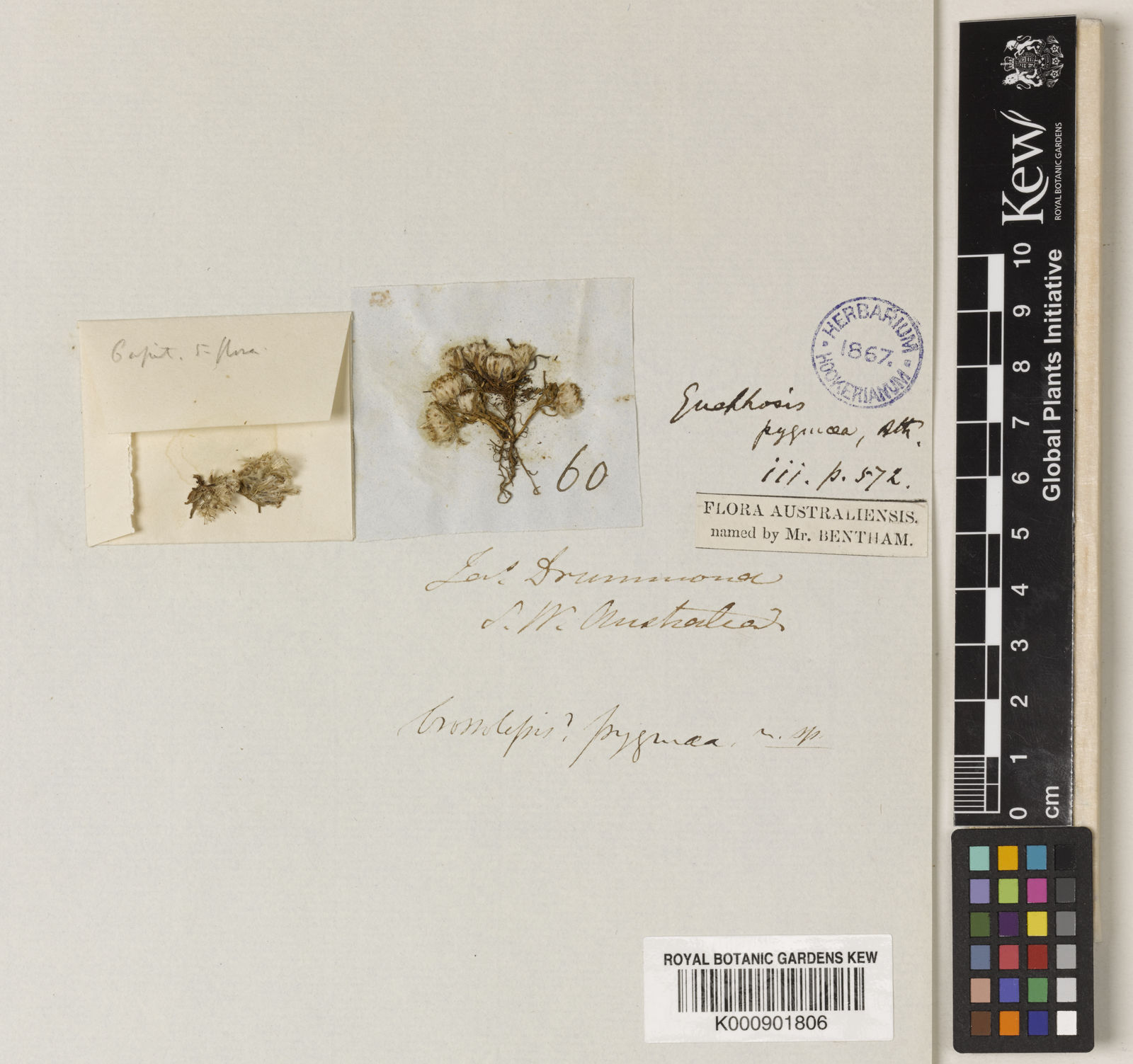
Museum specimens
- Specimen records
- 25
- With media
- 15
- Family
- Asteraceae
- Collections
- RSA, MEL, BPBM, BRIT, VT
- Recorded in
- Australia
Wikidata facts
- Instance of
- taxon
- Parent taxon
- Gnaphalieae
- Image
- Gnephosis arachnoides habit.jpg
Show 5 more facts
- taxon name
- Gnephosis
- taxon rank
- genus
- topic's main category
- Category:Gnephosis
- Commons category
- Gnephosis
Sources (1)
via Wikidata · CC0
~1 min read
Encyclopedic overview
5 sectionsContents
- Taxonomy
- Distribution
- Species list
- Formerly placed here
- References
Gnephosis is a genus of about sixteen flowering plants in the family Asteraceae, all endemic to Australia. Plants in the genus Gnephosis are hairy annual herbs, the upper leaves arranged alternately, the lower leaves sessile and arranged in opposite pairs. The flowers are arranged in narrowly elliptic to oblong heads with up to 300 flowers, each with up to 16 bisexual florets. The achenes are pink or pale purple and more or less cone-shaped, sometimes without a pappus.
==Taxonomy== The genus Gnephosis was first formally described in 1820 by Henri Cassini in the Bulletin des Sciences par la Société Philomatique de Paris, and the first species he described (the type species) was Gnephosis tenuissima.
Excerpted from Wikipedia’s “Gnephosis” article, available under the CC BY-SA 4.0 licence.
Gallery (2)
Available in 10 languages
via Wikidata sitelinks · CC0