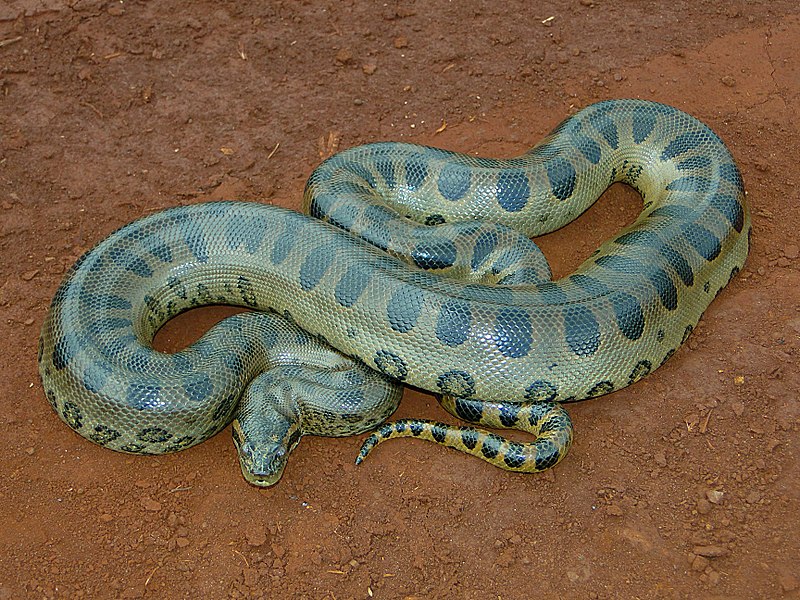
File:Sucuri_verde.jpg · Wikimedia Commons · See Wikimedia Commons
green anaconda
Sign in to saveAlso known as Eunectes murinus, giant anaconda, emerald anaconda, common anaconda, common water boa, southern green anaconda
species of reptile
OverviewAI-generated
The green anaconda, scientifically known as *Eunectes murinus*, is a species of snake classified within the Anaconda group. It is a member of the class Reptilia and is also referred to by the common names anaconda, anakonda, and anakonda zielona. The species is described as a large, non-venomous snake that is the largest member of its family and one of the largest snakes in the world.
Its range includes Barcarena, and it primarily inhabits South America. The IUCN Red List assigned the species a conservation status of Least Concern in 2021. On the iNaturalist platform, the taxon has recorded 2035 observations.
Synthesized by Vinony from 20 facts across 5 sources: Wikidata, iNaturalist, IUCN Red List, Encyclopedia of Life, Vinony graph. Generated from structured data (not the Wikipedia text) and checked against those facts — may still contain errors.
Species
Least ConcernGreen Anaconda
species
森蚺(學名:Eunectes murinus)是一種體型巨大的無毒蛇,主要棲息於南美洲,為蚺科體型最大的成員,同時也是世上最大的蛇之一。
via IUCN
Wikidata facts
Show 9 more facts
- taxon name
- Eunectes murinus
- taxon rank
- species
- Commons category
- Eunectes murinus
- Commons gallery
- Eunectes murinus
- taxon common name
- Große Anakonda
- used by
- anaconda
- IUCN conservation status
- Least Concern
- short name
- E. murinus
- taxon range
- Barcarena
via Wikidata · CC0
~20 min read
Encyclopedic overview
The green anaconda (Eunectes murinus), common anaconda, common water boa, akayima, or sucuri, is a boa species found in South America. It is one of the longest and heaviest known extant snake species. Like all boas, it is a non-venomous constrictor. Green anacondas only have a lifespan of 10 years in the wild, although some specimens live longer when they are taken care of in captivity. Green anacondas live in tropical rainforests and tend to prefer shallow, slow-moving waters, such as streams, rivers and flooded grasslands. They spend most of their time in the water but are also found on land in thick vegetation.
Taxonomy
Excerpted from Wikipedia’s “green anaconda” article, available under the CC BY-SA 4.0 licence.
Gallery (10)
Available in 65 languages
- Español
- Français
- Deutsch
- 中文
- 日本語
- Русский
- Português
- Italiano
- العربية
- Aragonese
- Armenian
- Azerbaijani
- Bahasa Indonesia
- Balinese
- Bangla
- Basque
- be_x_old
- Belarusian
Show 46 more
- Bulgarian
- Catalan
- Cebuano
- Czech
- Danish
- Egyptian Arabic
- Estonian
- Finnish
- Galician
- Georgian
- Guarani
- Hebrew
- Hungarian
- Icelandic
- Kazakh
- Kyrgyz
- Latvian
- Lithuanian
- Macedonian
- Malayalam
- Mongolian
- Navajo
- Nederlands
- Northern Frisian
- Norwegian
- Ossetic
- Polski
- Quechua
- Saterland Frisian
- Scots
- Serbian
- simple
- Slovak
- Sranan Tongo
- Svenska
- Tajik
- Tiếng Việt
- Türkçe
- Ukrainian
- Uzbek
- Waray
- Western Panjabi
- Wu Chinese
- فارسی
- ไทย
- 한국어
via Wikidata sitelinks · CC0