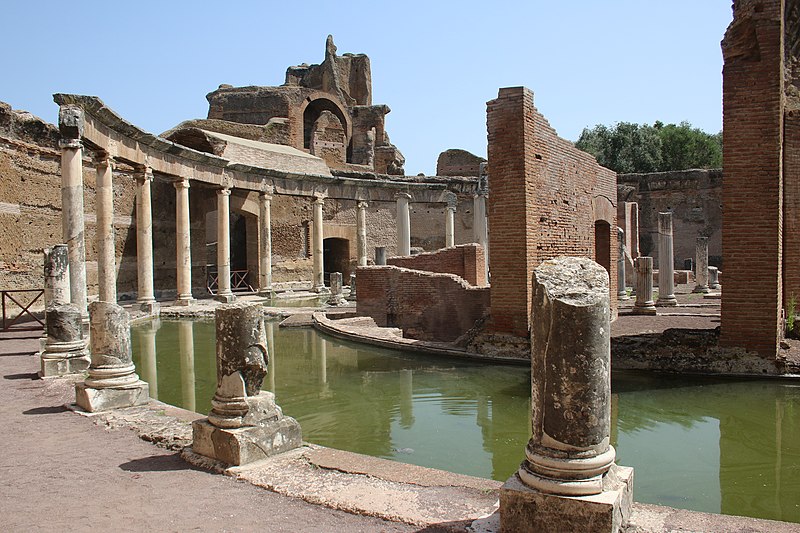
File:Villa_Hadriana_(Villa_Adriana_Tivoli)_1000_03.jpg · Wikimedia Commons · See Wikimedia Commons
Key facts
- Location
- Tivoli, Lazio , Italy
- Criteria
- Cultural: (i), (ii), (iii)
- Inscription
- 1999 (23rd Session )
- Area
- 80 ha (200 acres)
- Buffer zone
- 500 ha (1,200 acres)
- Website
- villae.cultura.gov.it
via Wikipedia infobox
Wikidata facts
- Country
- Italy
- Located in
- Tivoli
- Area
- 400
- Time zone
- UTC+02:00
- Founded by
- Hadrian
- Employees
- 35
- Location
- Ostia
- Official website
- www.villaadriana.beniculturali.it
- Image
- Tivoli - Wall of the Poikile of Hadrian's Villa (Villa Adriana) - 2019.jpg
Show 13 more facts
- native label
- Villa Adriana
- street address
- Largo Marguerite Yourcenar 1, Tivoli
- Commons category
- Villa Adriana (Tivoli)
- Commons gallery
- Villa Adriana
- heritage designation
- World Heritage Site
- described by source
- Brockhaus and Efron Encyclopedic Dictionary
- culture
- Ancient Rome
- different from
- Hadrian's Wall
- postal code
- 00010
- visitors per year
- 180452
- Wi-Fi access
- no
- has facility
- café
- collection or exhibition size
- 60
Sources (7)
via Wikidata · CC0
~12 min read
Encyclopedic overview
Hadrian's Villa (Italian: Villa Adriana; Latin: Villa Hadriana) is a UNESCO World Heritage Site comprising the ruins and archaeological remains of a large villa complex built around AD 120 by Roman emperor Hadrian near Tivoli outside Rome.
It is the most imposing and complex Roman villa known. The complex contains over 30 monumental and scenic buildings arranged on a series of artificial esplanades at different heights and surrounded by gardens decorated with water basins and nymphaea (fountains). The whole complex covers an area of at least a square kilometre, an area larger than the city of Pompeii. In addition to the villa's impressive layout, many of the buildings are considered masterpieces of Roman architecture, making use of striking curved shapes enabled by extensive use of concrete. They were ingenious for the complex symmetry of their ground plans and are considered unrivalled until the arrival of Baroque architecture in the 17th century, initiated by Borromini, who used Hadrian's Villa for inspiration.
Excerpted from Wikipedia’s “Hadrian's Villa” article, available under the CC BY-SA 4.0 licence.