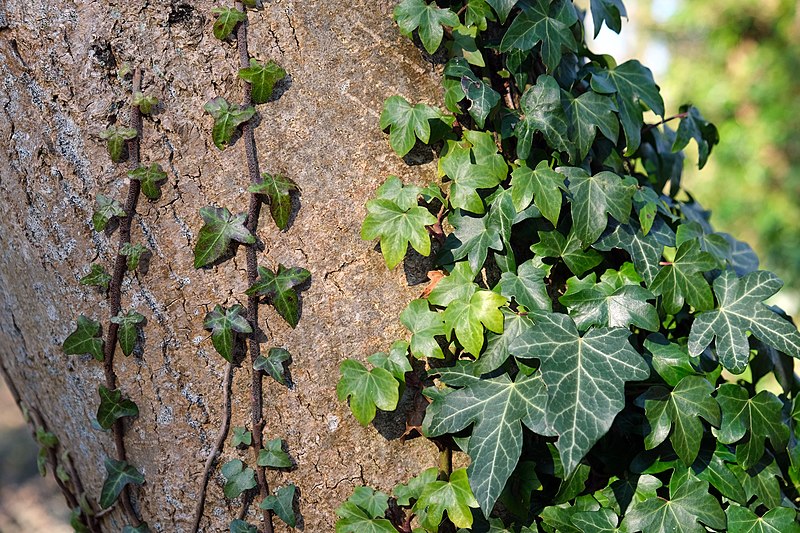
File:Hedera_helix_Dover.jpg · Wikimedia Commons · See Wikimedia Commons
OverviewAI-generated
Hedera helix, commonly known as common ivy, English ivy, or Gewöhnlicher Efeu, is a species of evergreen plant in the family Araliaceae. It belongs to the genus Hedera within the order Apiales and class Magnoliopsida. The species is classified under the phylum Tracheophyta and kingdom Plantae. Its scientific name is cited as Hedera helix L.
This plant produces berries and utilizes aerial roots. It inhabits trees, cliffs, lowlands, and walls. The taxon range includes China, Fujian, and Guangdong. Hedera helix is considered a useful plant.
The species has a status of Least Concern according to the IUCN Red List from 2012. It is not extinct. Records exist in institutions such as the University of Alberta Museums, INECOL, UACH, CMN, and SEMAHN, with occurrences documented in the United States, Canada, and Mexico.
Synthesized by Vinony from 52 facts across 9 sources: Wikidata, GBIF, iNaturalist, IUCN Red List, Gbif Occ, Plants of the World, iDigBio, WoRMS, Vinony graph. Generated from structured data (not the Wikipedia text) and checked against those facts — may still contain errors.
Species
Least ConcernEnglish ivy
Hedera helix
SPECIES
- KingdomPlantae
- PhylumTracheophyta
- ClassMagnoliopsida
- OrderApiales
- FamilyAraliaceae
本文介紹的是一种植物。關於美国的大学联盟,請見「常春藤盟校」。 二名法 Hedera helixL. 常春藤的葉子和果實 常春藤(学名:Hedera helix),又名洋常春藤、長春藤、土鼓藤、木蔦、百角蜈蚣,是常春藤屬下的一種常綠攀援植物,在很多地區常春藤實際都屬於入侵物種。 目录 1 命名 2 描述 3 分布 4 與人類的關係 4.1 入侵植物 5 参考文献 6 外部链接 命名 常春藤的種加詞helix來自古希臘語,意思是“扭”。[3] 描述 其莖生氣根以攀緣他物,嫩葉以及花序被有星形鱗片,葉有柄,厚質,葡枝之葉稍做三角形,掌狀。 分布 常春藤自然分布于北至爱尔兰東北部和斯堪的納維亞南部、南至葡萄牙、東至烏克蘭、土耳其。在處於零下二攝氏度冬季等溫線以上的地區,一般會被其他植物取代。[4][5][6][7][8][9] 與人類的關係 叶有香气,形态优美,常作園藝观赏用。 其果實、種子和葉子均有毒,孩童誤食會引起腹痛、腹瀉等症狀,嚴重時會引發腸胃發炎、昏迷,甚至導致呼吸困難等。[來源請求] 入侵植物 人類將常春藤引入了許多地區,其中一些地區將其列為入侵物種。常春藤會迅速蔓延并纏繞其他植物造成後者死亡。它們創造了大片的“常春藤荒漠”(ivy deserts)。例如美國的許多州,特別是俄勒岡州全部禁止銷售與進口常春藤[10][11][12]。太平洋西北地區和美國南部的政府也鼓勵消滅常春藤[13][14]。 在澳大利亞南部,特别是東南部,常春藤被當做有害植物。在一些地區禁止販售常春藤[15]。與澳大利亞相鄰的新西蘭的環保局自1990年開始也將常春藤列為雜草(environmental weed)[16]。 参考文献 ^ Bean, W. J. (1978) Trees and Shrubs Hardy in the British Isles Volume 2. ^ International Plant Names Index ^ Harrison, Lorraine. RHS Latin for gardeners. United Kingdom: Mitchell Beazley. 2012: 224. ISBN 978-1-84533-731-5. ^ Metcalfe, D. J. (2005). Biological Flora of the British Isles no. 268 Hedera helix L. Journal of Ecology 93: 632–648. ^ McAllister, H. (1982). New work on ivies. Int. Dendrol. Soc. Yearbook 1981: 106-109. ^ Flora of NW Europe[永久失效連結] ^ Ackerfield, J. &
via GBIF · IUCN · Kew POWO
Museum specimens
- Specimen records
- 5,321
- With media
- 3,632
- Family
- Araliaceae
- Collections
- UNIVERSITY OF ALBERTA MUSEUMS, INECOL, UACH, CMN, SEMAHN, IBUNAM
- Recorded in
- United States, Canada, Mexico
Wikidata facts
- Instance of
- taxon
- Subclass of
- useful plant
- Parent taxon
- Hedera
- Image
- 20121002Hedera helix1.jpg
Show 13 more facts
- taxon rank
- species
- taxon name
- Hedera helix
- Commons category
- Hedera helix
- taxon common name
- Hiedra
- Commons gallery
- Hedera helix
- habitat
- wall
- has fruit type
- berry
- uses
- aerial root
- taxon range
- Fujian
- foliage type
- evergreen plant
- short name
- H. helix
- taxon author citation
- L.
Sources (8)
via Wikidata · CC0
~15 min read
Encyclopedic overview
Botanical illustration of H. Helix. Leaf Immature inflorescence Berries Stems with rootlets used to cling to walls and tree trunks Hedera helix (MHNT)
Hedera helix, simply ivy, or common ivy, English ivy, European ivy, King's choice ivy, is a species of flowering plant in the family Araliaceae. It is native to most of Europe and parts of western Asia. Ivy is a clinging evergreen vine that grows on tree trunks, walls, and fences in gardens, waste spaces, and wild habitats. Ivy is popular as an ornamental plant, but escaped plants have become naturalised outside its native range. Ivy has considerable cultural significance and symbolism.
Excerpted from Wikipedia’s “Hedera helix” article, available under the CC BY-SA 4.0 licence.
Gallery (18)
Available in 73 languages
- Español
- Français
- Deutsch
- 中文
- 日本語
- Русский
- Português
- Italiano
- العربية
- Albanian
- Armenian
- Asturian
- Azerbaijani
- Bahasa Indonesia
- Basque
- bat_smg
- Bavarian
- Belarusian
Show 54 more
- Bulgarian
- Catalan
- Cebuano
- Croatian
- Czech
- Danish
- Egyptian Arabic
- eml
- Esperanto
- Estonian
- Finnish
- Galician
- Georgian
- Greek
- Hebrew
- Hungarian
- Icelandic
- Kashmiri
- Kashubian
- Latin
- Latvian
- Limburgish
- Lithuanian
- Lombard
- Lower Sorbian
- Luxembourgish
- Macedonian
- Malagasy
- Neapolitan
- Nederlands
- Northern Frisian
- Norwegian
- Norwegian Nynorsk
- nrm
- Polski
- Romanian
- rsk
- Sardinian
- Scots
- Serbian
- Sicilian
- simple
- Slovak
- Slovenian
- Svenska
- Tiếng Việt
- Türkçe
- Ukrainian
- Upper Sorbian
- Uyghur
- Waray
- Wu Chinese
- فارسی
- 한국어
via Wikidata sitelinks · CC0