Encyclopedia of Life · EOL (see source)
Helioporacea
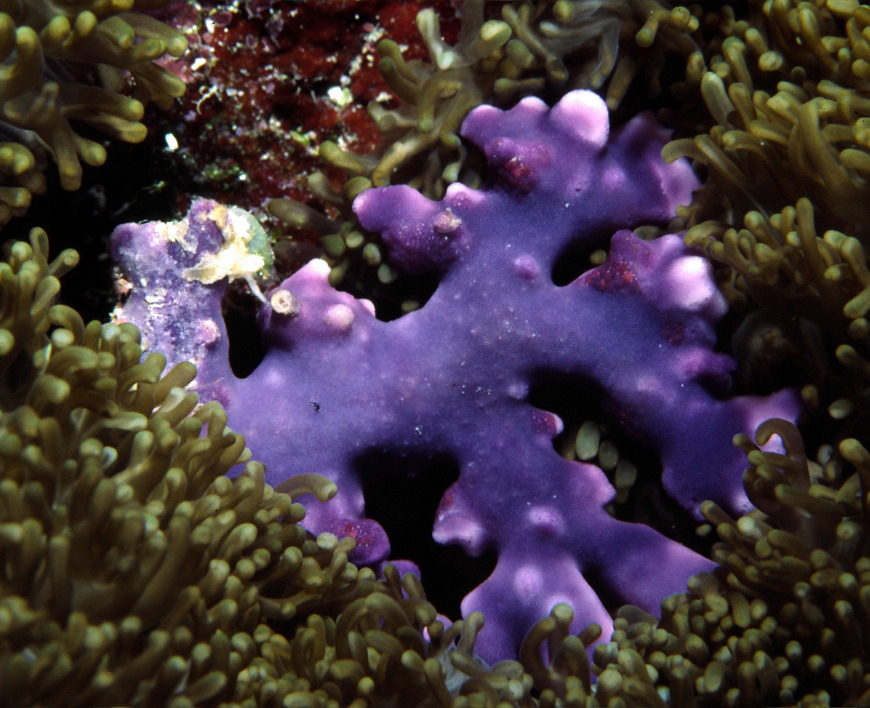
Sign in to saveHelioporacea is an order of the subclass Octocorallia that forms massive lobed crystalline calcareous skeletons in colonial corals. These corals first appeared in the Cretaceous period. It consists of two families, Helioporidae Moseley, 1876 and Lithotelestidae Bayer & Muzik, 1977.
Species
blue corals
ORDER
- KingdomAnimalia
- PhylumCnidaria
- ClassAnthozoa
- OrderScleralcyonacea
- FamilyHelioporidae
Die Helioporacea sind eine Ordnung der Blumentiere (Anthozoa) aus der Unterklasse der Octocorallia, die heute nur mit fünf Arten in den heutigen Meeren vertreten ist. Inhaltsverzeichnis 1 Merkmale 2 Systematik 3 Phylogenie 4 Quellen 4.1 Einzelnachweise 4.2 Literatur 5 Weblinks Merkmale Im Unterschied zu allen anderen Oktokorallen produzieren die Helioporacea wie die nicht nah verwandten Steinkorallen ein massives Aragonit-Skelett. Ansonsten teilen sie die in der Unterklasse Octocorallia übliche Polypenanatomie und die obligatorischen acht gefiederten Tentakel. Systematik Die Ordnung beinhaltet nur zwei Familien mit drei Gattung und acht Arten. Ordnung Helioporacea Bock, 1938 Familie Helioporidae Moseley, 1876 Gattung Heliopora de Blainville, 1830 Blaue Koralle (Heliopora coerulea (Pallas, 1776)) Heliopora hiberniana Richards et al., 2018 Gattung Pseudopolytremacis Kusmitschewa, 1975[1] Pseudopolytremacis hanagaensis Kusmitschewa, 1975, Unterkreide, Armenien Familie Lithotelestidae Bayer & Muzik, 1977 Gattung Epiphaxum Lonsdale, 1850 (syn. Lithotelesto Bayer & Muzik, 1977) †Epiphaxum auloporoides (Lonsdale, 1850) (Turonium, Campanium, Maastrichtium, Danium, verschiedene Loka
via GBIF
Wikidata facts
- Instance of
- taxon
- Parent taxon
- Octocorallia
- Image
- Blaue Koralle 4.jpg
Show 5 more facts
- Commons category
- Helioporacea
- taxon rank
- order
- taxon name
- Helioporacea
- topic's main category
- Category:Helioporacea
- taxon common name
- 青珊瑚目
Sources (1)
via Wikidata · CC0
~2 min read
Encyclopedic overview
1 sectionsContents
- References
Helioporacea is an order of the subclass Octocorallia that forms massive lobed crystalline calcareous skeletons in colonial corals. These corals first appeared in the Cretaceous period. It consists of two families, Helioporidae Moseley, 1876 and Lithotelestidae Bayer & Muzik, 1977.
The blue coral (Heliopora coerulea), the only extant species in the family Helioporidae, is most common in shallow water of the tropical Pacific and Indo-Pacific reefs. It has no spicules, and is the only octocoral known to produce a massive skeleton formed of fibrocrystalline aragonite fused into lamellae, similar to that of the Scleractinia (stony corals). They form large colonies that can exceed a meter in diameter. They are composed of vertical branches, or folia.
Excerpted from Wikipedia’s “Helioporacea” article, available under the CC BY-SA 4.0 licence.