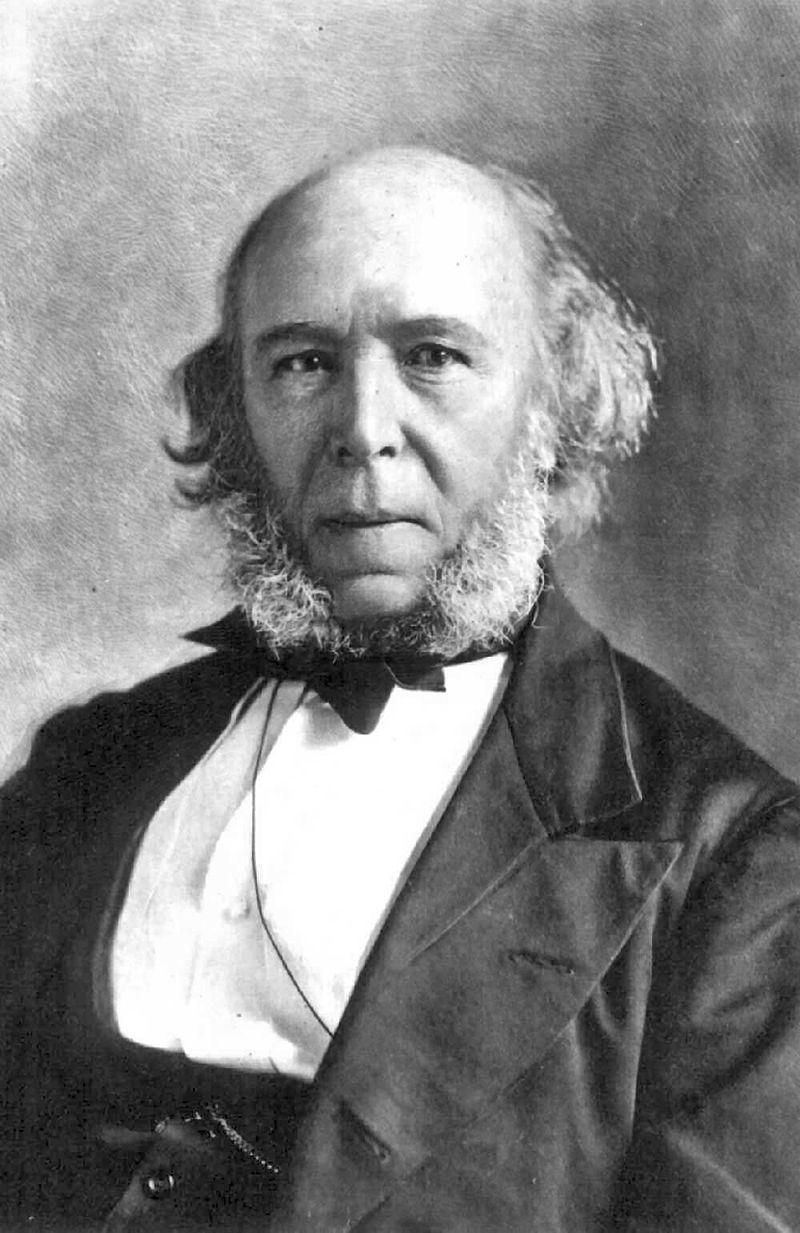
File:Herbert_Spencer.jpg · Wikimedia Commons · See Wikimedia Commons
Herbert Spencer
Sign in to saveAlso known as Spencert, Gerbert Spencer
English philosopher and political theorist (1820–1903)
Herbert Spencer was a 19th-century English philosopher who applied the concept of evolution to society and human development, arguing that societies progress through natural competition and struggle. His influential ideas shaped debates about politics, economics, and social change for generations, though many of his theories are now rejected by modern scholars.
AI-generated from the Wikipedia summary — may contain errors.
Wikidata facts
- Instance of
- human
- Given name
- Herbert
- Family name
- Spencer
- Gender
- male
- Citizenship
- United Kingdom of Great Britain and Ireland
- Place of birth
- Derby
- Place of death
- Brighton
- Occupation
- biologist
- Employer
- The Economist
- Languages spoken
- English language
- Native language
- English language
- Religion
- agnosticism
- Field of work
- botany
- Movement
- utilitarianism
- Image
- Herbert Spencer.jpg
Show 16 more facts
- on focus list of Wikimedia project
- Wikipedia:Vital articles/Level/4
- date of birth
- 1824-04-27
- date of death
- 1903-00-00
- place of burial
- Highgate Cemetery
- Commons category
- Herbert Spencer
- topic's main category
- Category:Herbert Spencer
- Commons Creator page
- Herbert Spencer
- Commons gallery
- Herbert Spencer
- nominated for
- Nobel Peace Prize
- name in native language
- Herbert Spencer
- writing language
- English language
- member of
- Accademia Nazionale dei Lincei
- has works in the collection
- Victoria and Albert Museum
- ethnic group
- British
- contributed to creative work
- Popular Science
- P12749
- Otto Günsche
Sources (9)
via Wikidata · CC0
Works in European collections
36 objects attributed to Herbert Spencer, held across European museums, libraries & archives · via Europeana

Die Principien der Biologie, 2
Obras filosóficas de Spencer : los primeros principios

Die Principien der Biologie, 1

The principles of biology, 1

Grundlagen der Philosophie
The principles of biology. by Herbert Spencer. 2
![Ecclesiastical Institutions: being Part VI. of the Principles of Sociology : [War früher als Theil des 'System of Synthetic Philosophy', Ph.u. 8?? 469 hx, ausgetellt.] Die 'Ecclesiastical Institutions' sind auch in der Ausgabe von 1896 im 8. Bande des 'System of Synthetic Philosophy' vorhanden. Das Anerbieten des Verlegers, die Ausgabe von 1885 zurückzunehmen, wurde aus bibliogr. und bibliothekarischen Gründen nicht acceptiert](https://api.europeana.eu/thumbnail/v2/url.json?uri=https%3A%2F%2Fapi.digitale-sammlungen.de%2Fiiif%2Fimage%2Fv2%2Fbsb11615132_00015%2Ffull%2Ffull%2F0%2Fdefault.jpg&type=IMAGE)
Ecclesiastical Institutions: being Part VI. of the Principles of Sociology : [War früher als Theil des 'System of Synthetic Philosophy', Ph.u. 8?? 469 hx, ausgetellt.] Die 'Ecclesiastical Institutions' sind auch in der Ausgabe von 1896 im 8. Bande des 'System of Synthetic Philosophy' vorhanden. Das Anerbieten des Verlegers, die Ausgabe von 1885 zurückzunehmen, wurde aus bibliogr. und bibliothekarischen Gründen nicht acceptiert
The principles of sociology. by Herbert Spencer. 2
Einleitung in das Studium der Sociologie ; 2. von Herbert Spencer ; hrsg. von Heinrich Marquardsen
Einleitung in das Studium der Sociologie ; 1. von Herbert Spencer ; hrsg. von Heinrich Marquardsen

Classification des sciences

Erziehungslehre : In dt. Übers. hrsg. v. Fritz Schultze
Essays. scientific, political and speculative. by Herbert Spencer. 2
The principles of psychology. 2
The principles of biology. by Herbert Spencer. 1
The principles of sociology. by Herbert Spencer. 1
The study of sociology
Essays. scientific, political and speculative. by Herbert Spencer. 3
Von der Freiheit zur Gebundenheit. Herbert Spencer. Vom Verf. genehmigte Übers. durch Wilhelm Bode
The principles of psychology. 1
System der synthetischen Philosophie. von Herbert Spencer. Übers. von B. Vetter. I. Band. Grundlagen der Philosophie
Introduction a la science sociale. par Herbert Spencer
Essays. scientific, political and speculative. by Herbert Spencer. 1
Education. intellectual, moral, and physical

Social Statics, abridged and revised, together with The Man versus the State

The man 'versus' the state : containing 'The new Toryism', 'The coming slavery', 'The sins of legislators' and 'The great political superstition'

The principles of psychology, 1

Einleitung in das Studium der Sociologie, 2

Essays: scientific, political & speculative, 3

Von der Freiheit zur Gebundenheit

Von der Freiheit zur Gebundenheit

Die Principien der Sociologie, 1

The Philosophy of Style, together with an Essay on Style by T. H. Wright, edited with Introduction and Notes by Fred. N. Scott

Einleitung in das Studium der Sociologie, 1

A system of synthetic philosophy, 6

The principles of biology, 2
~40 min read
Encyclopedic overview
Herbert Spencer (27 April 1820 – 8 December 1903) was an English polymath active as a philosopher, psychologist, biologist, sociologist, and anthropologist. Spencer originated the expression "survival of the fittest", which he coined in Principles of Biology (1864) after reading Charles Darwin's 1859 book On the Origin of Species. The term strongly suggests natural selection, yet Spencer saw evolution as extending into realms of sociology and ethics, so he also supported Lamarckism.
Spencer developed an all-embracing conception of evolution as the progressive development of the physical world, biological organisms, the human mind, and human culture and societies. As a polymath, he contributed to a wide range of subjects, including ethics, religion, anthropology, economics, political theory, philosophy, literature, astronomy, biology, sociology, and psychology. During his lifetime he achieved tremendous authority, mainly in English-speaking academia. Spencer was "the single most famous European intellectual in the closing decades of the nineteenth century" but his influence declined sharply after 1900: "Who now reads Spencer?" asked Talcott Parsons in 1937.
Excerpted from Wikipedia’s “Herbert Spencer” article, available under the CC BY-SA 4.0 licence.
Gallery (8)
Available in 82 languages
- Español
- Français
- Deutsch
- 中文
- 日本語
- Русский
- Português
- Italiano
- العربية
- हिन्दी
- Afrikaans
- Albanian
- Armenian
- Asturian
- azb
- Azerbaijani
- Bahasa Indonesia
- Bangla
Show 63 more
- Banjar
- Basque
- Bosnian
- Bulgarian
- Burmese
- Catalan
- Croatian
- Czech
- Danish
- Egyptian Arabic
- Esperanto
- Estonian
- Finnish
- Galician
- Georgian
- Greek
- Hebrew
- Hungarian
- Icelandic
- Ido
- Irish
- Kabyle
- Kannada
- Kazakh
- Kyrgyz
- Latin
- Latvian
- Lithuanian
- Macedonian
- Malagasy
- Malayalam
- Nederlands
- Norwegian
- Norwegian Nynorsk
- Occitan
- Pashto
- Piedmontese
- Polski
- Punjabi
- rki
- Romanian
- Sanskrit
- Serbian
- Serbian (Latin)
- simple
- Sinhala
- Slovak
- Slovenian
- Svenska
- Swahili
- Tamil
- Tatar
- Tiếng Việt
- Türkçe
- Ukrainian
- Waray
- Wu Chinese
- Yoruba
- zh_min_nan
- zh_yue
- فارسی
- ไทย
- 한국어
via Wikidata sitelinks · CC0