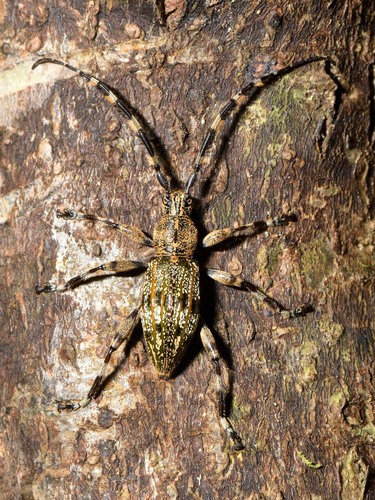
(c) Dougal Townsend, some rights reserved (CC BY-NC), uploaded by Dougal Townsend · cc-by-nc
Hexatricha
Sign in to saveHexatricha pulverulenta, commonly known as the squeaking longhorn, is a beetle in the family Cerambycidae, the only species in the monotypic genus Hexatricha. It is endemic to New Zealand. It was first described by John O. Westwood in 1843 as Lamia pulverulenta, and later moved into the genus Hexatricha (sometimes incorrectly spelled Hexathrica). left|thumb|Pair of Hexatricha pulverulenta on a karaka tree (Corynocarpus laevigatus) The squeaking longhorn is so called for the noise it makes, by stridulation, when handled. Female beetles lay an egg under the bark of dead or dying trees, especiall
In the Vinony graph
Within Vinony's link graph, Hexatricha is referenced by 2 other articles, and connects out to Cerambycidae, Animalia and insect.
Vinony files it under Beetles described in 1843, Endemic beetles of New Zealand and Monotypic Cerambycidae genera.
Its subject is documented across 4 Wikipedia language editions.
Species
Squeaking Longhorn
GENUS
- KingdomAnimalia
- PhylumArthropoda
- ClassInsecta
- OrderColeoptera
- FamilyCerambycidae
via GBIF
Wikidata facts
- Instance of
- taxon
- Parent taxon
- Cerambycidae
- Image
- Hexatricha pulverulenta.jpg
Show 4 more facts
- taxon name
- Hexatricha
- taxon rank
- genus
- topic's main category
- Category:Hexatricha
- Commons category
- Hexatricha
Sources (1)
via Wikidata · CC0
~1 min read
Encyclopedic overview
2 sectionsContents
- References
- External links
Hexatricha pulverulenta, commonly known as the squeaking longhorn, is a beetle in the family Cerambycidae, the only species in the monotypic genus Hexatricha. It is endemic to New Zealand. It was first described by John O. Westwood in 1843 as Lamia pulverulenta, and later moved into the genus Hexatricha (sometimes incorrectly spelled Hexathrica). left|thumb|Pair of Hexatricha pulverulenta on a karaka tree (Corynocarpus laevigatus) The squeaking longhorn is so called for the noise it makes, by stridulation, when handled. Female beetles lay an egg under the bark of dead or dying trees, especially Pinus radiata or New Zealand beech (Nothofagus). These hatch in 10–19 days, and larvae live under, and feed off, wood for perhaps two or three years. They pupate for 30 days, hatching from spring to autumn (August to April) into adult beetles which live for up to three months. Adults are reluctant fliers.
==References==
Excerpted from Wikipedia’s “Hexatricha” article, available under the CC BY-SA 4.0 licence.