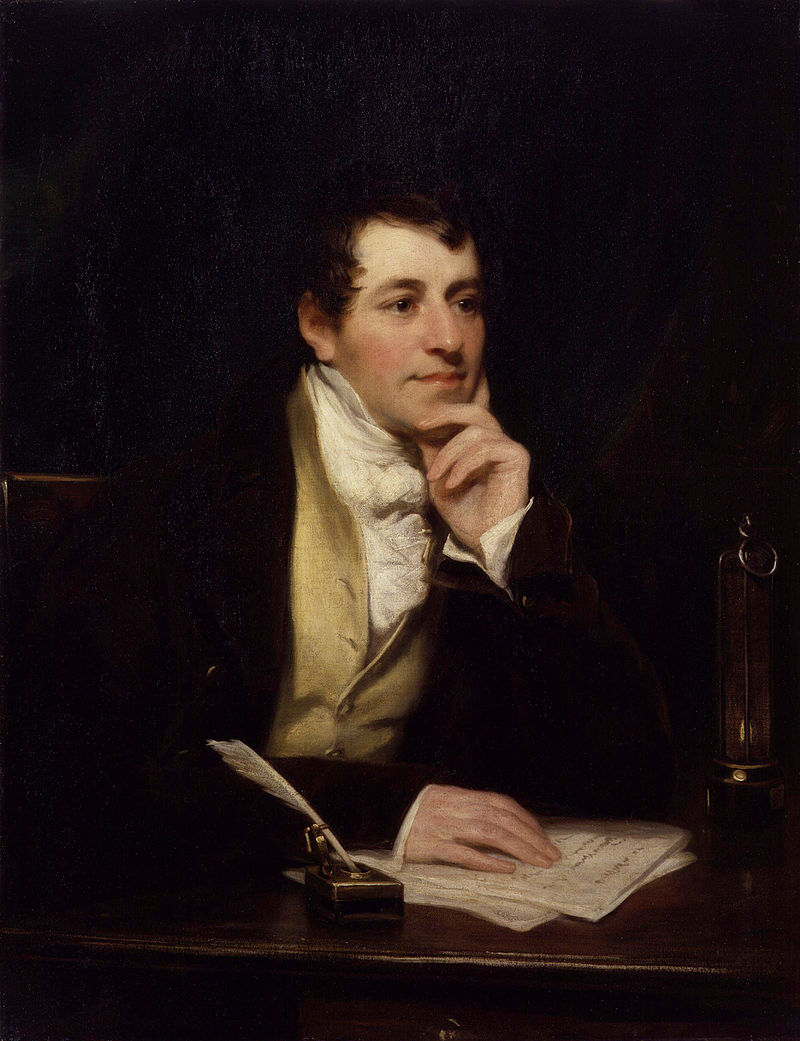
File:Sir_Humphry_Davy,_Bt_by_Thomas_Phillips.jpg · Wikimedia Commons · See Wikimedia Commons
Humphry Davy was a British chemist who made important discoveries about chemical elements and their properties during the late 1700s and early 1800s. His work laid foundational knowledge for modern chemistry and helped scientists understand the composition of matter.
AI-generated from the Wikipedia summary — may contain errors.
Wikidata facts
- Instance of
- human
- Gender
- male
- Citizenship
- Kingdom of Great Britain
- Place of birth
- Penzance
- Place of death
- Geneva
- Sibling
- John Davy
- Occupation
- poet
- Employer
- Royal Society
- Languages spoken
- English language
- Noble title
- Knight Bachelor
- Field of work
- geology
- Image
- Sir Humphry Davy, Bt by Thomas Phillips.jpg
Show 13 more facts
- place of burial
- Cemetery of Kings
- Commons gallery
- Humphry Davy
- Commons category
- Humphry Davy
- date of birth
- 1778-00-00
- date of death
- 1829-00-00
- name in native language
- Humphrey Davy
- student
- Michael Faraday
- writing language
- English language
- influenced by
- Benjamin Thompson
- on focus list of Wikimedia project
- Wikipedia:Vital articles/Level/4
- P8168
- Kakogawa
- P12749
- Oberwiesenthal
via Wikidata · CC0
Works in European collections
7 objects attributed to Humphry Davy, held across European museums, libraries & archives · via Europeana


~40 min read
Encyclopedic overview
Sir Humphry Davy, 1st Baronet (17 December 1778 – 29 May 1829) was a British chemist and inventor who invented the Davy lamp and a very early form of arc lamp. He is also remembered for isolating, by using electricity, several elements for the first time: potassium and sodium in 1807 and calcium, strontium, barium, magnesium and boron the following year, as well as for discovering the elemental nature of chlorine and iodine. Davy also studied the forces involved in these separations, inventing the new field of electrochemistry. He is credited with discovering clathrate hydrates.
In 1799, he experimented with nitrous oxide and was astonished at how it made him laugh. He nicknamed it "laughing gas" and wrote about its potential as an anaesthetic to relieve pain during surgery. Davy was a baronet, President of the Royal Society (PRS), Member of the Royal Irish Academy (MRIA), a founder member and Fellow of the Geological Society of London, a member of the Royal Geological Society of Cornwall, and a member of the American Philosophical Society. Berzelius called Davy's 1806 Bakerian Lecture "On Some Chemical Agencies of Electricity" "one of the best memoirs which has ever enriched the theory of chemistry."
Excerpted from Wikipedia’s “Humphry Davy” article, available under the CC BY-SA 4.0 licence.
Gallery (12)
Available in 84 languages
- Español
- Français
- Deutsch
- 中文
- 日本語
- Русский
- Português
- Italiano
- العربية
- हिन्दी
- Afrikaans
- Albanian
- Armenian
- Asturian
- azb
- Azerbaijani
- Bahasa Indonesia
- Bangla
Show 65 more
- Basque
- Belarusian
- Bosnian
- Bulgarian
- Burmese
- Catalan
- Central Kurdish
- Corsican
- Croatian
- Czech
- Danish
- Egyptian Arabic
- Esperanto
- Estonian
- Filipino
- Finnish
- Galician
- Georgian
- Greek
- Gujarati
- Hebrew
- Hungarian
- Ido
- Irish
- Kannada
- Latvian
- Malagasy
- Malay
- Malayalam
- Marathi
- Mingrelian
- Mongolian
- Nederlands
- Norwegian
- Norwegian Nynorsk
- Novial
- Occitan
- Odia
- Pashto
- Piedmontese
- Polski
- Punjabi
- Romanian
- Scottish Gaelic
- Serbian
- Serbian (Latin)
- simple
- Slovak
- Slovenian
- Svenska
- Tamil
- Telugu
- Tiếng Việt
- Türkçe
- Ukrainian
- Urdu
- Waray
- Welsh
- Western Panjabi
- Wu Chinese
- Yakut
- zh_yue
- فارسی
- ไทย
- 한국어
via Wikidata sitelinks · CC0