
File:David_Collins_and_Eoin_Kelly_(Tipperary).jpg · Wikimedia Commons · See Wikimedia Commons
hurling
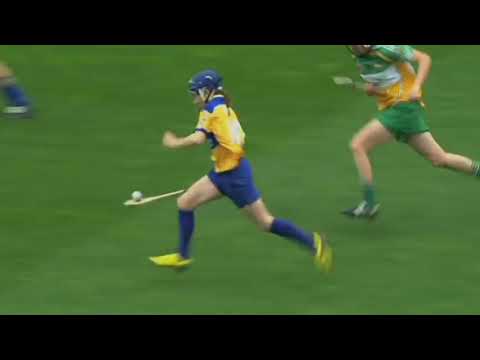
Sign in to saveHurling (, ') is an outdoor team game of ancient Gaelic Irish origin. When played by women, it is called camogie ('), which shares a common Gaelic root. One of Ireland's native Gaelic games, it shares a number of features with Gaelic football, such as the field and goals, the number of players and much terminology. It has been labelled as the fastest field sport in the world.
Key facts
- Sport.image
- David Collins and Eoin Kelly (Tipperary).jpg
- Sport.caption
- David Collins of Galway holds off Tipperary's Eoin Kelly in the 2014 National Hurling League
- Sport.union
- Gaelic Athletic Association
- Sport.first
- Pre-medieval origins; first codified match played 27 January 1883 in Dublin, Ireland
- Sport.contact
- Yes
- Sport.team
- 26 (15 and 11 substitutes)
- Sport.mgender
- Camogie is the female variant
- Sport.equipment
- '''', hurley, helmet
- Sport.olympic
- Demonstration sport 1904
- Sport.paralympic
- No
- Intangible heritage.ICH
- Hurling
- Intangible heritage.Countries
- Ireland
- Intangible heritage.ID
- 01263
- Intangible heritage.Region
- ENA
- Intangible heritage.Year
- 2
- Intangible heritage.Session
- 13th
- Intangible heritage.List
- Representative
via Wikipedia infobox
Described at
Hurling - UNESCO Intangible Cultural Heritage
ich.unesco.org →Hurling, or Camogie (a form of Hurling played by women), is a field game played by two teams which dates back 2,000 years and features strongly in Irish mythology, most notably in the epic saga of Cú Chulainn. It is played throughout the island of Ireland, particularly in more fertile agricultural areas, as well as overseas. Traditionally, the number of players in the game was unregulated and games were played across open fields. Nowadays, there are fifteen players on adult teams and the game is played on a clearly marked pitch. Players use a wooden stick (hurley), similar to a hockey stick but with a flat end, and a small ball (sliotar), with the aim being to use the hurley to strike the sliotar and hit it between the opposing team’s goalposts. The primary bearers and practitioners are the players, known as ‘hurlers’ (male) and ‘camógs’ (female). Hurling is considered as an intrinsic part of Irish culture and plays a central role in promoting health and wellbeing, inclusiveness and team spirit. Today, the skills are promoted and transmitted through coaching and games in schools and clubs. As the custodians of Hurling, the Gaelic Athletic Association and the Camogie Association, both volunteer-led organizations, play a central role in transmitting the skills and values associated with Hurling. 1. Knowledge and practices concerning nature and the universe (308) 2. Oral traditions and expressions (384) 3. Performing arts (411) 4. Social practices, rituals and festive events (584) 5. Traditional craftsmanship (460)
Excerpt from a page describing this subject · 7,262 chars · not written by Vinony
Wikidata facts
- Subclass of
- Gaelic games
- Country of origin
- Republic of Ireland
- Duration
- 70
- Image
- Scoring in Gaelic games - H shaped posts.png
Show 6 more facts
- Commons category
- Hurling
- topic's main category
- Category:Hurling
- Commons gallery
- Hurling
- indigenous to
- Ireland
- different from
- cammag
- described at URL
- nationalinventoryich.chg.gov.ie/hurling-iomanaiocht
via Wikidata · CC0
~28 min read
Encyclopedic overview
30 sectionsContents
- Statistics
- Rules
- Playing field
- Teams
- Helmets
- Duration, extra time, replays
- Technical fouls
- Aggressive fouls
- Scoring
- Tackling
- Restarting play
- Officials
- Injury risk
- History
- Early history
- First rules
- Gaelic Athletic Association
- International
- Argentina
- Australia
- Great Britain
- South Africa
- North America
- Olympic Games
- Major hurling competitions
- Popular culture
- See also
- References
- Further reading
- External links
Hurling (, ') is an outdoor team game of ancient Gaelic Irish origin. When played by women, it is called camogie ('), which shares a common Gaelic root. One of Ireland's native Gaelic games, it shares a number of features with Gaelic football, such as the field and goals, the number of players and much terminology. It has been labelled as the fastest field sport in the world.
The objective of the game is for players to use an ash wood stick called a hurl or hurley (in Irish a ', pronounced or in English) to hit a small ball called a ' (pronounced in English) between the opponent's goalposts either over the crossbar for one point or under the crossbar into a net guarded by a goalkeeper for three points. The ' can be caught in the hand and carried for not more than four steps, struck in the air or struck on the ground with the hurley. It can be kicked, or slapped with an open hand (the hand pass), for short-range passing. A player who wants to carry the ball for more than four steps has to bounce or balance the ' on the end of the stick (solo), and the ball can be handled only twice while in the player's possession. Provided that a player has at least one foot on the ground, he may make a shoulder-to-shoulder charge on an opponent who is in possession of the ball or is playing the ball, or when both players are moving in the direction of the ball. No protective padding is worn by players though a plastic protective helmet with a faceguard has been mandatory for all age groups since 2010.
Excerpted from Wikipedia’s “hurling” article, available under the CC BY-SA 4.0 licence.