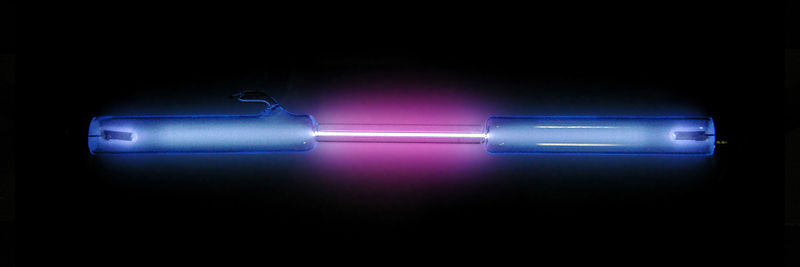
File:Hydrogen_discharge_tube.jpg · Wikimedia Commons · See Wikimedia Commons
OverviewAI-generated
Hydrogen is a chemical element with the symbol H and atomic number 1. It is classified as an atmophile element, a nonmetal, an s-block element, and a reducing agent. The element has an oxidation state of -1, 1, or 0 and an electronegativity of 2.2. Its antiparticle is antihydrogen.
The substance was discovered in 1766 by Henry Cavendish, Mikhail Lomonosov, and Antoine Lavoisier in the Russian Empire, the United Kingdom, and France. It is part of period 1 and group 1, and is a component of water. Physical properties include a mass of 1.008, a density of 0.089870, a refractive index of 1.000132, a speed of sound of 1270, and a thermal conductivity of 0.1805.
Synthesized by Vinony from 25 facts across 3 sources: Wikidata, PubMed, Vinony graph. Generated from structured data (not the Wikipedia text) and checked against those facts — may still contain errors.
Research
860,653 papers- Hydrogen from Water is more than a Fuel: Hydrogenations and Hydrodeoxygenations for a Biobased Economy.ReviewChemical record (New York, N.Y.) · 2021Harnisch F, Morejón MCDOI: 10.1002/tcr.202100034
- Development of Liquid Organic Hydrogen Carriers for Hydrogen Storage and Transport.ReviewInternational journal of molecular sciences · 2024Le TH, Tran N, Lee HJDOI: 10.3390/ijms25021359
- Hydrogen Production and Utilization in a Membrane Reactor.Journal of visualized experiments : JoVE · 2023Rousseau AR, Stankovic MD, Berlinguette CPDOI: 10.3791/65098
- Photocatalytic Approaches for Hydrogen Production via Formic Acid Decomposition.ReviewTopics in current chemistry (Cham) · 2019Navlani-García M, Salinas-Torres D, Mori K et al.DOI: 10.1007/s41061-019-0253-4
- Benzothiazoline: versatile hydrogen donor for organocatalytic transfer hydrogenation.ReviewAccounts of chemical research · 2015Zhu C, Saito K, Yamanaka M et al.DOI: 10.1021/ar500414x
- A strategy of local hydrogen capture and catalytic hydrogenation for enhanced therapy of chronic liver diseases.Theranostics · 2023Tao G, Liu F, Jin Z et al.DOI: 10.7150/thno.80494
- Carbon neutral hydrogen storage and release cycles based on dual-functional roles of formamides.Nature communications · 2023Wei D, Shi X, Junge H et al.DOI: 10.1038/s41467-023-39309-4
- Structural basis for bacterial energy extraction from atmospheric hydrogen.Nature · 2023Grinter R, Kropp A, Venugopal H et al.DOI: 10.1038/s41586-023-05781-7
via PubMed
Wikidata facts
- Instance of
- atmophile element
- Subclass of
- fuel
- Part of
- group 1
- Named after
- water
- Mass
- 1.008
- Image
- Elektronskal 1.svg
- Has use
- hydrogen technologies
Show 25 more facts
- oxidation state
- 0
- atomic number
- 1
- Commons category
- Hydrogen
- element symbol
- H
- topic's main category
- Category:Hydrogen
- electronegativity
- 2.2
- antiparticle
- antihydrogen
- discoverer or inventor
- Antoine Lavoisier
- time of discovery or invention
- 1766-00-00
- Commons gallery
- Hydrogen
- location of discovery
- France
- on focus list of Wikimedia project
- WikiProject Climate change
- refractive index
- 1.000132
- density
- 0.089870
- speed of sound
- 1270
- thermal conductivity
- 0.1805
- ionization energy
- 1312
- melting point
- -259.14
- boiling point
- -252.87
- molar enthalpy of vaporization
- 0.452
- electron configuration
- 1s¹
- ionic radius
- 54
- Unicode character
- 氫
- Stack Exchange tag
- physics.stackexchange.com/tags/hydrogen
- native label
- Hydrogène
Sources (9)
via Wikidata · CC0
Article · Italiano
L'idrogeno (simbolo H, dal greco ὕδωρ, hýdor, «acqua», più la radice γεν-, ghen-, «generare», quindi «generatore d'acqua») è il primo elemento chimico della tavola periodica (numero atomico 1) e il più leggero. Con l'idrogeno inizia il primo gruppo del sistema periodico e il blocco s. È l'elemento più abbondante dell'universo osservabile e il suo isotopo più comune, il prozio, consiste di un protone, che forma il nucleo, e di un elettrone. Essendo l'atomo più semplice, è stato studiato in maniera approfondita dalla meccanica quantistica. Allo stato libero, a pressione atmosferica e temperatura ambiente (298 K), si trova sotto forma di gas biatomico avente formula H2, incolore, inodore, insapore e altamente infiammabile, con un punto di ebollizione di 20,27 K e un punto di fusione di 14,02 K. Allo stato legato è presente nell'acqua (11,19%) e in tutti i composti organici e organismi viventi; inoltre è occluso in alcune rocce, come il granito, e forma composti con la maggior parte degli elementi, spesso anche per sintesi diretta. È il principale costituente delle stelle, dove è presente nello stato di plasma e rappresenta il combustibile delle reazioni termonucleari, mentre sulla Terra è scarsamente presente allo stato libero e molecolare e deve quindi essere prodotto per i suoi vari usi; in particolare è usato nella produzione di ammoniaca, nell'idrogenazione degli oli vegetali, in aeronautica (in passato nei dirigibili), come combustibile alternativo e più di recente come riserva di energia nelle pile a combustibile.
Abstract from DBpedia / Wikipedia · CC BY-SA
Gallery (42)
Available in 224 languages
- Español
- Français
- Deutsch
- 中文
- 日本語
- Русский
- Português
- Italiano
- العربية
- हिन्दी
- abstract
- Afrikaans
- Albanian
- Albanian
- Amharic
- Angika
- Aragonese
- Armenian
Show 205 more
- Assamese
- Asturian
- azb
- Azerbaijani
- Bahasa Indonesia
- Balinese
- Bangla
- Bashkir
- Basque
- bat_smg
- Bavarian
- be_x_old
- Belarusian
- Betawi
- Bhojpuri
- Bikol
- blk
- Bosnian
- Breton
- Bulgarian
- Buriat
- Burmese
- Catalan
- cdo
- Cebuano
- Central Kurdish
- Chechen
- Church Slavic
- Chuvash
- Colognian
- Cornish
- Corsican
- Crimean Tatar
- Croatian
- Czech
- Danish
- Divehi
- Egyptian Arabic
- eml
- Erzya
- Esperanto
- Estonian
- Extremaduran
- Faroese
- Fiji Hindi
- Fijian
- Filipino
- Finnish
- Friulian
- Galician
- Gan Chinese
- gcr
- Georgian
- Greek
- Guarani
- Gujarati
- Haitian Creole
- Hakka Chinese
- Hawaiian
- Hebrew
- Hungarian
- hyw
- Icelandic
- Ido
- Iloko
- Inari Sami
- Interlingua
- Interlingue
- Irish
- Jamaican Creole English
- Javanese
- Kabyle
- Kalmyk
- Kannada
- Kanuri
- Kara-Kalpak
- Kashmiri
- Kazakh
- kbp
- kge
- Khmer
- Kikuyu
- Komi
- Komi-Permyak
- Kurdish
- Kyrgyz
- Lao
- Latin
- Latvian
- Lezghian
- Ligurian
- Limburgish
- Lingala
- Lingua Franca Nova
- Lithuanian
- lld
- Lojban
- Lombard
- Low German
- Lower Sorbian
- Luxembourgish
- Macedonian
- Madurese
- Malagasy
- Malay
- Malayalam
- Maltese
- Manipuri
- Manx
- Māori
- Marathi
- Mari
- Mingrelian
- Mirandese
- Moksha
- Mongolian
- Moroccan Arabic
- nah
- Navajo
- nds_nl
- Nederlands
- Nepali
- Newari
- Northern Frisian
- Norwegian
- Norwegian Nynorsk
- Novial
- Occitan
- Odia
- Old English
- olo
- Oromo
- Ossetic
- Palatine German
- Papiamento
- Pashto
- Piedmontese
- Polski
- Pontic
- Punjabi
- Quechua
- roa_rup
- Romanian
- rsk
- Rusyn
- Sanskrit
- Santali
- Sardinian
- Saterland Frisian
- Scots
- Scottish Gaelic
- Serbian
- Serbian (Latin)
- Shona
- Sicilian
- Silesian
- simple
- Sindhi
- Sinhala
- skr
- Slovak
- Slovenian
- Somali
- Standard Moroccan Tamazight
- Sundanese
- Svenska
- Swahili
- Tachelhit
- Tajik
- Tamil
- Tatar
- Telugu
- Tibetan
- Tiếng Việt
- Toki Pona
- Tumbuka
- Türkçe
- Tuvinian
- Ukrainian
- Upper Sorbian
- Urdu
- Uyghur
- Uzbek
- Venetian
- Veps
- Volapük
- Walloon
- Waray
- Welsh
- West Flemish
- Western Frisian
- Western Mari
- Western Panjabi
- Wu Chinese
- Yakut
- Yiddish
- Yoruba
- Zaza
- zh_classical
- zh_min_nan
- zh_yue
- Zulu
- فارسی
- ไทย
- 한국어
via Wikidata sitelinks · CC0