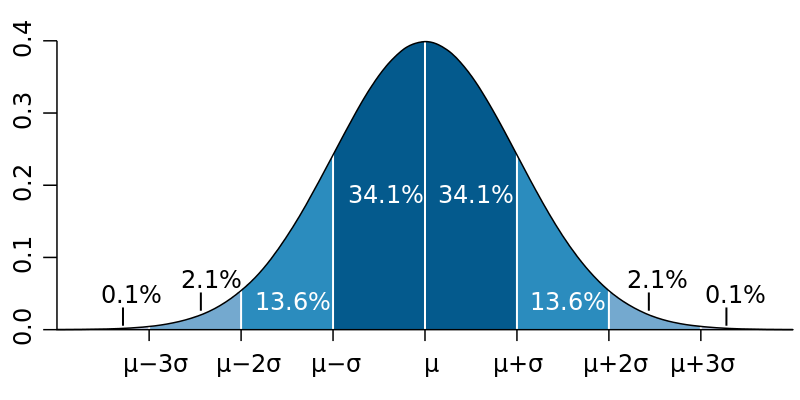
File:Standard_deviation_diagram_micro.svg · Wikimedia Commons · See Wikimedia Commons
independent events
Sign in to saveAlso known as independent, statistically independent, stochastically independent, independence
term in probability theory
Wikidata facts
- Instance of
- relation
Show 3 more facts
- Commons category
- Statistical dependence
- topic's main category
- Category:Independence (probability theory)
- maintained by WikiProject
- WikiProject Mathematics
Sources (2)
via Wikidata · CC0
~30 min read
Encyclopedic overview
Independence is a fundamental notion in probability theory, as in statistics and the theory of stochastic processes. Two events are independent, statistically independent, or stochastically independent if, informally speaking, the occurrence of one does not affect the probability of occurrence of the other or, equivalently, does not affect the odds. Similarly, two random variables are independent if the realization of one does not affect the probability distribution of the other. Conversely, dependence is when the occurrence of one event does affect the likelihood of another.
When dealing with collections of more than two events, two notions of independence need to be distinguished. The events are called pairwise independent if any two events in the collection are independent of each other, while mutual independence (or collective independence) of events means, informally speaking, that each event is independent of any combination of other events in the collection. A similar notion exists for collections of random variables. Mutual independence implies pairwise independence, but not the other way around. In the standard literature of probability theory, statistics, and stochastic processes, independence without further qualification usually refers to mutual independence.
Excerpted from Wikipedia’s “independent events” article, available under the CC BY-SA 4.0 licence.