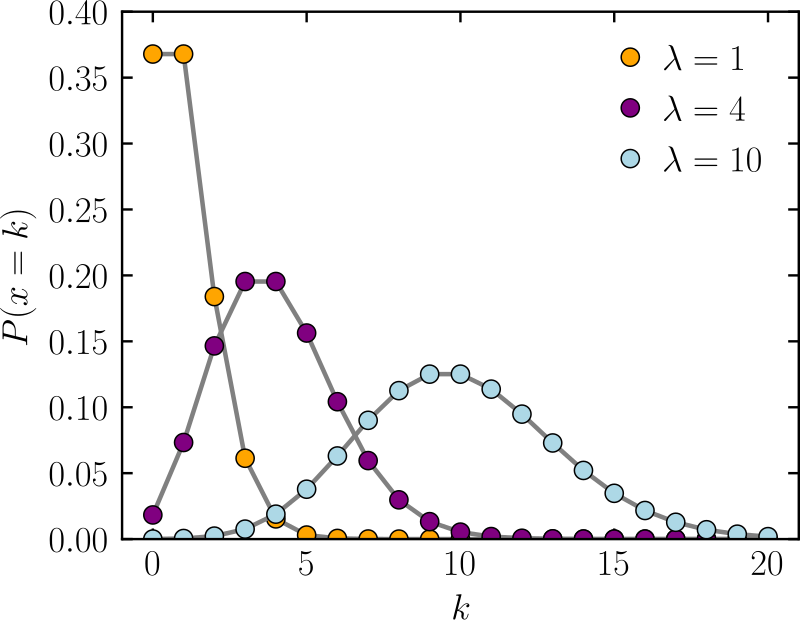
File:Poisson_pmf.svg · Wikimedia Commons · See Wikimedia Commons
Poisson distribution
Sign in to saveAlso known as law of small numbers
discrete probability distribution
A Poisson distribution is a mathematical tool for describing the probability of how many times something happens in a fixed period of time or space, like the number of emails you receive in an hour or customer arrivals at a store in a day. It's useful because many real-world events that occur randomly and independently follow this pattern, making it easier to predict and plan for these kinds of situations.
AI-generated from the Wikipedia summary — may contain errors.
Research
16,941 papers- [Poisson distribution for number of events].Tidsskrift for den Norske laegeforening : tidsskrift for praktisk medicin, ny raekke · 2023
- Understanding poisson regression.The Journal of nursing education · 2014
- The Poisson distribution model fits UMI-based single-cell RNA-sequencing data.BMC bioinformatics · 2023
- Use of the Poisson Distribution Is a Helpful Tool That Is Underused in Nursing Practice.Journal of nursing care quality · 2022
- Regression: Poisson.International journal of injury control and safety promotion · 2018
via PubMed
Wikidata facts
- Named after
- Siméon Denis Poisson
- Image
- Poisson pmf.svg
Show 5 more facts
- topic's main category
- Category:Poisson distribution
- Commons category
- Poisson distribution
- on focus list of Wikimedia project
- Wikipedia:Vital articles/Level/4
- maintained by WikiProject
- WikiProject Mathematics
- Stack Exchange tag
- stackoverflow.com/tags/poisson
Sources (3)
via Wikidata · CC0
~40 min read
Encyclopedic overview
In probability theory and statistics, the Poisson distribution (/ˈpwɑːsɒn/) is a discrete probability distribution that expresses the probability of a given number of events occurring in a fixed interval of time if these events occur with a known constant mean rate and independently of the time since the last event. It can also be used for the number of events in other types of intervals than time, and in dimension greater than 1 (e.g., number of events in a given area or volume). The Poisson distribution is named after French mathematician Siméon Denis Poisson. It plays an important role for discrete-stable distributions.
Under a Poisson distribution with the expectation of λ events in a given interval, the probability of k events in the same interval is:
Excerpted from Wikipedia’s “Poisson distribution” article, available under the CC BY-SA 4.0 licence.