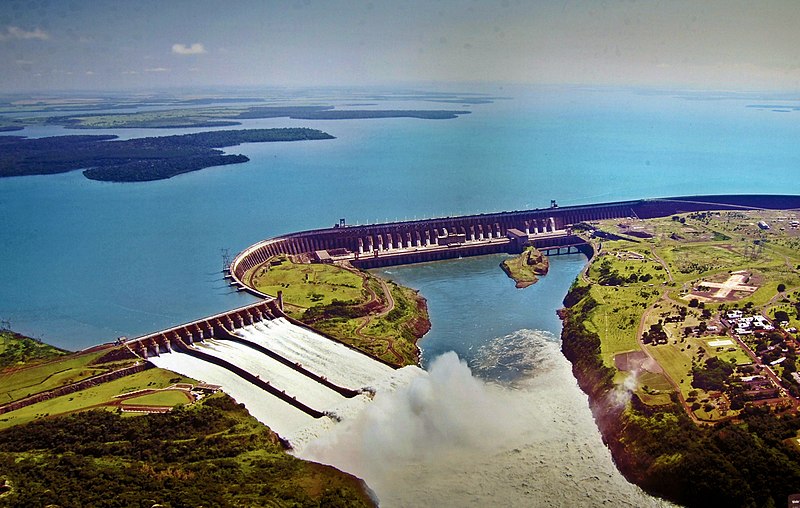
इटाइपू बाँध
Also known as Central Hidroeléctrica ITAIPU, ITAIPU Dam, Itaipu Power Plant
hydroelectric dam on the Paraná River on the border between Brazil and Paraguay
AI overview
Itaipu Dam is a hydroelectric dam built on the Paraná River between Brazil and Paraguay that generates electricity by harnessing water power. It matters because it is one of the world's largest sources of hydroelectric energy, providing significant electricity to both countries.
AI-generated from the Wikipedia summary — may contain errors.
Described at

Itaipu Hydroelectric Dam
The Itaipu Hydroelectric Dam (the Dam) is located on the Paraná River on the border between Brazil and Paraguay.
gihub.org →Location Paraná River on the border between Brazil and Paraguay Sector Energy Procuring authorities Government of Brazil, Government of Paraguay Project company Itaipu Binacional Project company obligations Design, build, operate Financial closure year - Capital value USD17.6 billion – 2018 value Start of operations Completion of works: 1982 Start of electricity generation: 1984 Contract period (years) 50 (Treaty of Itaipu: 1973–2023) Key facts Co-owned project between Brazil and Paraguay The dam was developed during a period of conflict over land at the border between Brazil and Paraguay in the 1960s, as both countries perceived the untapped energy potential of the Paraná river. The joint signature of the Act of Iguaçu in 1966 and the Treaty of Itaipu in 1973 enabled the project to emerge as a binational and coordinated effort to build and manage the dam while sharing its costs and benefits. Itaipu Binacional, a company jointly owned by Brazil and Paraguay, was created by the Treaty of Itaipu to build and operate the dam. The construction of the dam began in February 1971 and cost USD17.6 billion (2018 prices) by the time the facility started operating in 1984. The procurement of the project was widely exposed to corruption at the construction stage, as the politicians in power encouraged the selection of private companies that had ties with political figures. Since that period, the fight against corruption and fraud has been of major importance for Itaipu Binacional and has been managed by the establishment of a General Ombudsman’s office, Ethics Committee, and Internal Audits and Compliance Advisory functions. The Treaty, when originally signed, required Paraguay to sell its unused electricity to Brazil for USD124 million a year until 2023. In July 2009, the two countries signed a deal under which Brazil agreed to triple its payments to Paraguay. Since its completion, the dam has risen as a project of the highest significance in the economic and diplomatic history of the two countries. The Itaipu Hydroelectric Dam contract was signed and the dam built at a time when both Brazil and Paraguay were under military rule. The two countries had a long history of conflict and, in the 1960s, Brazil and Paraguay were in dispute over borderlands and the potential to produce hydroelectric power from water bodies on their shared border. Territorial sovereignty was at the heart of a conflict from March 1965 to June 1966. The Act of Iguaçu, signed on 22 June 1966, ended the conflict and “marked the first official step toward what became the Itaipu Hydroelectric Dam” and laid the groundwork for the Treaty of Itaipu signed in 1973. The signature of the Treaty led to conflicts with Argentina, as the construction of the dam directly affects water flows received downstream on the Paraná river. This threatened Argentina’s various plans for hydropower production, such as at the then-planned Corpus hydroelectric power plant. The conflict was resolved in the 1979 Tripartite Itaipu-Corpus Agreement, signed by Paraguay, Argentina and Brazil, which sets out downstream flow requirements with which Itaipu Binacional must comply. The 1966 Act of Iguaçu proclaimed that Brazil and Paraguay would commonly explore the hydroelectric potential of the resources common to the two countries, and stated the agreement that the electricity generated would be evenly shared but could be sold from one of the two parties to the other at a fixed price decided by the countries, and not at ‘cost price’ as requested by Paraguay. The Treaty of Itaipu of 1973 further reinforced the joint agreement of both governments in “effecting the hydroelectric development of the hydraulic resources of the Paraná River.” To that effect, the Treaty of Itaipu created a binational entity called Itaipu Binacional, founded in 1974 and co-owned by Brazil and Paraguay. The national administrations in charge of electricity in the two countries, Centrais Elétricas Brasileiras (Eletrobr