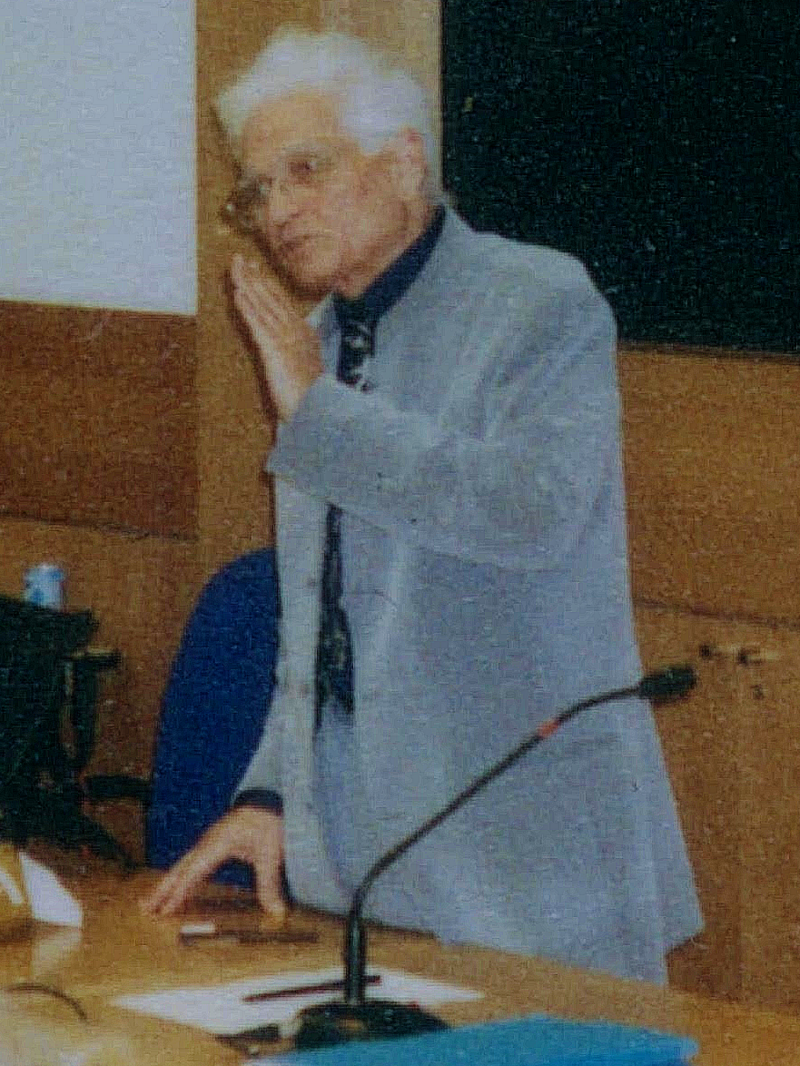
File:Derrida_EHESS_(cropped).png · Wikimedia Commons · See Wikimedia Commons
Jacques Derrida
Sign in to saveAlso known as Jackie Derrida, Jackie Elie Derrida, Jackie Élie Derrida, J. Derrida
French philosopher (1930–2004)
Jacques Derrida was a French philosopher who developed an influential approach to reading texts called deconstruction, which challenged the idea that language and meaning are straightforward or stable. His work fundamentally changed how scholars across many fields—including literature, law, and politics—think about language, interpretation, and the assumptions embedded in Western thought.
AI-generated from the Wikipedia summary — may contain errors.
Film & TV
El Biar, French Algeria
Jacques Derrida (born Jackie Élie Derrida; 15 July 1930 – 9 October 2004) was a French philosopher. He was best known for developing a form of semiotic analysis known as deconstruction, which he discussed in numerous texts, and developed in the context of phenomenology. Derrida is one of the major figures associated with post-structuralism and postmodern philosophy.
Known for
- Hamlet Within2022
- Cameraperson — Self (archive footage)2016
- Pourquoi la guerre aujourd’hui? — Self2015
- Jacques Derrida, le courage de la pensée — Self (Archive footage)2014
- Arrows of Time2007
- Kulturplatz — Self2004
- Parola (su una data)2003
- Derrida — Himself2002
- Jacques Lacan, la psychanalyse réinventée — Self2001
- Derrida's Elsewhere — Himself1999
via TMDB
Wikidata facts
- Instance of
- human
- Given name
- Jacques
- Gender
- male
- Citizenship
- France
- Place of birth
- El Biar
- Place of death
- 5th arrondissement of Paris
- Spouse
- Marguerite Aucouturier
- Child
- Pierre Alferi
- Occupation
- writer
- Educated at
- Lycée Louis-le-Grand
- Employer
- University of California, Irvine
- Languages spoken
- French
- Doctoral advisor
- Jean-Toussaint Desanti
- Student of
- Jean Hyppolite
- Field of work
- philosophy of language
- Movement
- deconstruction
- Official website
- plato.stanford.edu/entries/derrida
- Image
- Derrida EHESS (cropped).png
- Work location
- France
Show 19 more facts
- Commons category
- Jacques Derrida
- cause of death
- pancreatic cancer
- date of birth
- 1930-07-15
- topic's main category
- Category:Jacques Derrida
- influenced by
- Ludwig Wittgenstein
- student
- Bernard-Henri Lévy
- described by source
- UbuWeb
- manner of death
- natural causes
- birth name
- Jackie Élie Derrida
- name in native language
- Jacques Derrida
- writing language
- French
- Academia.edu profile URL
- www.academia.edu/People/Jacques_Derrida
- end of work period
- 2004-01-01
- date of death
- 2004-10-09
- time period
- contemporary philosophy
- start of work period
- 1957-01-01
- on focus list of Wikimedia project
- Wikipedia:Vital articles/Level/4
Sources (8)
via Wikidata · CC0
~40 min read
Encyclopedic overview
Jacques Derrida (/dɛrɪˈdə, ˈdɛriːdɑː/; French: [ʒak dɛʁida]; born Jackie Élie Derrida; 15 July 1930 – 9 October 2004) was a French philosopher. He developed the philosophy of deconstruction, which he utilized in a number of his texts, and which was developed through close readings of the linguistics of Ferdinand de Saussure and Husserlian and Heideggerian phenomenology. He is one of the major figures associated with post-structuralism and postmodern philosophy although he distanced himself from post-structuralism and disavowed the word "postmodernity".
During his career, Derrida published over 40 books, together with hundreds of essays and public presentations. He has had a significant influence on the humanities and social sciences, including philosophy, literature, law, anthropology, historiography, applied linguistics, sociolinguistics, psychoanalysis, music, architecture, and political theory.
Excerpted from Wikipedia’s “Jacques Derrida” article, available under the CC BY-SA 4.0 licence.
Gallery (4)
Available in 85 languages
- Español
- Français
- Deutsch
- 中文
- 日本語
- Русский
- Português
- Italiano
- العربية
- हिन्दी
- Afrikaans
- Albanian
- Armenian
- Assamese
- Asturian
- Azerbaijani
- Bahasa Indonesia
- Bangla
Show 66 more
- Basque
- be_x_old
- Belarusian
- Bosnian
- Bulgarian
- Catalan
- Croatian
- Czech
- Danish
- Egyptian Arabic
- Esperanto
- Estonian
- Finnish
- Galician
- Georgian
- Greek
- Hebrew
- Hungarian
- Icelandic
- Ido
- Interlingua
- Irish
- Javanese
- Kazakh
- Latin
- Latvian
- Lithuanian
- Macedonian
- Malagasy
- Malayalam
- Mingrelian
- Nederlands
- Newari
- Norwegian
- Norwegian Nynorsk
- Occitan
- Pashto
- Piedmontese
- Polski
- Punjabi
- Quechua
- Romanian
- Scots
- Serbian
- Serbian (Latin)
- simple
- Slovak
- Slovenian
- Svenska
- Swahili
- Tamil
- Tiếng Việt
- Türkçe
- Ukrainian
- Urdu
- Uzbek
- Volapük
- Waray
- Welsh
- Western Frisian
- Western Panjabi
- Wu Chinese
- zh_min_nan
- zh_yue
- فارسی
- 한국어
via Wikidata sitelinks · CC0