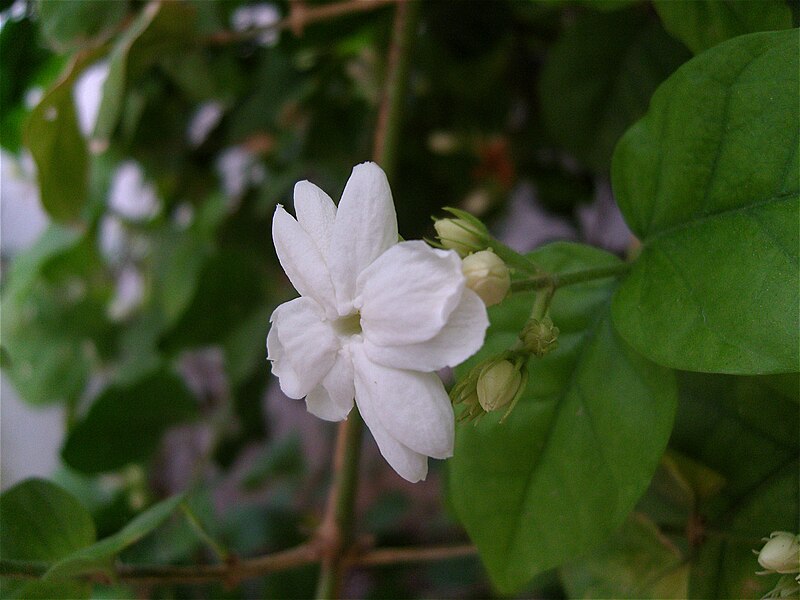
Jasminum sambac
Also known as Jasminium Sambac (flower), mogra, sampaguita
species of shrub from the olive family
AI overview
Jasminum sambac is a shrub belonging to the olive family, commonly known as Arabian jasmine. It's valued worldwide for its fragrant white flowers, which are used in perfumes, teas, and traditional medicines.
AI-generated from the Wikipedia summary — may contain errors.
Species
Jasminum sambac
SPECIES
- KingdomPlantae
- PhylumTracheophyta
- ClassMagnoliopsida
- OrderLamiales
- FamilyOleaceae
Native toEast Himalaya, India
Arabischer Jasmin (Jasminum sambac) ist eine Pflanzenart der Gattung Jasminum in der Familie der Ölbaumgewächse (Oleaceae). Die Art kommt wild von Bhutan bis Indien vor und wird weltweit kultiviert.
via GBIF · Kew POWO
Article
Jasminum sambac (Arabian jasmine or Sambac jasmine or Mogra) is a species of jasmine native to Bhutan and India. It is cultivated in many places, especially West Asia, South Asia and Southeast Asia. It is naturalised in many scattered locales: Mauritius, Madagascar, the Maldives, Christmas Island, Chiapas, Central America, southern Florida, the Bahamas, Cuba, Hispaniola, Jamaica, Puerto Rico, and the Lesser Antilles.
Jasminum sambac is a small shrub or vine growing up to 0.5 to 3 m (1.6 to 9.8 ft) in height. It is widely cultivated for its attractive and sweetly fragrant flowers. The flowers may be used as a fragrant ingredient in perfumes and jasmine tea. It is the national flower of the Philippines, where it is known as sampaguita, as well as being one of the three national flowers of Indonesia, where it is known as melati putih.