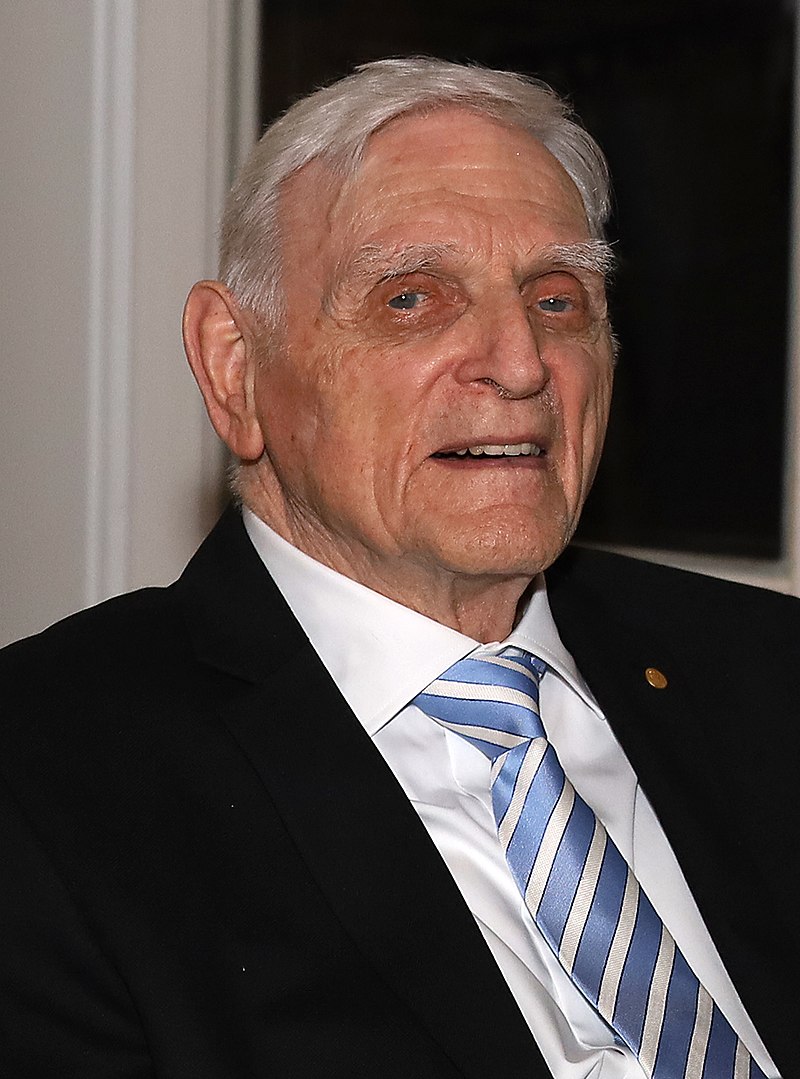
File:Nobel_9_Dec_2019_029_copy_(49204051647)_(cropped).jpg · Wikimedia Commons · See Wikimedia Commons
John B. Goodenough
Sign in to saveAlso known as John B Goodenough, J. B. Goodenough, J B Goodenough, J. Goodenough, J Goodenough, Goodenough, Goodenough J, Goodenough J.
American materials scientist (1922–2023)
John B. Goodenough was an American materials scientist who lived from 1922 to 2023 and made pioneering contributions to battery technology and materials science. His work has had widespread practical importance for modern electronics and energy storage, earning him significant recognition in the scientific community.
AI-generated from the Wikipedia summary — may contain errors.
Person · Open Library
- Born
- 1922
- Died
- 2023
- Works
- 16
Top works
- Structure and Bonding
- Magnetism and the chemical band
- Magnetism and the chemical bond
- Last poems
- Les oxydes des métaux de transition
via Open Library + Wikidata
Listeners · Last.fm
- Listeners
- 2
- Total plays
- 2
<a href="https://www.last.fm/music/John+B.+Goodenough">Read more on Last.fm</a>
Recent publications · Crossref
5 total works indexed
- Generalized Gradient Approximation Made Simple
· 1996 · cited 204,591x
- Highly accurate protein structure prediction with AlphaFold
· 2021 · cited 43,635x
- Gene Ontology: tool for the unification of biology
· 2000 · cited 36,910x
- Matplotlib: A 2D Graphics Environment
· 2007 · cited 35,581x
- The MOS 36-ltem Short-Form Health Survey (SF-36)
· 1992 · cited 29,131x
via Crossref · CC0
Nobel Prize
- The Nobel Prize in Chemistry2019
“for the development of lithium-ion batteries”
Shared · 1/3 portion
Wikidata facts
- Instance of
- human
- Gender
- male
- Citizenship
- United States
- Place of birth
- Jena
- Place of death
- Austin
- Sibling
- Ward Goodenough
- Occupation
- university teacher
- Educated at
- University of Chicago
- Employer
- Air National Guard
- Languages spoken
- English language
- Academic degree
- Doctor of Philosophy
- Doctoral advisor
- Clarence Zener
- Field of work
- lithium-ion battery
- Conflict
- World War II
- Military branch
- United States Army Air Forces
- Official website
- www.me.utexas.edu/people/faculty-directory/goodenough
- Image
- Nobel 9 Dec 2019 029 copy (49204051647) (cropped).jpg
Show 10 more facts
- influenced by
- Philip W. Anderson
- member of
- Association for Computing Machinery
- date of birth
- 1922-07-25
- name in native language
- John Bannister Goodenough
- subject has role
- centenarian
- Commons category
- John B. Goodenough
- date of death
- 2023-06-25
- medical condition
- dyslexia
- Commons Creator page
- John B. Goodenough
- interested in
- physics
Sources (13)
via Wikidata · CC0
~15 min read
Encyclopedic overview
John Bannister Goodenough (/ˈɡʊdɪnʌf/ GUUD-in-uf; July 25, 1922 – June 25, 2023) was an American materials scientist, a solid-state physicist, and a Nobel laureate in chemistry. From 1986 he was a professor of Materials Science, Electrical Engineering and Mechanical Engineering, at the University of Texas at Austin. He is credited with identifying the Goodenough–Kanamori rules of the sign of the magnetic superexchange in materials, with developing materials for computer random-access magnetic memory and with inventing cathode materials for lithium-ion batteries.
Goodenough was awarded the National Medal of Science, the Copley Medal, the Fermi Award, the Draper Prize, and the Japan Prize. The John B. Goodenough Award in materials science is named for him. In 2019, he was awarded the Nobel Prize in Chemistry alongside M. Stanley Whittingham and Akira Yoshino; at 97 years old, he became the oldest Nobel laureate in history. From August 27, 2021, until his death, he was the oldest living Nobel Prize laureate.
Excerpted from Wikipedia’s “John B. Goodenough” article, available under the CC BY-SA 4.0 licence.