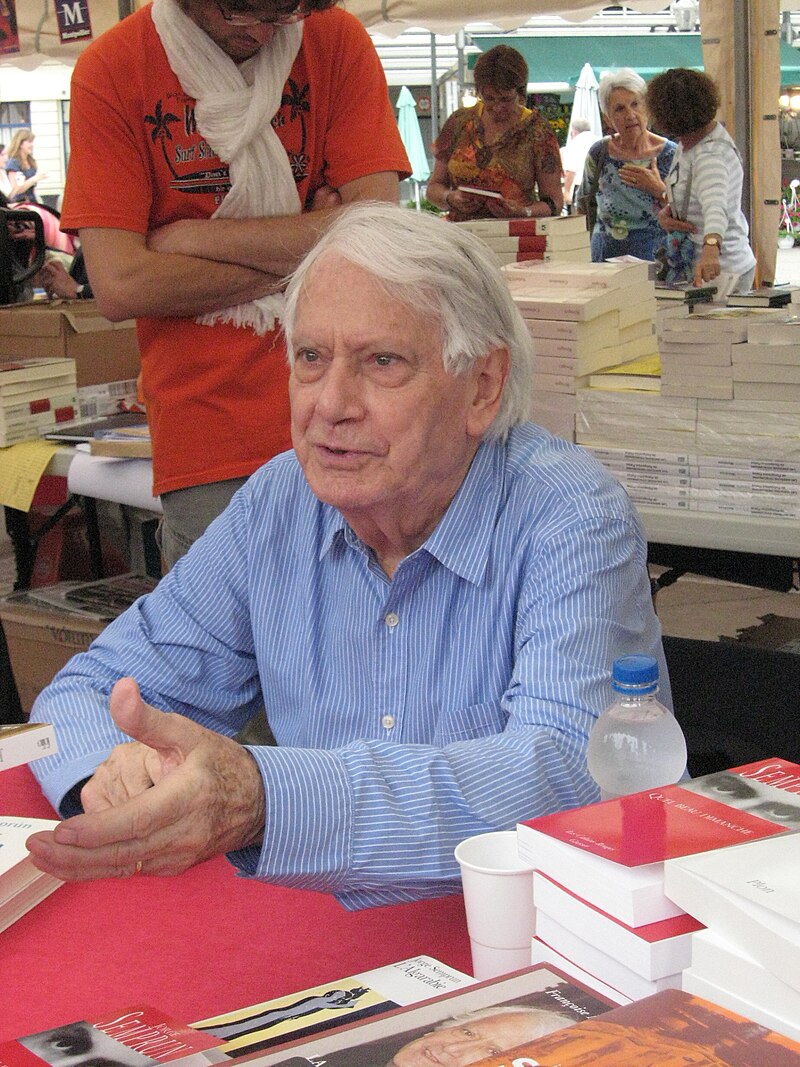
File:Jorge_Semprun_2009.jpg · Wikimedia Commons · See Wikimedia Commons
Jorge Semprún
Sign in to saveAlso known as Jorge Semprun, Jorge Semprun Maura
Spanish-French writer (1923-2011)
OverviewAI-generated
Jorge Semprún was a Spanish and French writer, screenwriter, politician, and philosopher. Born in Madrid in 1923, he was educated at Lycée Henri-IV and spoke both Spanish and French. He was a member of the Communist Party of Spain and served as a member of the Francs-tireurs et partisans. During his life, he was detained at the Buchenwald concentration camp. He used the pseudonym Federico Sánchez and had a child named Jaime Semprun.
Semprún was a member of the German Academy for Language and Literature, the Bavarian Academy of Fine Arts, and the Académie Goncourt. He received the Prix Femina, Saint George's Cross, Edgar Awards, and Premio Planeta de Novela. He was nominated for an Academy Award for Best Writing, Original Screenplay, an Academy Award for Best Writing, Adapted Screenplay, a BAFTA Award for Best Screenplay, and an award from the National Society of Film Critics. He died in the 7th arrondissement of Paris in 2011.
Synthesized by Vinony from 31 facts across 3 sources: Wikidata, TMDb, Open Library. Generated from structured data (not the Wikipedia text) and checked against those facts — may still contain errors.
Person · Open Library
- Born
- 1923
- Died
- 2011
- Works
- 93
Top works
- Ti apeginan hoi hevdomēnta chiliades Hevraioi tēs Thessalonikēs?
- Geopolítica del hambre
- Long Voyage
- Ne Guzel Bir Pazar
- Federico Sanchez'in Özyasamöyküsü
via Open Library + Wikidata
Film & TV
Madrid, Spain
Jorge Semprún Maura was a Spanish writer and politician. From 1953 to 1962, during the dictatorship of Francisco Franco, Semprún lived clandestinely in Spain working as an organizer for the exiled Communist Party of Spain, but was expelled from the party in 1964. After Franco's death and the change to a democratic government, he was Spain's Minister of Culture from 1988 to 1991. He was…
Known for
- The Many Lives of Jorge Semprún — Self (archive footage)2023
- Inside a Nazi Mind: The Kindly Ones by Jonathan Littell — Self - Writer (archive footage)2023
- Valérian, histoire d'une création — Self (archive footage)2017
- Literatur im Foyer — himself2000
- Che: muerte de la utopia?1999
- Vivement dimanche — Self1998
- Lo + plus — Self1995
- Rush - Voyage à Moscou — Self1990
- Meticulous and Desperate — himself1989
- A Grin Without a Cat — Narrator (voice)1977
via TMDB
Key facts
- Born
- Jorge Semprún Maura , ( 1923-12-10 ) 10 December 1923, Madrid , Spain
- Died
- 7 June 2011 (2011-06-07) (aged 87), Paris , France
- Occupation
- Author, screenwriter, politician
- Language
- Spanish , French , German , English
- Nationality
- Spanish
- Notable awards
- Jerusalem Prize , 1997 , Ovid Prize , 2002
- Partner
- Loleh Bellon
- Children
- Jaime Semprún
- Prime minister
- Felipe González
- Preceded by
- Javier Solana
- Succeeded by
- Jordi Solé Tura
- Party
- Communist Party of Spain (1942–1964)
via Wikipedia infobox
Wikidata facts
- Instance of
- human
- Given name
- Jorge
- Gender
- male
- Citizenship
- France
- Place of birth
- Madrid
- Place of death
- 7th arrondissement of Paris
- Spouse
- Loleh Bellon
- Child
- Jaime Semprun
- Sibling
- Carlos Semprún
- Occupation
- novelist
- Educated at
- Lycée Henri-IV
- Political party
- Communist Party of Spain
- Languages spoken
- French
- Field of work
- performing arts
- Image
- Jorge Semprun 2009.jpg
Show 11 more facts
- Commons category
- Jorge Semprún
- date of birth
- 1923-12-10
- date of death
- 2011-06-07
- member of
- Académie Goncourt
- pseudonym
- Federico Sánchez
- nominated for
- National Society of Film Critics
- place of detention
- Buchenwald concentration camp
- writing language
- French
- name in native language
- Jorge Semprún
- P12674
- Atherton antechinus
- birth name
- Jorge Semprún Maura
via Wikidata · CC0
~14 min read
Encyclopedic overview
Jorge Semprún Maura ( Spanish pronunciation: [ˈxoɾxe semˈpɾum ˈmawɾa]; 10 December 1923 – 7 June 2011) was a Spanish writer and politician who lived in France most of his life and wrote primarily in French. From 1953 to 1962, during the dictatorship of Francisco Franco, Semprún lived clandestinely in Spain working as an organizer for the exiled Communist Party of Spain, but was expelled from the party in 1964. After the death of Franco and the change to a democratic government, he served as Minister of Culture in Spain's socialist government from 1988 to 1991.
He was a screenwriter for two successive films by the Greek director Costa-Gavras, Z (1969) and The Confession (1970), which dealt with the theme of persecution by governments. For his work on the films La Guerre est finie (The War Is Over; Alain Renais, 1966) and Z (Costa-Gavras, 1969) Semprún was nominated for the Academy Award. In 1996, he became the first non-French author elected to the Académie Goncourt, which awards an annual literary prize. Unlike most left-wing figures in Spain, Semprún was a zionist and in 1997 he won the Jerusalem Prize in Israel. Also, in 2002 he won Ovid Prize in Romania".
Excerpted from Wikipedia’s “Jorge Semprún” article, available under the CC BY-SA 4.0 licence.