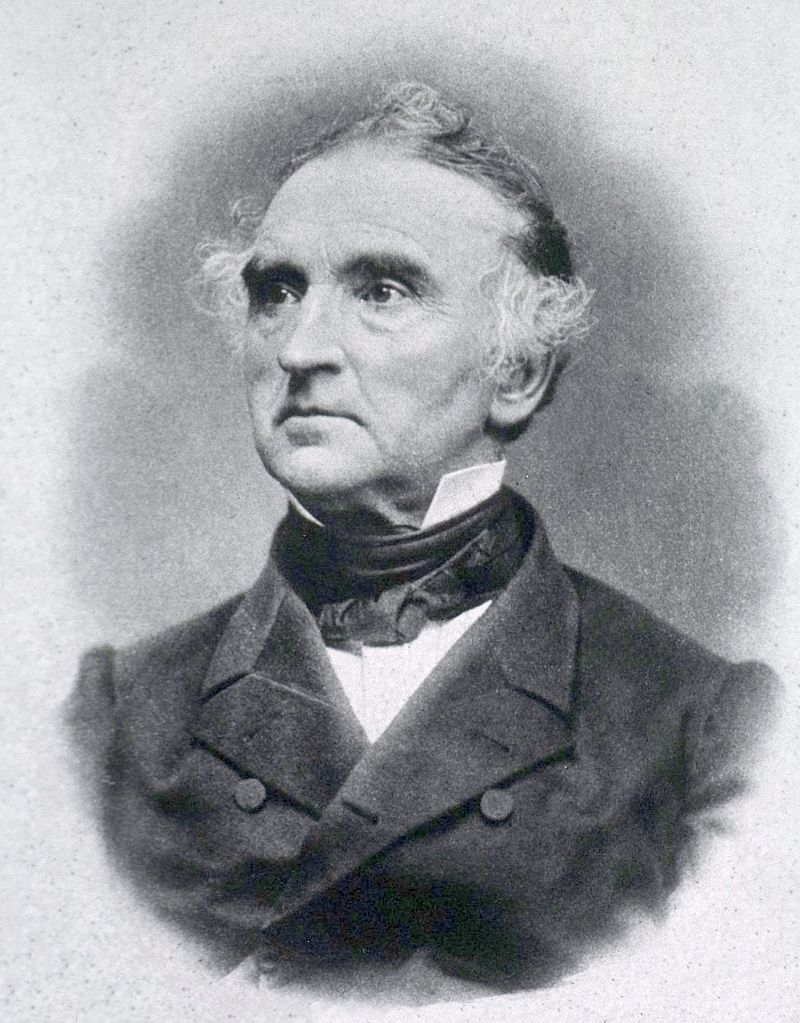
File:Justus_von_Liebig_NIH.jpg · Wikimedia Commons · See Wikimedia Commons
Justus von Liebig
Sign in to saveAlso known as Justus Freiherr von Liebig, Baron von Liebig, Justus, Baron von Liebig, Liebig
German chemist (1803-1873)
OverviewAI-generated
Justus von Liebig was a German chemist, inventor, university teacher, and agronomist. Born in Darmstadt in 1803, he received his education at the Friedrich-Alexander-Universität Erlangen-Nürnberg and the University of Bonn. He served as a doctoral student under Karl Wilhelm Gottlob Kastner and later held positions at Heidelberg University, the University of Giessen, and the Ludwig-Maximilians-Universität München. His notable works include *Die Chemie in ihrer Anwending auf Agricultur und Physiologie* and *Sur un nouvel aliment pour nourrissons*.
Liebig was a member of the Royal Society, the German Academy of Sciences Leopoldina, the Royal Swedish Academy of Sciences, and the Bavarian Academy of Sciences and Humanities. He received the Copley Medal, the Bavarian Maximilian Order for Science and Art, the Albert Medal, and was a Fellow of the American Academy of Arts and Sciences. He held the noble title of Freiherr and spoke German. He died in Munich in 1873 and was buried at Alter Südfriedhof.
Synthesized by Vinony from 31 facts across 4 sources: Wikidata, Europeana Sparql, Open Library, Vinony collections. Generated from structured data (not the Wikipedia text) and checked against those facts — may still contain errors.
Person · Open Library
- Born
- 12 May 1803
- Died
- 18 April 1873
- Works
- 99
Top works
- Sur un nouvel aliment pour nourrissons (la bouillie de Liebig), avec instructions pour sa préparation et son emploi
- Die Chemie in ihrer Anwending auf Agricultur und Physiologie in zwei Theilen
- Guide pour l'introduction a l'étude de chimie
- Complete works on chemistry
- Kleine Schriften
via Open Library + Wikidata
Wikidata facts
- Instance of
- human
- Given name
- Justus
- Gender
- male
- Citizenship
- Grand Duchy of Hesse
- Place of birth
- Darmstadt
- Place of death
- Munich
- Occupation
- writer
- Educated at
- University of Bonn
- Employer
- Heidelberg University
- Languages spoken
- German
- Noble title
- Freiherr
- Academic degree
- Doctor of Sciences
- Doctoral advisor
- Karl Wilhelm Gottlob Kastner
- Field of work
- chemistry
- Image
- Liebig Lettres RGNb10348645.01.fp portrait Liebig.tif
- Work location
- Munich
- Residence
- Grand Duchy of Hesse
Show 16 more facts
- member of
- Accademia Nazionale dei Lincei
- Commons category
- Justus von Liebig
- date of birth
- 1803-00-00
- date of death
- 1873-00-00
- topic's main category
- Category:Justus von Liebig
- Commons gallery
- Justus von Liebig
- place of burial
- Alter Südfriedhof
- ethnic group
- Germans
- name in native language
- Justus von Liebig
- student
- Max Joseph von Pettenkofer
- relative
- Jacob Volhard
- writing language
- German
- on focus list of Wikimedia project
- Wikipedia:Vital articles/Level/4
- P8168
- Betty Sutton
- P12749
- Courroux
- archives at
- Bavarian State Library
Sources (7)
via Wikidata · CC0
Works in European collections
12 objects attributed to Justus von Liebig, held across European museums, libraries & archives · via Europeana


~40 min read
Encyclopedic overview
Justus Freiherr von Liebig (12 May 1803 – 18 April 1873 ) was a German scientist who made major contributions to the theory, practice, and pedagogy of chemistry, as well as to agricultural and biological chemistry; he is considered one of the principal founders of organic chemistry. As a professor at the University of Giessen, he devised the modern laboratory-oriented teaching method, and for such innovations, he is regarded as one of the most outstanding chemistry teachers of all time. He has been described as the "father of the fertilizer industry" for his emphasis on nitrogen and minerals as essential plant nutrients, and his popularization of the law of the minimum, which states that plant growth is limited by the scarcest nutrient resource, rather than the total amount of resources available. He also developed a manufacturing process for beef extracts, and with his consent a company, called Liebig Extract of Meat Company, was founded to exploit the concept; it later introduced the Oxo brand beef bouillon cube. He popularized an earlier invention for condensing vapors, which came to be known as the Liebig condenser.
Early life and education
Excerpted from Wikipedia’s “Justus von Liebig” article, available under the CC BY-SA 4.0 licence.
Gallery (12)
Available in 70 languages
- Español
- Français
- Deutsch
- 中文
- 日本語
- Русский
- Português
- Italiano
- العربية
- Afrikaans
- Albanian
- Albanian
- Armenian
- Asturian
- azb
- Azerbaijani
- Bahasa Indonesia
- Bangla
Show 51 more
- Basque
- Belarusian
- Bosnian
- Bulgarian
- Catalan
- Croatian
- Czech
- Danish
- Egyptian Arabic
- Esperanto
- Estonian
- Finnish
- Galician
- Georgian
- Greek
- Hebrew
- Hungarian
- Ido
- Irish
- Kazakh
- Latin
- Latvian
- Lithuanian
- Luxembourgish
- Malagasy
- Mingrelian
- Nederlands
- Norwegian
- Norwegian Nynorsk
- Pashto
- Piedmontese
- Polski
- Quechua
- Romanian
- Scottish Gaelic
- Serbian
- simple
- Slovenian
- Svenska
- Swahili
- Tiếng Việt
- Türkçe
- Ukrainian
- Urdu
- Waray
- Western Frisian
- Wu Chinese
- Yakut
- zh_yue
- فارسی
- 한국어
via Wikidata sitelinks · CC0