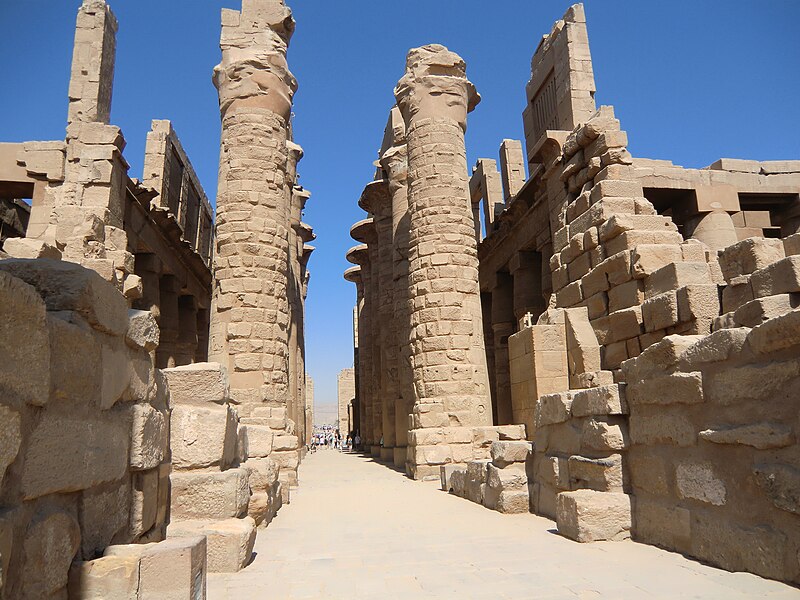
File:Temple_de_Louxor_68.jpg · Wikimedia Commons · See Wikimedia Commons
Karnak-Tempel
Sign in to saveAlso known as Temple of Karnak, Karnak
größte Tempelanlage Ägyptens, nahe Luxor
The Karnak Temple Complex near Luxor, Egypt is a vast collection of temples, chapels, and other religious buildings that was built over more than 1,900 years, starting in the Middle Kingdom and continuing through the Ptolemaic period, though most surviving structures date from the New Kingdom. It served as the primary worship site for ancient Egypt's Theban Triad, centered on the god Amun, and was considered by Egyptians to be "The Most Selected of Places."
AI-generated from the Wikipedia summary — may contain errors.
Key facts
- Ancient site.name
- Karnak
- Ancient site.image
- 250px
- Ancient site.caption
- Pillars of the Great Hypostyle Hall from the Precinct of Amun-Re
- Ancient site.map_type
- Egypt
- Ancient site.relief
- yes
- Ancient site.location
- El-Karnak, Luxor Governorate, Egypt
- Ancient site.region
- Upper Egypt
- Ancient site.type
- Sanctuary
- Ancient site.part_of
- Thebes
- Ancient site.builder
- Senusret I–Nectanebo I
- Ancient site.material
- Stone
- Ancient site.epochs
- Middle Kingdom to Ptolemaic Kingdom
- Ancient site.condition
- Ruin
- Ancient site.public_access
- Yes
- Ancient site.designation1
- WHS
- Ancient site.designation1_offname
- Ancient Thebes with its Necropolis
- Ancient site.designation1_type
- Cultural
- Ancient site.designation1_criteria
- I, III, VI
via Wikipedia infobox
Wikidata facts
- Instance of
- temple
- Part of
- Thebes
- Named after
- Karnak
- Country
- Egypt
- Located in
- Karnak
- Area
- 443.55
- Founded by
- Senusret I
- Location
- Karnak
- Image
- Luxor, Egypt, Karnak.jpg
Show 9 more facts
- Commons category
- Karnak temple complex
- inception
- 1900-00-00
- Commons gallery
- Karnak
- culture
- Ancient Egypt
- topic's main category
- Category:Karnak temple complex
- architectural style
- ancient Egyptian architecture
- P8168
- Jurōjin
- on focus list of Wikimedia project
- Wikipedia:Vital articles/Level/4
- native label
- الكرنك
via Wikidata · CC0
Article · Deutsch
Die Karnak-Tempel liegen als größte Tempelanlage von Ägypten in Karnak, einem Dorf etwa 2,5 Kilometer nördlich von Luxor und direkt am östlichen Nilufer. Die ältesten heute noch sichtbaren Baureste des Tempels stammen aus der 12. Dynastie unter Sesostris I. Bis in die römische Kaiserzeit wurde die Tempelanlage immer wieder erweitert und umgebaut. Die Tempelanlage steht seit 1979 zusammen mit dem Luxor-Tempel und der thebanischen Nekropole auf der Weltkulturerbeliste der UNESCO.
Abstract from DBpedia / Wikipedia · CC BY-SA
Gallery (32)
On the map
Available in 63 languages
- Español
- Français
- Deutsch
- 中文
- 日本語
- Русский
- Português
- Italiano
- العربية
- हिन्दी
- Afrikaans
- Albanian
- Armenian
- Azerbaijani
- Bahasa Indonesia
- Bashkir
- Basque
- Belarusian
Show 44 more
- Breton
- Bulgarian
- Catalan
- Cebuano
- Czech
- Danish
- Esperanto
- Estonian
- Finnish
- Galician
- Greek
- Hebrew
- Hungarian
- Icelandic
- Igbo
- Irish
- Kannada
- Latvian
- Limburgish
- Lithuanian
- Luxembourgish
- Malagasy
- Malay
- Malayalam
- Nederlands
- Norwegian
- Occitan
- Punjabi
- Romanian
- Serbian
- simple
- Slovak
- Slovenian
- Svenska
- Tamil
- Tiếng Việt
- Türkçe
- Ukrainian
- Urdu
- Waray
- zh_yue
- فارسی
- ไทย
- 한국어
via Wikidata sitelinks · CC0