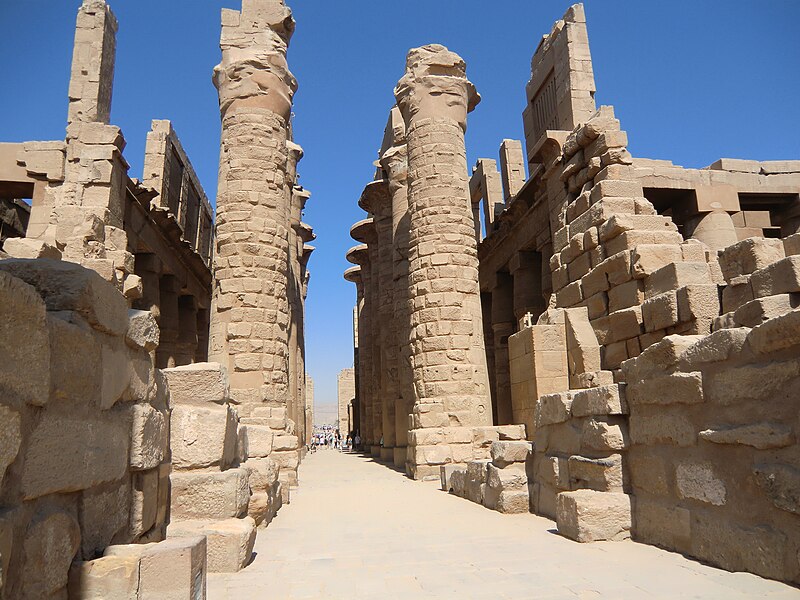
File:Temple_de_Louxor_68.jpg · Wikimedia Commons · See Wikimedia Commons
The Karnak Temple Complex near Luxor, Egypt is a vast collection of temples, chapels, and other religious buildings that was built over more than 1,900 years, starting in the Middle Kingdom and continuing through the Ptolemaic period, though most surviving structures date from the New Kingdom. It served as the primary worship site for ancient Egypt's Theban Triad, centered on the god Amun, and was considered by Egyptians to be "The Most Selected of Places."
AI-generated from the Wikipedia summary — may contain errors.
Key facts
- Ancient site.name
- Karnak
- Ancient site.image
- 250px
- Ancient site.caption
- Pillars of the Great Hypostyle Hall from the Precinct of Amun-Re
- Ancient site.map_type
- Egypt
- Ancient site.relief
- yes
- Ancient site.location
- El-Karnak, Luxor Governorate, Egypt
- Ancient site.region
- Upper Egypt
- Ancient site.type
- Sanctuary
- Ancient site.part_of
- Thebes
- Ancient site.builder
- Senusret I–Nectanebo I
- Ancient site.material
- Stone
- Ancient site.epochs
- Middle Kingdom to Ptolemaic Kingdom
- Ancient site.condition
- Ruin
- Ancient site.public_access
- Yes
- Ancient site.designation1
- WHS
- Ancient site.designation1_offname
- Ancient Thebes with its Necropolis
- Ancient site.designation1_type
- Cultural
- Ancient site.designation1_criteria
- I, III, VI
via Wikipedia infobox
Wikidata facts
- Instance of
- temple
- Part of
- Thebes
- Named after
- Karnak
- Country
- Egypt
- Located in
- Karnak
- Area
- 443.55
- Founded by
- Senusret I
- Location
- Karnak
- Image
- Luxor, Egypt, Karnak.jpg
Show 9 more facts
- Commons category
- Karnak temple complex
- inception
- 1900-00-00
- Commons gallery
- Karnak
- culture
- Ancient Egypt
- topic's main category
- Category:Karnak temple complex
- architectural style
- ancient Egyptian architecture
- P8168
- Jurōjin
- on focus list of Wikimedia project
- Wikipedia:Vital articles/Level/4
- native label
- الكرنك
via Wikidata · CC0
Article · Français
Le complexe religieux de Karnak — appelé temple de Karnak, ou simplement Karnak — comprend un vaste ensemble de ruines de temples, chapelles, pylônes et d’autres bâtiments situés au nord de Thèbes, aujourd’hui la ville de Louxor, en Égypte, sur la rive Est du Nil. Le complexe de Karnak, reconstruit et développé pendant plus de 2 000 ans par les pharaons successifs, de Sésostris Ier au Moyen Empire à l’époque ptolémaïque, s’étend sur plus de 2 km2 et il est composé de trois enceintes (espaces fermés par un mur). Il est le plus grand complexe religieux de toute l’Antiquité. Temple le plus important de la XVIIIe dynastie, il était consacré à la triade thébaine avec à sa tête le dieu Amon-Rê. Le complexe était relié au temple de Louxor par l'allée des sphinx de près de trois kilomètres de long. Site touristique, il est classé au patrimoine mondial de l'UNESCO depuis 1979. Seule l’enceinte d’Amon peut être visitée. Le site fait l’objet de fouilles conduites dès le XIXe siècle par des archéologues français, organisés depuis 1967 au sein du Centre franco-égyptien d'étude des temples de Karnak (CFEETK). Les découvertes continuent à être nombreuses.
Abstract from DBpedia / Wikipedia · CC BY-SA
Gallery (32)
On the map
Available in 63 languages
- Español
- Français
- Deutsch
- 中文
- 日本語
- Русский
- Português
- Italiano
- العربية
- हिन्दी
- Afrikaans
- Albanian
- Armenian
- Azerbaijani
- Bahasa Indonesia
- Bashkir
- Basque
- Belarusian
Show 44 more
- Breton
- Bulgarian
- Catalan
- Cebuano
- Czech
- Danish
- Esperanto
- Estonian
- Finnish
- Galician
- Greek
- Hebrew
- Hungarian
- Icelandic
- Igbo
- Irish
- Kannada
- Latvian
- Limburgish
- Lithuanian
- Luxembourgish
- Malagasy
- Malay
- Malayalam
- Nederlands
- Norwegian
- Occitan
- Punjabi
- Romanian
- Serbian
- simple
- Slovak
- Slovenian
- Svenska
- Tamil
- Tiếng Việt
- Türkçe
- Ukrainian
- Urdu
- Waray
- zh_yue
- فارسی
- ไทย
- 한국어
via Wikidata sitelinks · CC0