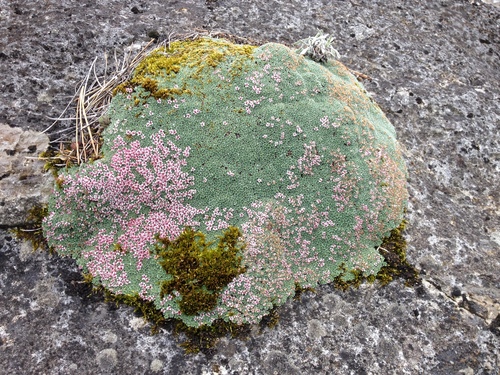
(c) Samsara Duffey, some rights reserved (CC BY-NC), uploaded by Samsara Duffey · cc-by-nc
Kelseya
Sign in to saveKelseya is a monotypic genus of flowering plants belonging to the family Rosaceae. The only species is Kelseya uniflora. It is commonly called the oneflower kelseya, spiraea or alpine laurel. The genus was named in honor of Francis Duncan Kelsey, a Montana resident botanist, who discovered the plant in 1888 at the "Gate of the Mountains" near Townsend.
Species
Oneflower Kelseya
GENUS
- KingdomPlantae
- PhylumTracheophyta
- ClassMagnoliopsida
- OrderRosales
- FamilyRosaceae
via GBIF · Kew POWO
Museum specimens
- Specimen records
- 17
- With media
- 15
- Family
- Rosaceae
- Collections
- CAS, BRIT
- Recorded in
- United States
Wikidata facts
Show 7 more facts
- taxon name
- Kelseya
- taxon rank
- genus
- topic's main category
- Category:Kelseya
- taxon common name
- kelseya
- ploidy
- 18
- Commons category
- Kelseya
Sources (2)
via Wikidata · CC0
~3 min read
Encyclopedic overview
7 sectionsContents
- Range and habitat
- Description
- Taxonomy
- Uses
- Conservation status
- References
- External links
Kelseya is a monotypic genus of flowering plants belonging to the family Rosaceae. The only species is Kelseya uniflora. It is commonly called the oneflower kelseya, spiraea or alpine laurel. The genus was named in honor of Francis Duncan Kelsey, a Montana resident botanist, who discovered the plant in 1888 at the "Gate of the Mountains" near Townsend.
==Range and habitat== Kelseya uniflora is a perennial limestone endemic that grows in cracks of volcanic and limestone outcrops at 1500-3500 m elevation. It is native in 3 states in Northwestern USA: Idaho, Montana and Wyoming. It typically grows as a solitary plant in a sun-exposed position as a ground covering subshrub. This species has also been reported in riparian woodland but this should be considered an outlier. Their most prolific growth is on the South Summit of Hunt Mountain in the Bighorn Mountains where it grows on Karst features.
Excerpted from Wikipedia’s “Kelseya” article, available under the CC BY-SA 4.0 licence.